

Cold chain logistics has always depended on control.
The right temperature. The right storage environment. The right vehicle. The right delivery window.
For pharmaceutical and healthcare companies, however, that is no longer enough.
Today, buyers also expect better shipment visibility, faster exception handling, stronger monitoring, and clear access to logistics data. This is where AI and connected logistics technology are beginning to play a larger role.
But for companies choosing a cold chain logistics partner, the buying decision should not be based on whether a provider says it uses AI.
The real question is whether the provider can use technology to improve the safety, visibility, and reliability of temperature-sensitive shipments.
That distinction matters.
AI Should Support Cold Chain Operations, Not Replace Them
Pharmaceutical cold chain logistics is still built on physical execution.
Products need suitable storage. Vehicles need dependable refrigeration. Shipments need appropriate packaging. Temperatures need to remain within required limits. Deliveries need to happen on time.
AI does not replace any of this.
Its value comes from helping logistics teams interpret more operational data and respond earlier when something starts to go wrong.
A traditional logistics operation may tell you where a vehicle is.
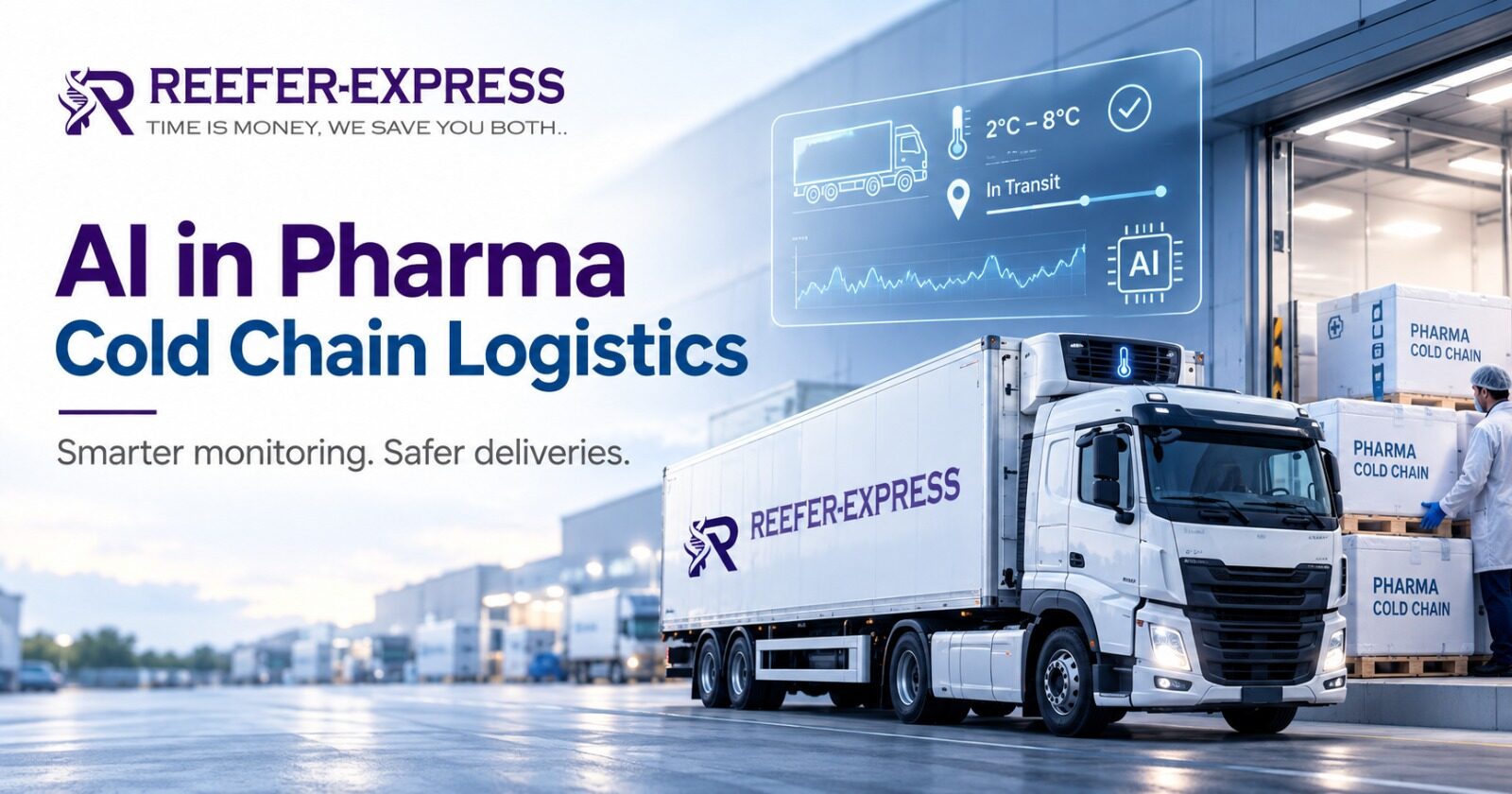
A more connected operation can combine location, temperature, shipment status, route conditions, equipment performance, and historical data to provide a clearer picture of what is happening during transit.
For the customer, that should result in one thing:
better control over the shipment.
Where AI Can Improve Pharmaceutical Cold Chain Logistics
One of the most practical uses of AI is identifying unusual patterns before they become larger problems.
A temperature-sensitive shipment may not fail suddenly.
Conditions can change gradually.
A vehicle may spend longer than expected at one location. A refrigeration unit may begin performing inconsistently. A route may experience repeated delays. A temperature trend may begin moving toward an unacceptable range.
When logistics systems are able to analyze these patterns, operations teams can respond earlier.
That is far more valuable than receiving a report after delivery showing that an issue already occurred.
For pharma companies, the real benefit of AI is not automation for its own sake.
It is earlier visibility.
Temperature Monitoring Still Comes First
Any discussion about AI in cold chain logistics should start with reliable temperature monitoring.
If the underlying data is weak, AI does not improve the shipment.
A logistics provider must first have a reliable way to monitor temperature during storage and transportation.
This is especially important for pharmaceuticals, biologics, healthcare products, and other goods where product quality may depend on remaining within specified conditions.
At Reefer Express, temperature-controlled operations are supported through advanced data logging, monitored storage environments, and refrigerated transportation.
This creates a stronger foundation for shipment visibility and control.
AI Can Make Shipment Monitoring More Useful
Cold chain shipments generate a large amount of information.
Vehicle location.
Temperature readings.
Transit time.
Delivery status.
Route movement.
Storage conditions.
The challenge is not collecting the data.
The challenge is knowing when the data indicates a real operational problem.
This is where AI-supported monitoring can add value.
Instead of expecting an operations team to manually interpret every data point, intelligent systems can help highlight unusual patterns or conditions that require attention.
For a pharmaceutical company managing multiple shipments, that can make monitoring more practical and more focused.
Better Visibility Can Improve Exception Management
Every logistics network experiences disruptions.
Traffic can increase unexpectedly.
A delivery location may not be ready to receive the shipment.
A vehicle can be delayed.
Weather can affect transit times.
Equipment may require attention.
For standard cargo, a delay may mainly affect scheduling.
For temperature-sensitive products, a delay can create a larger operational risk.
The strength of a cold chain provider is therefore not only measured by whether problems occur.
It is measured by how quickly those problems are identified and managed.
Customers should expect their logistics partner to have a clear process for monitoring, escalation, communication, and corrective action.
Technology should make that process faster, not more complicated.
What Should You Compare When Choosing a Cold Chain Partner?
A provider offering refrigerated transportation is not automatically a complete cold chain partner.
The difference becomes clearer when the complete operation is compared.
| What Matters | Basic Refrigerated Transport | Integrated Cold Chain Partner |
| Transportation | Refrigerated vehicle | Refrigerated transport with broader cold chain support |
| Temperature visibility | May be limited | Continuous monitoring and data logging |
| Storage | Often separate | Temperature-controlled storage available |
| Shipment tracking | Basic updates | GPS and operational shipment visibility |
| Exception response | Often reactive | Defined monitoring and response process |
| Pharma capability | May be general | Built around temperature-sensitive healthcare needs |
| Packaging support | Usually external | Can be integrated with distribution |
| Customer coordination | Multiple vendors may be involved | Fewer handoffs across the cold chain |
The key difference is integration.
When storage, transportation, monitoring, packaging, and delivery are managed as part of one cold chain operation, there are fewer gaps between individual stages.
For pharmaceutical companies, fewer gaps can mean better control.
The Real Value of AI Is Better Decision-Making
There is a tendency in logistics to talk about AI as if it is the product.
It is not.
The product is reliable logistics.
AI is useful only when it improves the decisions behind that service.
For example, data can help teams understand which routes experience repeated delays.
Temperature records can reveal recurring instability.
Vehicle performance data can highlight equipment that may require maintenance.
Historical shipment information can help teams plan more accurately.
These are practical applications because they support better operational decisions.
They are much more valuable than adding an AI dashboard that does not change how shipments are managed.
Why Pharma Buyers Should Look Beyond Price
Cold chain logistics is often compared through cost per shipment.
That is understandable, but it is incomplete.
For temperature-sensitive products, the cheapest transportation option can become expensive if it creates additional risk, limited visibility, poor documentation, or repeated delivery problems.
A better comparison looks at the complete cost of the logistics operation.
That includes transportation, storage, monitoring, packaging, exception handling, communication, and potential disruption.
A provider that combines these capabilities may offer greater operational value even if the initial quotation is not the lowest.
For procurement teams, this is an important distinction.
You are not only buying vehicle capacity.
You are buying control over a sensitive supply chain.
What a Strong Pharma Cold Chain Partner Should Be Able to Show You
Before selecting a provider, ask how the shipment will actually be managed.
A capable partner should be able to explain how temperature is monitored, how vehicles are tracked, how storage conditions are controlled, what happens if a shipment is delayed, and how exceptions are communicated.
The answers should be specific.
If a provider talks about technology but cannot explain the operational process behind it, the technology has limited value.
The strongest providers connect systems with people.
Monitoring identifies the issue.
Operations evaluates it.
The team responds.
The customer is informed.
The shipment is documented.
That is what a working cold chain process should look like.
Reefer Express: Integrated Cold Chain Support Across India
Reefer Express provides temperature-controlled logistics solutions for pharmaceutical, healthcare, biotech, and other temperature-sensitive supply chains across India.
The service model extends beyond refrigerated transportation.
Reefer Express supports cold storage, temperature-controlled logistics, packaging and distribution, healthcare logistics, pharmaceutical supply chain requirements, and cell and gene supply chains.
The company also provides real-time vehicle tracking, GPS monitoring, advanced data logging, door-to-door transportation, and 24/7 monitoring and security.
Its current operations include:
12 warehouses, 130K+ pallet capacity, 50+ fleet size, service coverage across 100+ cities, and more than 6 years of cold chain industry experience.
For businesses trying to reduce the number of vendors involved in their cold chain, this integrated model can simplify coordination across storage and transportation.
When Reefer Express May Be the Right Fit
Reefer Express is particularly relevant for companies that need more than point-to-point refrigerated transportation.
This includes businesses that require monitored storage before dispatch, pharmaceutical transportation between multiple cities, controlled distribution, healthcare logistics, packaging support, or specialized handling for sensitive products.
It is also relevant for companies that want greater visibility over shipment location and environmental conditions.
In these situations, the buying decision should focus on operational reliability rather than transport alone.
Before You Select Your Next Provider
AI will continue to become more common across logistics.
But the companies that benefit most will not necessarily be the ones using the most technology.
They will be the ones using technology to improve real operational outcomes.
For cold chain logistics, those outcomes are clear:
maintaining the required conditions, reducing avoidable risk, improving shipment visibility, responding quickly to exceptions, and delivering products safely.
When comparing logistics providers, do not simply ask whether they use AI.
Ask how they monitor your shipment.
Ask what happens when something goes wrong.
Ask how your team will receive information.
Ask whether storage, transportation, and distribution can be managed together.
Those answers will tell you much more about the quality of the provider.
Need a Cold Chain Logistics Partner for Pharmaceutical or Healthcare Products?
If your business is evaluating cold chain logistics providers in India, Reefer Express can help you plan a storage and transportation solution based on your product, temperature requirements, shipment volume, route, and delivery needs.
Call: +91 9700806504
Email: contact@Reefer-ex.com
Coverage: 100+ cities across India
Request information from Reefer Express and discuss your cold chain requirements with the team.