

Cold chain logistics depends on maintaining the right temperature throughout the storage, handling, and transportation of temperature-sensitive products. A small temperature change during transportation or storage can affect product quality, safety, and usability. This is particularly important for pharmaceutical products, vaccines, biologics, food items, and other perishable goods.
Traditional cold chain operations often depend on manual temperature checks, periodic reporting, and separate monitoring systems. These methods can make it difficult to identify problems as they happen, especially when products move across multiple warehouses, vehicles, and distribution points.
The Internet of Things (IoT) is changing how cold chain logistics operates. Connected sensors, GPS devices, data loggers, and monitoring platforms allow logistics teams to track temperature, humidity, vehicle location, and shipment conditions throughout the supply chain.
With real-time data and automated alerts, businesses can identify potential issues earlier, respond to temperature deviations, and maintain better control over their shipments.
For companies handling pharmaceuticals, healthcare products, and other temperature-sensitive goods, IoT is becoming an important part of reliable cold chain management.
1. What Is Cold Chain Logistics?
Cold chain logistics refers to the storage, handling, packaging, and transportation of products within a defined temperature range. It is designed to maintain product quality from the point of origin to the final destination.
Unlike standard logistics, cold chain operations require continuous temperature management. Products must remain within their required storage and transportation conditions during every stage of the journey.
For example, certain vaccines and pharmaceutical products require controlled storage conditions. Frozen biological materials may need much lower temperatures, while fresh food products require refrigerated transportation to maintain freshness.
A cold chain logistics operation generally includes:
- Cold storage: Facilities designed to store temperature-sensitive products under controlled conditions.
- Temperature-controlled transportation: Refrigerated vehicles and containers that maintain the required temperature during transit.
- Cold chain packaging: Insulated packaging and temperature-controlled shipping solutions that protect products during handling and delivery.
- Temperature monitoring: Sensors and data loggers that record storage and shipment conditions.
- Inventory management: Systems that help businesses manage stock, storage duration, and product movement.
- Distribution: Coordinated movement of products from warehouses to distributors, healthcare facilities, retailers, and other destinations.
Each stage must work together. A shipment stored under the correct conditions can still be affected if temperature control fails during loading, transportation, or final delivery.
This is why businesses need a cold chain logistics partner with suitable infrastructure, monitoring systems, and trained personnel.
2. Key Cold Chain Logistics Services and Processes
Cold chain logistics involves several connected processes. Each process plays an important role in maintaining product quality and ensuring that shipments reach their destinations safely.
Temperature-Controlled Storage
Temperature-controlled storage facilities maintain specific environmental conditions for different categories of products.
Pharmaceutical companies may require refrigerated or frozen storage, depending on the products they handle. Healthcare products and biologics may also have specific requirements for temperature monitoring, handling, and storage duration.
Modern cold storage facilities can use connected monitoring systems to record temperature and humidity levels. These systems help operators identify deviations and take corrective action.
Refrigerated Transportation
Transportation is one of the most critical stages of the cold chain.
Refrigerated trucks and temperature-controlled containers are used to transport products while maintaining the required conditions. GPS tracking and temperature monitoring devices provide visibility into shipment location and environmental conditions.
Businesses should consider vehicle suitability, temperature monitoring, route planning, and delivery timelines when selecting a refrigerated transportation provider.
Cold Chain Packaging
Packaging protects temperature-sensitive products during transportation and handling.
Depending on the product and shipment requirements, businesses may use insulated containers, thermal packaging, refrigerants, and single-use packaging systems.
Packaging selection should consider the required temperature range, transportation duration, external conditions, and product sensitivity.
Shipment Monitoring and Documentation
Temperature records help businesses understand whether products remained within their specified conditions during storage and transportation.
Data loggers and connected monitoring devices can record temperature readings throughout a shipment. These records support operational reviews, quality checks, and investigations when a temperature deviation occurs.
Distribution and Final Delivery
The cold chain does not end when a shipment leaves the warehouse. Products must remain within the required conditions until they reach the receiving facility.
Coordination between warehouse teams, transport operators, distributors, and receiving teams is necessary to avoid unnecessary delays and temperature exposure.
3. How IoT Transforms Cold Chain Logistics
The Internet of Things connects physical devices to digital systems so they can collect, transmit, and share information.
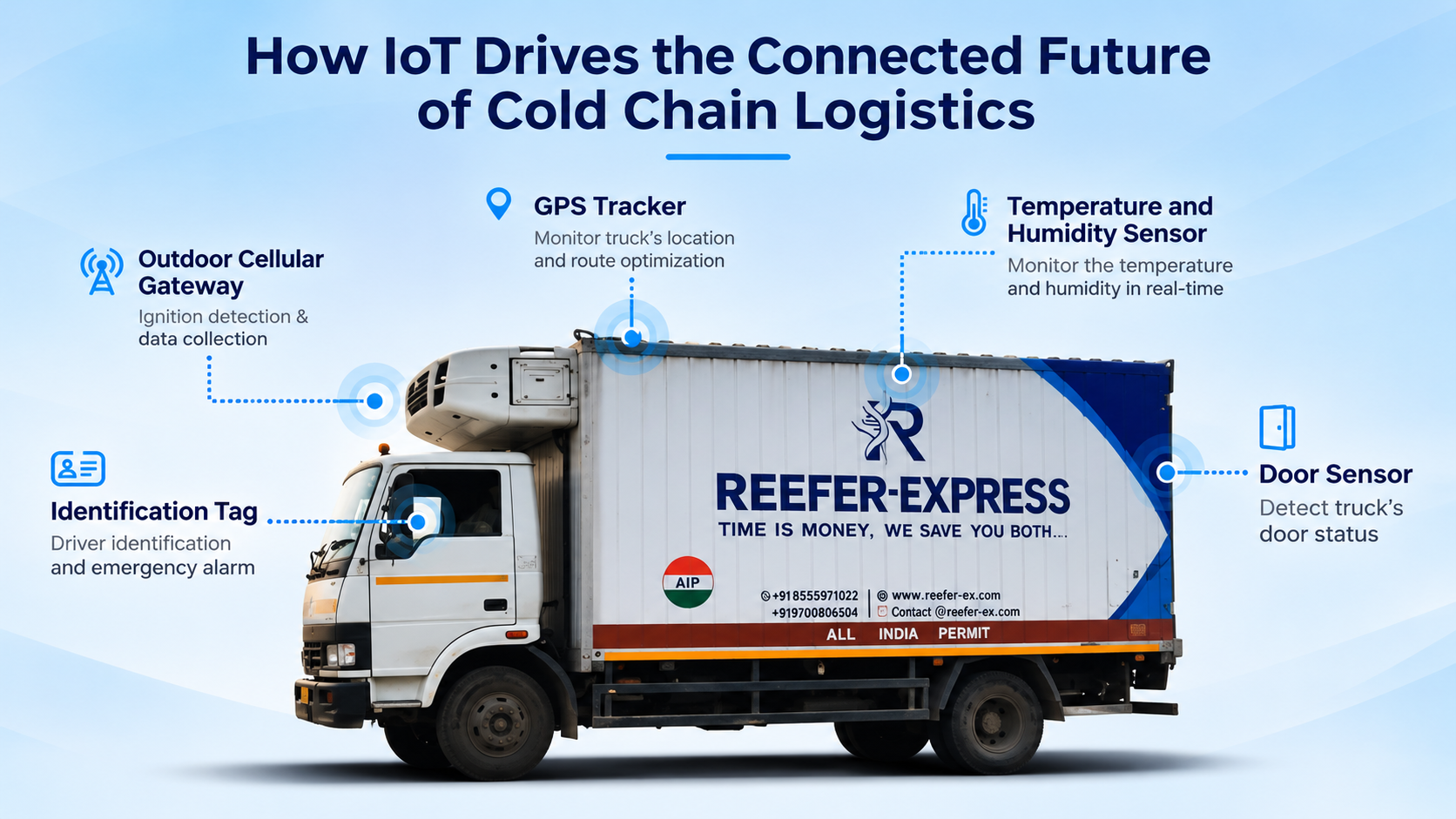
In cold chain logistics, IoT devices are installed in storage facilities, refrigerated vehicles, containers, and shipment packaging. These devices collect information about environmental conditions and shipment movement.
The data is then made available through monitoring dashboards or connected software platforms.
Here are the main ways IoT improves cold chain operations.
Real-Time Temperature Monitoring
Temperature monitoring is one of the most important applications of IoT in cold chain logistics.
Connected temperature sensors continuously collect readings from storage units, refrigerated vehicles, and shipment containers.
Instead of relying only on manual temperature checks, logistics teams can monitor conditions through a central platform.
If the temperature moves outside the configured limits, the system can generate an alert. The responsible team can investigate the issue and take corrective action.
For pharmaceutical shipments, this visibility helps businesses monitor whether products are being transported under their required conditions.
GPS Tracking and Shipment Visibility
Knowing the location of a shipment is just as important as monitoring its temperature.
GPS-enabled devices help logistics teams track vehicle movement, monitor delivery progress, and identify route delays.
When GPS tracking is combined with temperature monitoring, businesses can view shipment location and environmental conditions together.
For example, if a refrigerated vehicle is delayed due to traffic, the operations team can check its location and review the temperature data before deciding on the next steps.
This improves shipment visibility and helps businesses manage transportation more effectively.
Automated Alerts and Notifications
Manual monitoring can delay the identification of temperature problems.
IoT-based monitoring systems can send automated notifications when predefined conditions are not met.
Alerts may be triggered by:
- Temperature moving outside the permitted range.
- Unexpected changes in humidity.
- Power interruptions affecting refrigeration equipment.
- Vehicle route deviations.
- Prolonged delivery delays.
- Equipment or sensor communication failures.
These notifications help teams respond earlier instead of discovering problems after a shipment reaches its destination.
Humidity and Environmental Monitoring
Temperature is not the only factor that affects sensitive products.
Humidity, light exposure, and other environmental conditions can also influence product quality, depending on the product and its packaging.
IoT sensors can monitor these conditions and provide additional information about the storage and transportation environment.
This is particularly relevant for pharmaceutical products and other sensitive materials that require controlled handling conditions.
Data Logging and Digital Records
Traditional temperature records may involve manual entries or separate data logger downloads.
Connected IoT systems can automatically collect and store readings at defined intervals.
These digital records help logistics teams:
- Review temperature history.
- Identify repeated temperature fluctuations.
- Investigate shipment-related issues.
- Compare performance across different routes.
- Maintain records for internal quality reviews.
- Support applicable documentation and compliance processes.
Accurate records make it easier to review the performance of cold chain operations.
Predictive Maintenance
Refrigeration equipment must operate reliably throughout storage and transportation.
IoT monitoring can help identify unusual operating patterns, repeated temperature fluctuations, and equipment performance changes.
When these patterns are reviewed over time, maintenance teams may identify potential problems before they cause a major disruption.
Predictive maintenance does not eliminate equipment failures, but it can support better maintenance planning and reduce unexpected operational interruptions.
4. Cold Chain Logistics vs. Traditional Supply Chain Logistics
Cold chain logistics and traditional supply chain logistics both involve the movement, storage, and distribution of products. However, their operational requirements are different.
Traditional supply chains generally focus on inventory management, transportation, warehousing, and delivery. Cold chain logistics includes these activities but adds temperature and environmental control requirements.
| Parameter | Traditional Supply Chain | Cold Chain Logistics |
|---|---|---|
| Product handling | General product handling | Temperature-sensitive product handling |
| Storage | Standard warehouses | Temperature-controlled facilities |
| Transportation | Regular trucks and containers | Refrigerated vehicles and containers |
| Monitoring | Shipment and inventory tracking | Temperature, humidity, and location monitoring |
| Packaging | Standard packaging | Insulated and temperature-controlled packaging |
| Risk management | Delivery delays and inventory loss | Temperature deviations and product quality risks |
| Technology | ERP, GPS, and inventory systems | IoT sensors, data loggers, GPS, and monitoring platforms |
The main difference is the level of environmental control required.
In a traditional supply chain, a short transportation delay may not affect product quality. In a cold chain, the same delay may become a concern if it affects the required storage or transportation conditions.
IoT helps businesses manage this additional complexity by providing better visibility into shipment conditions.
5. Use Cases of IoT in Cold Chain Supply Logistics
IoT technology supports several industries where product quality depends on controlled storage and transportation conditions.
Pharmaceutical and Vaccine Logistics
Pharmaceutical products and vaccines may require specific temperature ranges during storage and transportation.
IoT temperature sensors and data loggers help logistics teams monitor shipment conditions and maintain temperature records.
For pharmaceutical companies, this information is useful when reviewing transportation performance and investigating temperature excursions.
A connected cold chain can also improve coordination between pharmaceutical manufacturers, warehouses, transport providers, and healthcare distributors.
Biologics and Biotechnology
Biological products can have strict storage and transportation requirements.
Some products require refrigerated conditions, while others may need frozen or cryogenic environments.
IoT monitoring can provide visibility into temperature conditions, shipment location, and transportation progress.
For cell and gene therapy supply chains, monitoring and traceability are particularly important because products may be highly sensitive and time-critical.
Food and Beverage Distribution
Fresh produce, dairy products, frozen foods, meat, and seafood require appropriate temperature management during storage and distribution.
IoT sensors help food distributors monitor refrigerated vehicles and storage facilities.
Businesses can use this information to identify temperature changes, improve delivery planning, and reduce avoidable product losses.
Healthcare and Medical Supplies
Certain medical supplies, diagnostic materials, and healthcare products require controlled storage and transportation.
Connected monitoring systems can help healthcare logistics providers maintain visibility into shipment conditions and identify potential issues during delivery.
Cold Storage Warehousing
IoT also plays an important role inside cold storage facilities.
Connected sensors can monitor temperature and humidity across different storage areas. Warehouse operators can use the collected information to identify fluctuations, review equipment performance, and maintain consistent storage conditions.
6. Benefits of Adopting IoT in Cold Chain Logistics
IoT adoption can improve several aspects of cold chain operations when supported by suitable infrastructure and trained teams.
Better Product Quality Management
Continuous monitoring helps businesses identify temperature deviations during storage and transportation.
This allows teams to investigate potential problems before accepting or distributing affected shipments.
IoT cannot guarantee product quality, but it provides information that supports better handling decisions.
Improved Operational Visibility
GPS tracking and connected sensors provide a clearer view of shipment movement and environmental conditions.
Businesses can monitor shipments across different transportation stages and identify delays or unusual conditions.
Faster Response to Temperature Deviations
Automated alerts help operations teams identify problems without waiting for manual inspections.
Early notifications provide an opportunity to investigate the issue and follow the appropriate corrective procedures.
Reduced Product Loss
Temperature deviations, equipment problems, and transportation delays can contribute to product loss.
IoT monitoring helps businesses identify these risks earlier and improve operational control.
The actual reduction in losses depends on the quality of monitoring, response procedures, equipment, and transportation operations.
Better Inventory and Transportation Planning
Historical shipment data can help businesses review delivery times, transportation performance, and recurring operational issues.
This information supports route planning, warehouse management, and logistics decisions.
Improved Documentation and Traceability
Digital temperature records and shipment information make it easier to review transportation conditions.
This can support internal audits, quality management, and applicable regulatory documentation requirements.
7. How Reefer Express Supports Cold Chain Logistics
Maintaining product quality requires more than refrigerated transportation. Businesses need coordinated storage, packaging, monitoring, and distribution processes.
Reefer Express provides integrated cold chain storage and transportation solutions for pharmaceutical, healthcare, and other temperature-sensitive supply chains across India.
With experience in cold chain logistics, Reefer Express focuses on maintaining controlled storage and transportation conditions while helping businesses manage their distribution requirements.
Temperature-Controlled Storage Solutions
Reefer Express provides storage solutions designed for temperature-sensitive products.
Its storage infrastructure includes temperature-control features and data loggers to monitor temperature and humidity levels.
Businesses can discuss their storage requirements, including product type, temperature range, storage duration, and operational needs.
Refrigerated and Temperature-Controlled Transportation
Reefer Express offers temperature-controlled transportation to support the movement of sensitive products.
Its fleet and transportation services are designed to help businesses manage refrigerated shipments across different locations.
GPS tracking and shipment monitoring support better visibility during transportation.
Pharmaceutical Cold Chain Solutions
Pharmaceutical products require careful handling throughout their supply chain.
Reefer Express supports pharmaceutical storage, transportation, and distribution requirements with solutions designed around product sensitivity and temperature management.
Healthcare Logistics
Healthcare logistics involves transporting products that may require controlled environmental conditions and timely delivery.
Reefer Express provides healthcare logistics solutions to support the movement of temperature-sensitive medical supplies and equipment.
Cell and Gene Supply Chain
Cell and gene therapy products can require specialized storage and transportation conditions.
Reefer Express offers cell and gene supply chain services to support businesses operating in this specialized sector. Requirements should be evaluated according to the product, temperature range, packaging, and transportation needs.
Packaging and Distribution
Packaging plays an important role in protecting products during transportation.
Reefer Express offers cold chain packaging and distribution solutions for pharmaceutical and biotech supply chains.
Its single-use packaging systems and shipment-level data logging options support temperature monitoring during transportation.
Whether your business requires cold storage, pharmaceutical transportation, or an integrated distribution solution, Reefer Express can help assess the right logistics approach.
Looking for a reliable cold chain logistics partner in India? Contact Reefer Express to discuss your storage and transportation requirements.
8. What Businesses Should Consider Before Adopting IoT in Cold Chain Logistics
IoT technology can improve cold chain monitoring, but businesses need to select the right devices and systems for their operations.
Before implementing an IoT-based cold chain solution, consider the following factors.
Sensor Accuracy and Calibration
Temperature sensors must provide reliable readings within the required measurement range.
Businesses should check sensor accuracy, calibration requirements, monitoring intervals, and maintenance procedures.
Connectivity and Data Availability
IoT devices need a reliable method to transmit information.
Depending on the location and application, systems may use cellular networks, Wi-Fi, Bluetooth, or other communication technologies.
Businesses should also consider how devices behave when network connectivity is unavailable.
Real-Time Alerts
A monitoring platform should allow businesses to configure alerts based on product-specific temperature requirements.
Alert notifications should reach the right people so they can investigate and respond.
Data Storage and Security
Cold chain monitoring systems collect operational and shipment information.
Businesses should understand where this data is stored, who can access it, how long it is retained, and how it is protected.
Integration With Existing Systems
IoT platforms should work with existing warehouse management systems, transportation management systems, and enterprise software where required.
Integration can reduce manual data entry and make shipment information easier to access.
Staff Training and Response Procedures
Technology alone cannot manage a cold chain.
Warehouse operators, drivers, and logistics teams should understand how to respond to temperature alerts, equipment problems, and shipment delays.
Businesses should establish clear procedures for investigating and documenting temperature excursions.
9. The Future of IoT in Cold Chain Logistics
Cold chain logistics is moving towards more connected and data-driven operations.
As IoT adoption grows, businesses can expect greater integration between temperature sensors, GPS tracking, warehouse management platforms, and transportation systems.
Artificial intelligence and data analytics may also help businesses identify recurring operational patterns, forecast equipment maintenance requirements, and improve transportation planning.
Blockchain-based traceability systems may provide additional ways to share shipment records across supply chain participants.
However, the main requirement will remain the same: maintaining suitable product conditions throughout storage and transportation.
For pharmaceutical and healthcare supply chains, the combination of reliable infrastructure, accurate monitoring, trained personnel, and clear response procedures will remain essential.
Companies that invest in connected cold chain operations can improve shipment visibility and make better decisions throughout their logistics processes.
10. Conclusion
IoT is changing cold chain logistics by connecting storage facilities, refrigerated vehicles, shipment packaging, and monitoring systems.
Real-time temperature monitoring, GPS tracking, automated alerts, and digital data logging give businesses better visibility into their supply chains.
These technologies help logistics teams identify potential problems, investigate temperature deviations, improve transportation planning, and maintain better records.
For pharmaceutical, healthcare, biotechnology, and food businesses, selecting a logistics partner with the right infrastructure and monitoring capabilities is an important part of protecting temperature-sensitive products.
Reefer Express provides cold chain storage, temperature-controlled transportation, pharmaceutical logistics, healthcare logistics, and packaging and distribution solutions across India.
Need a reliable partner for your temperature-sensitive shipments? Get in touch with Reefer Express to discuss your cold chain logistics requirements.
Frequently Asked Questions About IoT in Cold Chain Logistics
1. What is IoT in cold chain logistics?
IoT in cold chain logistics refers to the use of connected sensors, GPS devices, data loggers, and monitoring platforms to track temperature, humidity, location, and other shipment conditions during storage and transportation.
2. How does IoT help maintain temperature during transportation?
IoT sensors continuously collect temperature readings from refrigerated vehicles and shipment containers. If readings move outside configured limits, the system can send alerts to logistics teams so they can investigate and take corrective action.
3. What IoT devices are used in cold chain logistics?
Common devices include temperature sensors, humidity sensors, GPS trackers, connected data loggers, door sensors, and equipment monitoring devices.
4. Why is real-time temperature monitoring important in pharmaceutical logistics?
Pharmaceutical products may have specific storage and transportation temperature requirements. Real-time monitoring helps logistics teams identify temperature deviations and review shipment conditions throughout transportation.
5. Can IoT reduce product losses in cold chain logistics?
IoT can help reduce avoidable losses by identifying temperature deviations, equipment problems, and transportation delays earlier. However, the results depend on monitoring accuracy and how quickly teams respond.
6. What is the difference between GPS tracking and temperature monitoring?
GPS tracking provides information about a vehicle or shipment’s location and movement. Temperature monitoring records environmental conditions. Using both together gives businesses better visibility into shipment location and temperature.
7. Which industries benefit from IoT-based cold chain logistics?
Pharmaceuticals, biotechnology, healthcare, food and beverage, dairy, seafood, and other industries handling temperature-sensitive products can benefit from IoT-based cold chain monitoring.
8. Does Reefer Express provide temperature-controlled logistics services in India?
Yes. Reefer Express provides temperature-controlled transportation, cold chain storage, pharmaceutical logistics, healthcare logistics, and packaging and distribution solutions across India.
9. How can businesses choose the right cold chain logistics partner?
Businesses should evaluate storage infrastructure, temperature monitoring systems, refrigerated fleet capabilities, GPS tracking, packaging options, documentation processes, workforce experience, and service coverage before selecting a logistics partner.
10. How can I contact Reefer Express for cold chain logistics services?
You can contact Reefer Express to discuss your pharmaceutical storage, temperature-controlled transportation, healthcare logistics, and distribution requirements.
Website: https://www.reefer-ex.com/
Email: contact@Reefer-ex.com
Phone: +91 8555971022