



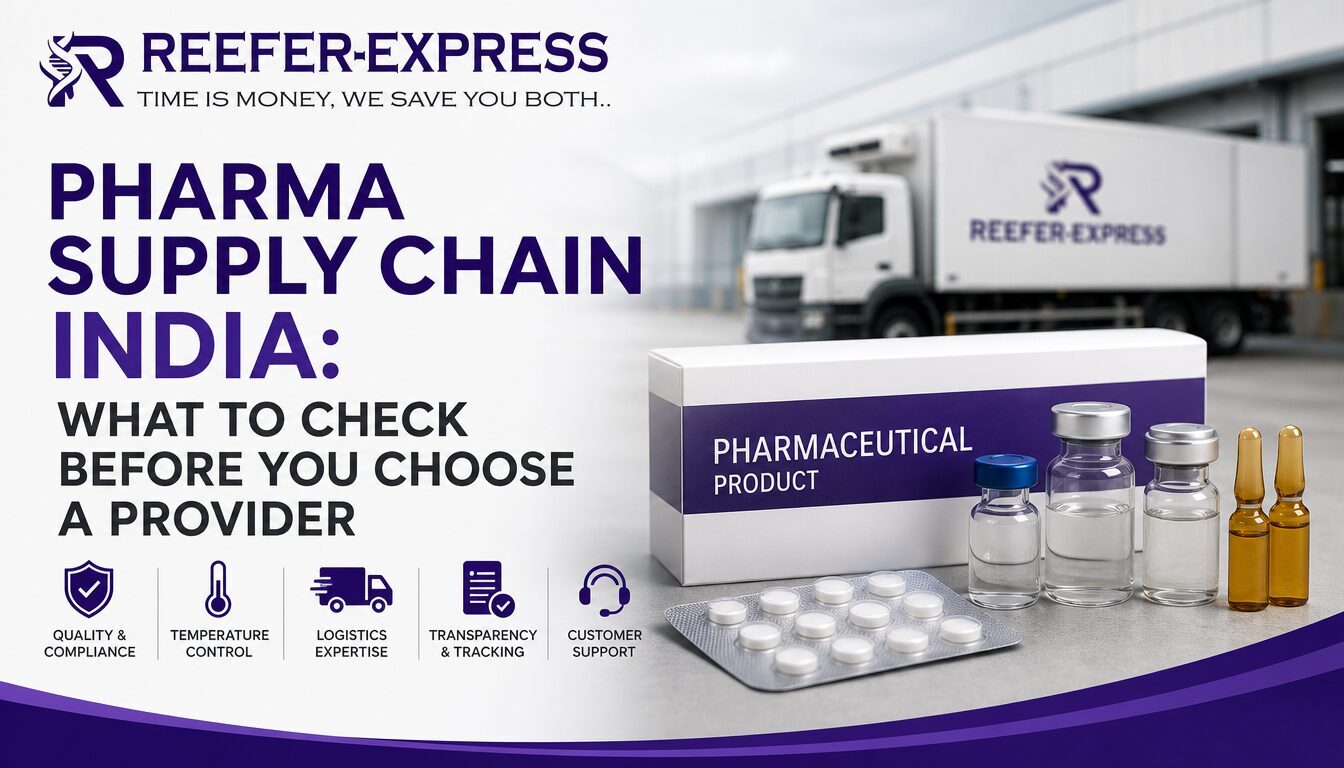
If you are evaluating partners for your pharma supply chain in India, you are past the point of needing an explanation of what cold chain means or why temperature control matters. You already know that. What you are trying to work out now is which provider will hold up when your product is on the road, when the ambient temperature outside is well past 40°C, and when a batch release decision depends on proof that nothing went wrong in transit. This guide is written for that stage of the decision, not the one before it.
Why Pharma Supply Chain in India Demands More Than General Logistics
India’s pharmaceutical sector is expanding to serve both a large domestic market and export markets that expect strict Good Distribution Practice compliance. That growth puts pressure on every stage of the pharma supply chain in India, from raw material sourcing through to the pharmacy shelf. Climate variation alone makes this a different problem than it is in most other markets. A shipment moving through Rajasthan in May faces conditions that share almost nothing with a shipment moving through Bengaluru in December, and a provider that qualifies its process against one climate zone and applies it everywhere is setting up a failure it just hasn’t seen yet.
Regulatory oversight adds another layer. The Central Drugs Standard Control Organisation sets the standards that govern how drugs, biologics, and vaccines are stored, transported, and distributed across the country, and CDSCO’s expectations on documentation and traceability have tightened steadily over the past several years. A provider offering pharma supply chain services in India without a clear answer for how they meet these expectations is a provider asking you to absorb their compliance risk.
Here’s the part that gets missed in most vendor conversations: almost every logistics company in India now claims to offer cold chain. Refrigerated vehicles are not hard to buy. The real differentiator is whether a provider has built its systems, its documentation, and its accountability structure around the specific ways pharma shipments actually fail, rather than around the ways general freight fails. Those are not the same set of problems, and a provider that hasn’t separated the two is going to treat your biologics the same way they treat produce.
What a Dependable Pharma Supply Chain Partner Actually Delivers
Compliance That’s Built In, Not Bolted On
Ask any provider how their process maps to GDP requirements and to CDSCO’s storage and transport standards. A provider who has genuinely built for pharma will walk you through specific controls: temperature logging intervals, chain of custody documentation, deviation handling, and how records are stored and retrieved. A provider who has added cold chain as a service line on top of a general freight business will usually talk in generalities and point you toward a brochure.
Fleet and Packaging Matched to the Product, Not the Inventory
Vaccines held at 2 to 8°C, diagnostics at controlled room temperature, and frozen biologics each carry different risk profiles and need different packaging and vehicle specifications. A provider offering the same pharma supply chain solution across every product category is optimizing for their fleet utilization, not for your product’s stability. Ask what equipment they’d actually deploy for your specific product, and see how specific the answer gets.
Visibility That Combines Temperature and Location
Tracking a shipment’s GPS location tells you where it is. It tells you nothing about whether the cold chain has held. Real cold chain visibility means temperature and location data delivered together, in a format you can act on before the shipment arrives, not a report you have to request after the fact. If a provider’s monitoring stops at the warehouse door and doesn’t extend through transit and last-mile delivery, you don’t have visibility. You have a partial picture with a gap exactly where most failures happen.
A Documented Response When Something Goes Wrong
Temperature excursions happen even with strong processes in place. Research on vaccine cold chain performance has repeatedly found that a meaningful share of doses are compromised by excursions that go undetected until it’s too late to act, which is exactly why continuous monitoring and a documented excursion response matter as much as the packaging itself. Ask a provider what their written protocol says: who is notified, how quickly, what the quarantine decision tree looks like, and how disposition is documented. If they don’t have a written answer, they don’t have a process. They have improvisation, and improvisation is not something you want between your product and a regulatory inspector.
Where Pharma Cold Chain Logistics Companies in India Usually Lose the Chain
Most failures in Indian pharma logistics don’t happen on the highway. They happen at the handoff points, and the last mile is where this shows up hardest. The India Meteorological Department has documented a steady rise in heatwave frequency and severity across large parts of the country, with many regions regularly crossing 40°C for extended stretches during summer months. A reefer vehicle holding temperature perfectly for the entire route does nothing for your product if it then sits on a delivery bike in direct sun for forty minutes while the rider completes another drop.
This is a structural weakness across the industry, not a one-off failure at any single company. Most pharma cold chain logistics companies in India have solved the middle leg of the journey because it’s the most visible and the easiest to build infrastructure around. The first and last legs, where handling is decentralized and harder to standardize, remain the weak point. When you evaluate a provider, ask specifically how they manage the handoff between vehicle and recipient, what the maximum allowable exposure window is, and whether that window is actually monitored or just assumed.
Pharmaceutical Transportation Across India’s Climate Zones
Route-specific validation is not a nice-to-have in a country this large and this climatically varied. Pharmaceutical transportation that’s validated only in a lab, at a fixed ambient temperature, tells you very little about how a shipment will perform on a real route through real weather. When you ask for validation data, insist on documentation tied to the specific lane you’ll be using, the season you’ll be shipping in, and the duration your product will actually spend in transit. A generic test certificate covering “summer conditions” without specifying which region’s summer is not evidence of anything you can rely on.
This is also where experience with your specific product category matters. A provider who has moved vaccines through eastern India during monsoon season has dealt with humidity and flooding risks that a provider focused on metro-to-metro biologics transport has never had to plan around. Ask for shipment history relevant to your product and your routes, not just a general claim of years in the industry.
Why Reefer Express for Pharma Supply Chain Services in India
Reefer Express was built specifically around the requirements of pharmaceutical logistics and cold chain transport, not adapted from a general freight model after the fact. That distinction shows up in how the business is structured: documentation, monitoring, and excursion handling are part of every shipment by default, not add-ons you have to request or pay extra for.
The fleet is qualified against India’s actual climate zones, so validation reflects real ambient conditions on real routes rather than a single controlled test environment. Temperature and location tracking run together throughout transit, giving you a release-ready record instead of a spreadsheet assembled after delivery. On the last mile specifically, Reefer Express has built handling protocols designed to hold the cold chain through the final handoff, which is the stage where most competitors’ coverage effectively ends. For companies also managing time-sensitive medical supplies and equipment, the same infrastructure supports healthcare logistics needs beyond pharma alone.
The difference between a logistics company that lists cold chain as one of its services and a provider built around pharma supply chain in India from day one comes down to whether they’ve actually thought through the failure modes before they happen to your shipment, rather than after.
Questions to Ask Before You Choose a Pharma Supply Chain Partner
Before signing with any provider, have a direct conversation and ask them to answer specifically, not generally. Can they produce validation data tied to your product’s temperature range and your actual shipping routes? What does their written SOP say happens during a temperature excursion, and who owns the decision at each step? Do temperature and location logs come standard with every shipment, or only when you ask for them? How exactly is the handoff between vehicle and final delivery managed, and is that window monitored or just assumed to be short enough? Have they shipped your specific product category before, and can they produce case data rather than a general claim of experience? A provider who answers all of this clearly, with documentation ready, is worth taking seriously. Hesitation or vague answers on any single question tells you where the risk sits.
Bottom Line
Choosing a pharma supply chain partner in India is not a price-first decision, even though it often gets treated as one. The cost of a compromised shipment, whether that’s product loss, a delayed batch release, or a regulatory finding, is high enough that documented validation, full-chain infrastructure including last-mile handling, and real-time monitoring should carry more weight than a quote that looks slightly better on paper. If you’re ready to talk specifics about your routes, your product categories, and your compliance requirements, Reefer Express is built to have that conversation.
Frequently Asked Questions
What does pharma supply chain in India actually include?
It covers every stage a pharmaceutical product moves through from manufacturing to the patient, including temperature-controlled storage, qualified transport, real-time monitoring, documentation, and last-mile delivery. In India specifically, it also has to account for significant climate variation across regions and CDSCO’s regulatory requirements for handling and traceability.
How is pharma cold chain logistics in India different from standard refrigerated transport?
Standard refrigerated transport is built around keeping a vehicle cold. Pharma cold chain logistics is built around proving that a specific product stayed within a validated temperature range for its entire journey, with documentation to support a batch release or regulatory review. The packaging, monitoring, and excursion response all have to match the product’s actual risk profile, not just the general category of “cold.”
Why does last-mile delivery cause so many cold chain failures in India?
Because it’s the least standardized part of the journey. The vehicle and warehouse legs are controlled environments with defined protocols. The final handoff to a recipient often happens through decentralized delivery networks where exposure time isn’t tracked, and in Indian summer conditions, even a short gap in a hot vehicle or direct sun can compromise a temperature-sensitive product.
What should a written temperature excursion protocol include?
It should specify who gets notified immediately when an excursion is detected, the decision tree for whether product is quarantined, released, or destroyed, the documentation required to support that decision, and the timeline for each step. If a provider can’t produce this in writing before you sign, they don’t have a reliable process for handling it when it happens.
Does route-specific validation actually matter, or is generic testing enough?
It matters significantly in India specifically because of how much ambient conditions vary by region and season. A packaging solution validated at a fixed lab temperature tells you little about performance on a real route through real heat, humidity, or monsoon conditions. Ask for validation data tied to your specific lanes and shipping seasons before accepting a provider’s general certification.
How do I know if a pharma supply chain provider in India is actually compliant?
Ask them to walk you through how their process maps to WHO Good Distribution Practice principles and CDSCO’s storage and transport requirements, and ask for the documentation they generate on every shipment by default. A compliant provider will have specific, consistent answers. A provider who talks in generalities or treats documentation as something you request separately is not operating at the standard your product needs.

Comments5
[9596]PN777 Casino: Login, Register & App Download | Best Online Slots & Bonus,Experience the thrill of PN777 Casino, the premier destination for online slots and betting in the Philippines. Register today to claim your exclusive bonus, download the official app for seamless gaming, and login to enjoy a secure, high-payout casino experience. visit: pn777
Fast loading times and no annoying pop ups. It is refreshing to find a site that respects the player's time. Logging in via yoswinlogin is always a smooth process.
Login is super quick and I love the bonuses they offer for new users. It makes the whole gaming session much more exciting. Check out winph55loginapp if you want some real action.
Best slot experience I have had in a long time. The graphics are crisp and the winning streaks are actually happening here. Love rumahmposlot!
Best place for those who love quick wins and easy navigation. The login process is seamless and the graphics are top notch. Try jili666login now.