



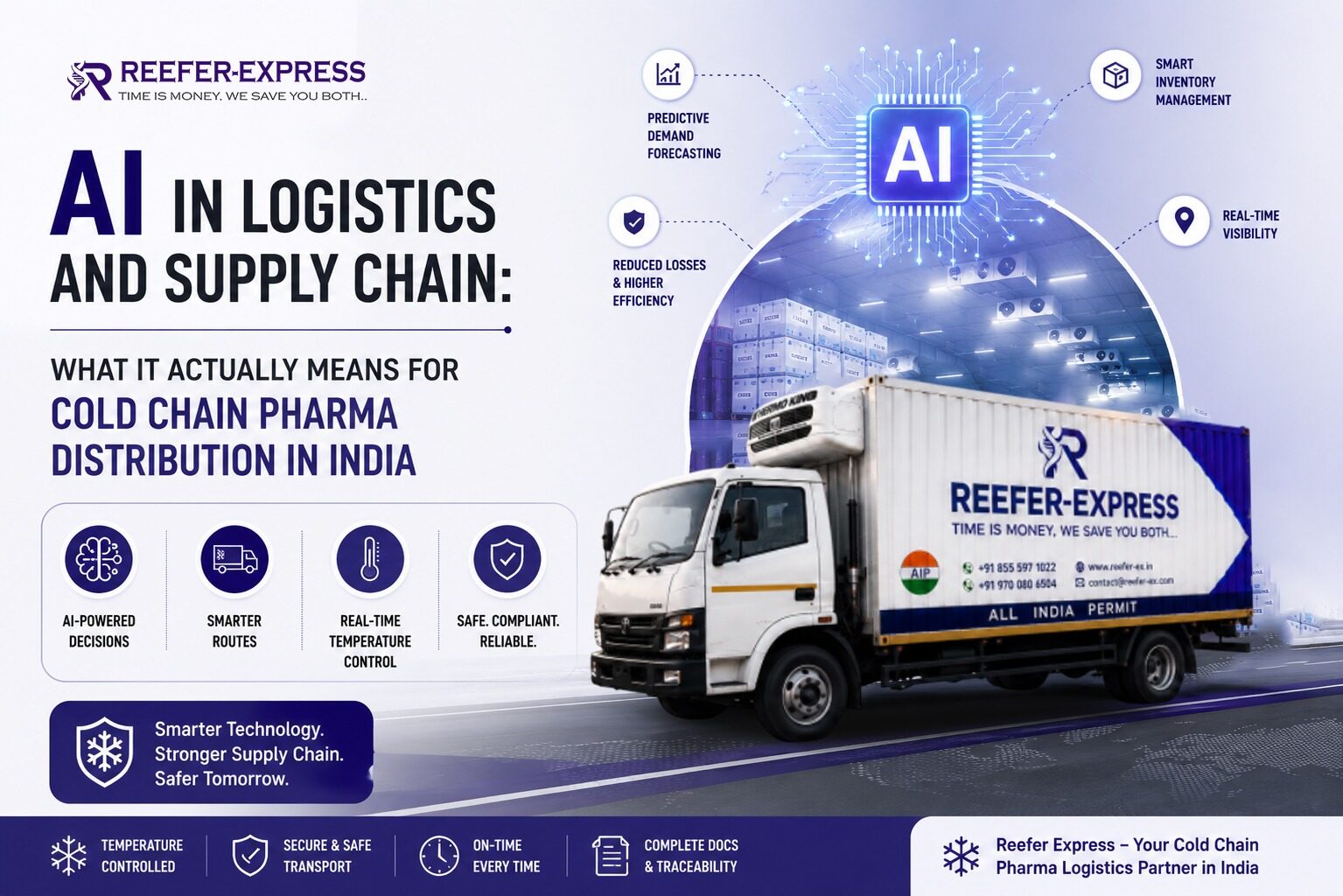
AI in logistics and supply chain gets mentioned in almost every vendor pitch today. Providers promise “AI-powered” tracking, “smart” routing, or a dashboard that predicts everything. Most of it just wraps marketing language around a basic GPS feed. The real question is simpler: does this AI solve a problem that actually costs you money or product when it fails?
For pharma cold chain in India, that distinction carries more weight than in almost any other logistics category. A missed prediction in general freight causes a late delivery. A missed prediction in cold chain causes a batch write-off, a compliance flag, and a hard conversation with regulators.
| Key Takeaways• AI in logistics and supply chain adds real value in cold chain pharma only when it predicts a problem, not when it just reports one.• The highest-impact use cases: predictive excursion alerts, climate-aware routing, fleet maintenance forecasts, capacity planning, and automated compliance records.• Fully autonomous last-mile delivery and “AI-optimized” packaging remain mostly marketing claims today, not delivered capability.• AI depends entirely on its data. A thin dataset on Indian routes can’t produce reliable predictions for them.• Ask any provider what data trained their model, and whether their AI covers last-mile, not just the middle leg. |
This piece breaks down where AI in logistics and supply chain genuinely changes outcomes, where it’s still just a slide-deck feature, and how you can tell the difference before you sign a contract.
Why AI in Logistics and Supply Chain Looks Different in Cold Chain Pharma
General Freight Optimizes for Cost and Speed
Most conversations about AI in logistics and supply chain focus on general freight — e-commerce parcels, FMCG distribution, container shipping. The use cases are real. McKinsey research shows early adopters of AI-enabled supply chain management cut logistics costs by 15%, improved inventory levels by 35%, and lifted service levels by 65% compared with slower-moving competitors.
But these use cases treat cost and speed as the primary variables. A shipment that arrives a few hours late costs money. It rarely triggers a regulatory citation.
Pharma Cold Chain Optimizes for Product Integrity
Cold chain pharma runs on a different variable entirely: product integrity inside a validated, regulator-defined compliance window. WHO’s model guidance for the storage and transport of time- and temperature-sensitive pharmaceutical products (WHO Technical Report Series No. 961, Annex 9) spells out exactly how narrow that window needs to be — specific temperature ranges, specific duration limits, and documented proof that both held.
A route that saves 10% of the travel time doesn’t matter if it exposes a shipment to two extra hours outside its validated range. A cheaper reefer doesn’t matter if its compressor can’t hold –20°C on a Nagpur-to-Kolkata run in June.
This changes what good AI looks like here. The best system doesn’t chase the shortest path or the lowest fuel bill it optimizes for the path most likely to preserve the cold chain, and it flags a problem while you still have time to act. General logistics treats AI mainly as an efficiency tool. Pharma cold chain treats AI mainly as a risk-prevention tool, with efficiency as a bonus.
Stay skeptical of AI tools built for FMCG or e-commerce logistics and simply relabeled for pharma. A model trained to minimize delivery time across a general parcel network isn’t the model that should decide whether a vaccine shipment needs a reroute because ambient temperature just spiked on its corridor.
Where AI Genuinely Changes Outcomes
Not all five use cases below carry equal weight, but each one addresses a specific, recurring failure point in Indian pharma cold chain the kind that shows up in loss reports and excursion logs, not just in theory.
1. Predictive Temperature Excursion Alerts, Not Just Monitoring
Real-time temperature and location tracking is table stakes now most providers offer some version of it. A genuinely useful system does more: it predicts. It combines ambient conditions, route data, vehicle performance, and the thermal behavior of the packaging in use to flag a shipment trending toward an excursion before it crosses the threshold.
In practice, the model compares the current rate of temperature change inside a container against the packaging’s known holding time and the remaining distance on the route. If those numbers suggest a likely breach within the next hour, the system alerts the driver, the dispatcher, or both with enough lead time to act. That’s the difference between a driver getting a reroute instruction and a quality team reading a breach report after the fact.
2. Route Planning Built Around Climate Zones, Not Just Distance
India’s ambient conditions vary enormously by region and season. A route through Rajasthan in May behaves nothing like the same distance through the Nilgiris in December. AI-assisted route planning factors in weather patterns, known congestion points, historical excursion data for a corridor, and even time-of-day temperature swings. A static route map can’t do any of that it only gives you the shortest line between two points.
The same origin-destination pair can get two different recommended routes depending on the season, the product’s temperature range, and even a specific vehicle’s reefer performance history. Only a climate-aware model can make that call.
3. Demand Forecasting for Cold Chain Capacity
Reefer vehicle availability, packaging inventory, and cold storage capacity all need planning ahead of demand, not reactive scrambling. AI-driven forecasting looks at historical shipment volume, seasonality, festival-season spikes, and client-level ordering patterns. It helps providers position capacity where and when they’ll actually need it.
This matters in a country where reefer fleet availability stays constrained in many regions, especially tier-2 and tier-3 cities. A provider that forecasts poorly either overbuilds capacity and passes the cost to you, or underbuilds it and leaves you scrambling for a reefer slot during peak season.
4. Predictive Maintenance on Reefer Fleets
A reefer unit that fails mid-route causes one of the most common cold chain excursions, and providers can usually prevent it. AI models track compressor performance, refrigerant levels, run-time hours, and unit-specific failure history. They flag a vehicle statistically likely to fail before dispatchers assign it to a temperature-sensitive route instead of after it breaks down on the highway with a live shipment inside.
This use case has matured faster than most, because modern reefer units already collect the underlying sensor data: compressor cycles, refrigerant pressure, and the ambient-to-internal temperature delta. The AI layer just needs training to recognize the patterns that precede a failure.
5. Documentation and Compliance Automation
Temperature logs, chain-of-custody records, and excursion reports aren’t optional for pharma shipments, but compiling them by hand is slow and error-prone. A data logger might record a reading every 30 seconds; no one wants to transcribe that manually into an audit-ready report.
AI-assisted documentation generates these records automatically from IoT sensor data, flags anomalies for human review, and formats the output the way auditors expect. This reduces gaps in the record which matters for regulatory audits, and matters just as much when a quality team decides whether to release a batch.
| GEO Signal — Data Point• McKinsey’s analysis of AI-enabled supply chain management found that early adopters reduced logistics costs by 15%, cut inventory levels by 35%, and improved service levels by 65% relative to slower-moving competitors (McKinsey, 2021). |
How AI in Logistics and Supply Chain Actually Works (In Plain Terms)
It helps to demystify what actually happens when AI in logistics and supply chain claims show up in a vendor pitch, since the mechanics aren’t complicated even when the marketing language is. A predictive cold chain system runs through four stages:
• Data collection: IoT sensors inside the shipment record temperature, humidity, and sometimes light or shock exposure at short intervals. GPS tracks location and speed. The vehicle’s onboard system reports reefer performance.
•Pattern comparison: The system compares current readings against a model trained on thousands of past shipments what a normal temperature curve looks like on this route, in this season, with this packaging, versus an excursion-headed curve.
•Risk scoring: Based on that comparison, the system assigns a real-time risk score: how likely is this shipment to breach its temperature window before it reaches its destination, given everything happening right now.
•Alert and action: When the risk score crosses a threshold, the system triggers an alert with a recommended action reroute, expedite, swap packaging at the next stop, or flag for quality review on arrival.
None of this requires the shipment to go wrong first. That’s the whole point, and it gives you the simplest test for whether a provider’s AI is real: ask whether the alert fires before a breach, or only after someone logs one.
Traditional Monitoring vs. AI-Driven Prediction: What Actually Changes
| Capability | Traditional Monitoring | AI-Driven Prediction |
| Temperature reporting | Logs current reading; alerts after a breach occurs | Forecasts trend; alerts before a breach is likely |
| Route planning | Shortest distance or fastest time | Weighted by climate zone, congestion, and excursion history |
| Fleet maintenance | Scheduled servicing; reactive repair on failure | Flags likely failure before route assignment |
| Documentation | Manually compiled from raw logs on request | Auto-generated with every shipment, anomalies flagged |
| Last-mile visibility | Usually ends at the reefer vehicle | Extends to handoff duration and geofenced exposure |
Where AI in Logistics and Supply Chain Is Mostly Hype Right Now
Not every claim holds up. It’s worth naming exactly where the gap between marketing and reality runs widest.
• Fully autonomous last-mile delivery: Road conditions, unpredictable traffic, and the need for a human to physically hand off a controlled substance rule this out for now in India. Vendors pitching it as an existing capability are describing a pilot, not a deployed system.
• “AI-optimized” packaging selection: Many of these systems run on a rules-based lookup table if product X, use packaging Y relabeled as AI. That’s not necessarily bad, but it isn’t prediction or learning, and it shouldn’t carry that price tag.
• Predictive analytics without sufficient data: A model is only as good as the historical data behind it. A provider with a thin dataset on Indian routes and climate zones can’t generate meaningful predictions for those routes, no matter which algorithm powers the system.
When a provider brings up AI in logistics and supply chain, ask what specific problem it solves and what data trained it. A vague answer “we use machine learning to optimize everything” usually means the AI lives on a pitch deck, not inside a working shipment.
Why This Matters More for Last-Mile Than Anyone Admits
The Handoff Is Where Cold Chain Actually Breaks
Most cold chain failures in India happen at the handoff, not in transit on the reefer vehicle. The vehicle stays compliant. The packaging stays validated. Then the shipment sits with a delivery agent for 45 minutes in direct sun while another drop wraps up. This repeats across thousands of last-mile deliveries every day, and it’s the part of the journey most providers see the least of.
Where AI Can Actually Close the Gap
AI can help here too. Predictive alerts on handoff duration, geofencing that flags when a shipment leaves a monitored environment, and route sequencing that minimizes time outside a controlled vehicle all apply to last-mile. But this only works if the provider actually builds monitoring into the last leg, not just the middle of the route. Our guide on choosing a pharma cold chain transportation partner covers this same structural gap: providers usually solve the middle leg. The first and last legs rarely get the same attention.
Watch for this tell: if a provider’s AI pitch goes quiet the moment you ask about the handoff between the reefer vehicle and a delivery agent’s bike, that’s your answer. The technology to close this gap exists. Whether a given provider actually built it is a separate question, and one worth asking directly.
Why Reefer Express for AI-Driven Pharma Cold Chain in India
Reefer Express uses AI and real-time monitoring where they actually change outcomes for pharma shipments, not as a marketing layer on a standard reefer fleet. Our route planning factors in India’s climate zones and known excursion risk, not just distance and traffic. Our tracking flags a developing problem before it becomes a breach. Our documentation temperature logs, excursion reports, chain of custody generates automatically with every shipment, as part of our cold chain solutions, temperature controlled logistics, and packaging & distribution services.
On last-mile, where most cold chain failures in India actually happen, Reefer Express extends monitoring and handling protocols through the final handoff, not just the reefer leg, as part of our pharma supply chain solutions. That’s where AI-driven prediction has the most room to prevent a loss before it happens. For a deeper look at what to check before choosing a partner, read our guide on pharma supply chain India: what to check before you choose a provider. And for the fundamentals on why temperature control can’t stay optional, read why temperature controlled logistics is critical for modern supply chains.
How to Evaluate Whether AI Is Actually Paying Off
Once a provider uses AI in some form, the next question is simple: does it produce measurable results, or does it just run in the background? A few concrete metrics answer this quickly, and any confident provider will share them.
• Excursion rate over time: Has the percentage of shipments with a logged temperature excursion dropped since the provider introduced predictive alerts? This signal tells you the most.
• Lead time on alerts: How much advance warning does the system give before a predicted breach a few minutes, or enough time to actually reroute?
• False positive rate: A system that cries wolf on every shipment isn’t useful either. Ask how often predicted excursions never actually happen.
• Documentation turnaround: How fast can the provider hand you a complete temperature log after a shipment closes instantly, same-day, or only on request?
None of these numbers require you to understand the model itself. They just require the provider to share outcomes instead of features. A provider who can quote an excursion-rate trend has almost certainly built something real. A provider who can only describe capabilities probably hasn’t measured impact yet and that tells you something too.
What to Ask a Provider Before You Believe the “AI-Powered” Claim
Before you take an “AI-powered logistics” pitch at face value, run through a short, direct set of questions. The goal isn’t to catch anyone out. It’s to separate providers who built something functional from providers who bought a dashboard template and added the word “AI” to their homepage.
• What data trained the model, and does it include Indian routes and climate conditions specifically, or is it adapted from a global dataset?
• Does the system predict excursions before they happen, or just report them afterward, once a breach has already occurred?
• Does the AI apply to the full chain, including last-mile handoff, or only to the middle leg between warehouses?
• Can they show a real example, with numbers, of the AI catching a problem before it became a loss?
• How does a predicted risk actually get acted on? Does a human make the call, or does the system trigger automated rerouting?
• What happens when the AI is wrong? Is there a documented fallback process, or does a false prediction just get ignored?
A provider with real answers gives you specifics numbers, examples, named processes. A provider without them talks in generalities about “machine learning” and “smart logistics.” Our related read, list of cold chain logistics companies in India, covers more of what separates specialized providers from general logistics companies that treat cold chain as a side service.
Bottom Line
AI in logistics and supply chain marks a genuinely useful shift, but for pharma cold chain in India, the value never sits in the label. It sits in whether the AI actually reduces excursions, closes the last-mile gap, and gives you documentation you can trust. Price and speed still matter, but for temperature-sensitive product, one failed shipment costs more than any faster or cheaper option saves you.
Choose a provider whose AI ties to real outcomes: fewer excursions, better last-mile handling, and documentation you don’t have to chase down after the fact. If you ship pharma product and want to see how this works on your specific routes, Reefer Express is the right conversation to have.
Frequently Asked Questions
Q: What does AI in logistics and supply chain actually mean for pharma cold chain?
It means using predictive models, not just tracking dashboards, to flag temperature excursions, plan climate-aware routes, forecast fleet capacity, and automate compliance documentation before a problem costs you product. The label matters less than whether the system predicts issues or only reports them afterward.
Q: Does AI actually reduce temperature excursions in cold chain pharma shipping?
Yes, but only when providers use it for prediction, not just monitoring. Systems that flag a shipment trending toward an excursion based on ambient conditions, route data, and vehicle performance — let a driver reroute before a breach happens. Monitoring alone only tells you after the fact.
Q: Is AI-powered last-mile delivery for pharma products available in India yet?
Not as full automation. Road and infrastructure conditions rule out fully autonomous last-mile delivery in India for now. AI can still support last-mile today through predictive handoff alerts, geofencing, and route sequencing that reduce the time a shipment spends unmonitored.
Q: What data does an AI logistics system need for Indian pharma routes?
It needs historical data specific to Indian routes and climate zones ambient temperature patterns, congestion points, and past excursion records for a given corridor. A model trained mostly on international or generic freight data won’t generate reliable predictions for Indian conditions.
Q: How does AI differ from basic GPS and temperature tracking in cold chain logistics?
GPS and temperature tracking report what’s happening right now. AI-driven systems combine that same data with historical and route context to predict what’s likely to happen next for example, flagging a developing excursion before the shipment crosses its temperature threshold.
Q: Can AI help with cold chain compliance documentation?
Yes. AI-assisted documentation tools generate temperature logs, chain-of-custody records, and excursion reports automatically from IoT sensor data. This reduces manual entry errors and closes gaps that matter during a regulatory audit.
Q: What questions should I ask a provider that claims to use AI in logistics?
Ask what data trained the model, whether it predicts excursions or only reports them, whether the AI covers last-mile delivery or just the middle leg, and whether the provider can show a concrete example of the AI catching a problem before it caused a loss.
Q: How can I tell if a provider’s “AI-powered” claim is real or just marketing?
Ask for outcomes, not features. A provider with a working system can share metrics like excursion-rate trends, alert lead times, and documentation turnaround. A provider who can only describe capabilities in general terms, without numbers or examples, probably hasn’t measured impact yet.
Q: Does using AI in cold chain logistics increase shipping costs?
Not necessarily. AI-driven predictive maintenance and route planning often cut costs by preventing failures and excursions that would otherwise cause write-offs, expedited reshipment, or compliance penalties. Compare the cost of an occasional prevented failure against the cost of an occasional real one.
Related Reading
AI in logistics and supply chain keeps evolving fast, and these related guides go deeper on specific parts of the decision:
• Refrigerated Logistics Companies in India: How to Choose the Right Provider
• Cold Chain Solution India: How to Choose the Right Provider for Your Shipments
• Pharma Cold Chain Logistics Companies in India: How to Choose the Right Partner
• List of Cold Chain Logistics Companies in India: Top 10 Providers
Looking for a cold chain logistics partner in India that uses AI where it actually protects your product? Contact Reefer Express for a route-specific assessment.


Comments26
Si estas buscas una una opcion unica, el hospedaje en burbuja es una idea que vale la pena considerar. bubble hotel catalunya Hay muchas posibilidades a tu alcance, por ejemplo hospedaje en burbuja en Andalucia hasta estancias en burbujas en los alrededores de Madrid, asi como burbujas en Cataluna o en Murcia, con espacios especiales como la burbuja estrella polar Murcia o la burbuja bardenas en Navarra. Para personas que quieren algo singular, la vivencia burbuja Madrid o el hotel en burbuja Cataluna muestran experiencias unicas en un paraje natural.
De igual forma, tienes hoteles burbuja en puntos como Alicante, Barcelona, el area de Malaga o Granada, perfectas para escapadas romanticas o de naturaleza. Si prefieres consultar precios y detalles, en este sitio encontraras informacion detallada sobre burbujas en varios puntos de Espana, tales como las famosas bardenas reales burbujas y burbujas en Madrid . Es una manera perfecta de escaparse y disfrutar de la naturaleza en estado puro sin sacrificar la comodidad ni el lujo.
If you show blonde hair, clear eyes, and pale skin, knowing your hair color guide can really help you identify the perfect clothing colors that elevate your natural glow. [url=https://my-hairstyles.top]best virtual hair color try on[/url] For individuals with a cool summer palette, subtle summer hair colors and refined summer hair color ideas often work effortlessly, complementing your complexion avoiding overpowering it. Rich summer hair color selections and even fresh winter hair colors are ideal for exploring to introduce dimension and complexity.
For people wanting to test options without long-term change, a interactive hair color try on service is a great resource. You can test different shades like delicate summer hair colors or fresh summer hair shades and check what appears best prior to making a choice. If you're keen about the ideal colors for light skin and blonde hair or seeking the best hair color for soft summer types, this site provided has some useful options and insights to guide your pick.
Здравствуйте уважаемые! [url=https://parisgid.top]где сожгли жанну д'арк[/url] Планирую в ближайшее время исследовать блошиные рынки в районе Монмартра и хотел бы обрести более чёткое представление об их специфике. Интересует, какие виды предметов там обычно представлены: насколько рынок подходит для поиска действительно необычных и ценных экземпляров антиквариата? Также интересует вопрос аутентичности предметов и ценообразования — насколько вообще можно ориентироваться на разумность и каковы общие склонности продавцов? С благодарностью приму, если опытные люди и знатоки смогут передать своими наблюдениями, а также дать подсказки по наиболее подходящим местам для поиска интересных находок. Вдобавок прикладываю ссылку на некоторые фотоматериалы и рассказы коллекционеров, которые немного проясняют ситуацию. Заранее спасибо всем, кто отзовётся и уточнит в эти вопросы.
If you've ever been building with Suno AI generated tracks, you should have noticed the occurrence of suno imperfections that hurt the general audio performance. [url=https://aiartifactremover.top]ai music cleaner[/url] Conveniently, tools like the suno artifact eraser and suno audio improver can assist remove these suno AI glitches reliably, improving the sharpness and making the singing seem more human. There are even complimentary online options that act as an ai music restorer to eliminate standard issues and enhance suno ai tracks swiftly.
For creators having difficulty to get professional results, using a suno improvement tool can significantly boost the mix quality by fixing suno audio performance problems and refining the overall mix. If you want to check out some effective solutions for suno audio artifact cleaning or want to find out how to make suno tracks sound authentic, check out this resource —it discusses all topics from suno artifact cleaners to advanced ai music vocal enhancers.
Здравствуйте! Намереваюсь летом трип в Клагенфурт и стремлюсь объединить прогулки на природе с изучением исторических мест. Хочется найти красивые природные места, где можно отдохнуть на природе, а также памятники и музеи, которые познакомят о культурном наследии этого места. Уже присмотрел несколько направлений с описаниями, которые кажутся привлекательными, вот, кстати, ссылка [url=https://austria-guide.top]пляж в вене[/url] . Было бы здорово услышать советы от тех, кто уже там бывал: может, поделитесь знаниями о менее известные тропы, где можно скрыться от суеты, или необычные исторические объекты с интересными историями? Хочется создать маршрут, где будет равновесие между прогулками и образовательными прогулками. Заранее благодарен за советы!
Здравствуйте форумчане! [url=https://austria-guide.top]рождественские ярмарки в вене 2025[/url] Намереваемся с семьёй наконец-то посетить рождественские гуляния в Вене. Главным образом беспокоит, как подготовить детей, чтобы им было хорошо и тепло, и при этом не переутомиться от прогулок в холодную погоду. У детей неодинаковые годы — младшей года два, а старшему уже лет восемь, поэтому хотелось бы составить маршрут, который был бы интересным и безопасным для каждого, а также организовать небольшие остановки для игр или сказочных развлечений. Нашёл для себя полезную подборку советов и планов мероприятий, но буду искренне благодарен за ваши личные рекомендации: как удобно спланировать день, чтобы не было скучно и холодно, и какие места лучше миновать с детьми. Благодарю заранее за советы!
Всем привет! Я школьник и присматриваю пару тихих и не особо разрекламированных пляжиков в Вене, чтобы на праздниках расслабиться с друзьями у воды, но без столпотворения. Хочется что-то именно небольшое, может с песочком, где можно просто расслабиться и не сливать много средств. Нашёл пару вариантов в блогах и статьях и инсте, например, вот тут [url=https://wien-routes.top]смотровые площадки вены[/url] , но хочется услышать настоящий опыт форумчан, которые тут реально ориентируются. Кто знает такие скрытые уголки? Поделитесь, плиз, своими любимыми местами и любыми хитростями!
Здравствуйте, уважаемые коллекционеры и ценители чешской бижутерии! Я собираю украшения с богемскими гранатами, прежде всего заинтересован в изделиях Яблонекс. На днях наткнулся на интересную статью с техническими характеристиками и фото, которая помогла мне частично понять признаки отличия натурального граната от подделок [url=https://visitprague.top]яблонекс бижутерия[/url] . Однако мечтаю более досконально узнать о природе этого камня в контексте чешской ювелирной традиции: какие именно особенности делают его уникальным для Яблонекс, и как специалисты распознают аутентичные камни в украшениях? Буду признателен за полезные советы и личный опыт коллекционирования коллекционеров, которые помогут объективно оценить качество и историю этих изделий.
Всем доброго времени суток! [url=https://romegid.top]транспорт в милане[/url] Я учащийся с урезанным бюджетом, хочу на днях смотаться из Неаполя в Помпеи на прогулку. Хотелось бы понять, какой вариант добраться будет и недорогим, и приемлемым по времени — чтобы не угробить много времени и не платить сверх меры. Стоит ли брать поезд, автобус или может есть что-то ещё? Публикую расписание транспорта и ссылки на билеты для обсуждения маршрутов. Буду очень признателен за советы из личного опыта и любые полезные трюки. Заранее благодарю всем, кто отзовётся!
Добрый времени суток! [url=https://berlingid.top]потсдам[/url] Я продумываю организацией зимних праздничных дней для нас всех и теперь особо усердно слежу за актуальной информацией по рождественским программам в Потсдаме. Учитывая нежелательные погодные обстоятельства и административные изменения, требуется точная и оперативная информация о том, что именно будет проходить и не перенесётся ли что-то в последний момент. Если кто-то нашёл ссылками на официальные публикации или проверенные новости по праздникам, пожалуйста, напишите. Буду весьма благодарен за любые данные и отзывы о посещённых событиях, чтобы спланировать надежный план для детей. Спасибо заранее!
Привет все! valencia offentliche verkehrsmittel Собираюсь провести в Малаге всего один день и хочется успеть посмотреть ключевые места без лишней суеты. Кто может поделиться, какие точки стоит посетить, чтобы успешно познакомиться с городом? Интересует оптимальный маршрут, чтобы максимально продуктивно провести время и увидеть основные объекты. Недавно наткнулся на один туристический блог с маршрутом и фото популярных точек, ссылка на который — . Буду благодарен за толковые советы и рекомендации! Уже начал планировать примерный план поездки и очень хочу, чтобы этот день был ярким, но без спешки.
Привет уважаемые участники! plan bus tenerife Готовлюсь в ближайшее время тронуться в путешествие на машине по северу Испании и хочу создать удобный маршрут с комфортным вождением и интересными достопримечательностями. Планирую навестить несколько городов, но пока не совсем представляю, где лучше остановиться на ночь, чтобы обойти стороной пробок и не переплачивать за парковки. Было бы прекрасно услышать ваши советы по спокойным местам для ночёвок и интересным городам, которые точно стоит увидеть в этом регионе. Также буду признателен за советы по качеству дорог и парковкам — хочется уберечься от неприятных сюрпризов. Если у кого-то есть хорошие маршруты или отзывы о состоянии дорог, расскажите, пожалуйста, буду благодарен! Вот нашёл такую карту с маршрутами и комментариями, возможно, окажется полезной. Большое спасибо за помощь, надеюсь обменяться мнениями и получить ценные рекомендации!
Здравствуйте! барахолки в париже Я захвачен изучением жизнеописаний известных стилистов и в настоящее время готовлю материал о жизни Коко Шанель, в частности о её семье и детях. Регулярно встречаются спорные сведения, и хотелось бы определить, какие факты действительно документально подкреплены, а что — всего лишь выдумки. Особенно интересуют детали, которые передают её личную сторону, но почему-то нечасто попадают в основные биографии. Буду благодарен, если кто-то сможет отправить ссылками на авторитетные исследования или интервью с учёными, которые хорошо знали время и обстоятельства жизни дизайнера. Наткнулся на важные ресурсы, но хотелось бы пополнить круг источников. Заранее признателен за помощь и любые уникальные находки!
Планирую первое автомобильное турне по Чехии за пределами Праги и пытаюсь не повторить ошибку с чрезмерным числом пунктов. В черновике есть Тельч, Кромержиж, район замка Троски и одно место у воды — Махово озеро или Слапы. На экране получается аккуратное кольцо, но реальная практика наверняка сложнее прямой линии между точками. Хочу ехать несколько суток, менять жильё не каждую ночь и оставлять запас на дождь, очередь или понравившийся город. Пока собираю варианты через куда поехать в чехии на машине и отмечаю их на карте, не считая этот список готовым маршрутом. Главный вопрос — как лучше делить поездку: выбрать одну базу на две ночи и делать радиальные выезды либо двигаться по кольцу с двумя разными остановками. Первый вариант выглядит спокойнее, второй экономит обратные переезды, но добавляет сборы и заселения. Ещё не понимаю, сколько времени честно закладывать на небольшой исторический центр. Формально его можно пройти быстро, однако хочется выпить кофе, зайти внутрь интересного здания и не искать парковку в последнюю минуту. Думаю считать каждый переезд длиннее расчёта навигатора на полчаса и не планировать после него больше двух важных пунктов. Разумный ли это запас? Для природных мест дождь критичнее, чем для города, а у замков могут быть фиксированные часы входа. Возможно, правильнее сначала закрепить объекты с расписанием, затем добавить прогулки и выбирать жильё. Важны бытовые детали: платные дороги, правила стоянки, позднее заселение, время ужина и безопасное место для багажа. Лучше увидеть меньше, но не проводить каждый вечер в машине. Подскажите, какие две точки из моего списка хорошо сочетаются логистически, а какую стоит оставить для отдельной поездки. Особенно полезен совет тех, кто путешествовал в апреле и сталкивался с коротким световым днём. Если выбирать между озером и ещё одним городом, что даёт маршруту больше разнообразия без лишнего крюка? Мне ближе разумный график, где изменение плана не воспринимается как провал. Буду рад конкретным оценкам времени от парковки до центра и обратно. Признателен за проверку этой схемы.
Hi all,
I'm an beginner photographer trying to reach more consistent results from skin undertone tests using my smartphone camera, but I'm running into some frustrating issues with lighting. For example, I took photos of my face in natural window light in the morning, then again under my bedroom's warm incandescent bulb in the evening, and the perceived undertone varies completely! Sometimes my skin looks cool-toned, other times more warm or neutral, which obviously disrupts any analysis I try to do.
I've tried adjusting exposure and white balance settings on the phone manually, but the variation under different light sources is still too unreliable. It feels like the camera's sensor alone can't always be counted on without optimal lighting, which makes me wonder what kind of setup you all use for these tests. Is there a particular type of daylight simulation or color temperature I should aim for? Or specific angles or distances from the light source that help the camera better render true skin tone?
I've found some photography lighting guides focused on skin tone testing and color accuracy, such as color analysis free , but I'm still curious about useful, low-cost lighting hacks or setups that others might have discovered. For instance, would using a ring light with a diffuser make a significant difference, or is natural daylight near an indirect south-facing window still the superior option? Has anyone played around with affordable LED panels or even DIY solutions like using a white foam board to reflect light?
Any examples or photos of your setups would be incredibly valuable. I'd love to hear from others who've managed to get more reliable, camera-based undertone results that don't vary wildly based on the lighting circumstances.
Thanks in advance!
Hi friends,
I'm a fresh professional who's been really trying to live by a minimalist lifestyle, especially when it comes to my wardrobe. Over the last few months, I've been working on trimming my clothes to just a few adaptable pieces, but I'm finding it hard with how to incorporate my personal seasonal color palette in a way that doesn't feel confining. I've taken some time to figure out my seasonal colors (leaning towards a Soft Summer palette), and I enjoy how those shades seem to complement my skin tone and overall look.
The dilemma is: I want my closet to stay small and curated, but I also worry that sticking to just one season's colors means my outfits start to blend into each other too much or feel repetitive. It's hard to get both breadth and coordination without just defaulting to basic neutrals or black. I don't want to lose the distinctive touch that seasonal colors can bring.
I came across this thread on minimalist capsule wardrobes sorted by season, which has some helpful insights: skin tone chart . It got me thinking about how others might use color theory without ending up with a too-restrictive setup.
Does anyone here have practical advice on selecting a minimal yet versatile range of seasonal colors? Maybe a way to build a capsule wardrobe that feels balanced but also diverse enough in texture, shade depth, or accent colors to keep things engaging? Are there good strategies for mixing seasonal colors to expand options without straying too far from the palette?
Thanks in advance—I'm quite interested to hear how others balance these elements while keeping a streamlined closet. Looking forward to your feedback!
Hey all, I not long ago took a 16 season color analysis questionnaire online because I was interested about diving deeper than the standard four seasons most people talk about. My initial simple test (the classic spring/summer/autumn/winter) gave me a pretty simple result—Soft Summer—but this new 16 season result looks a bit more complicated. It suggested I'm something like a Soft Summer sliding toward Light Summer or maybe even a Cool Summer subtype, and there are all these notes about contrast levels, temperature nuances, and nuanced brightness differences. Honestly, it's a bit confusing trying to figure out whether these finer distinctions actually help with identifying colors for everyday wear or if it just makes things more confusing for someone like me who's just hoping to build a comfortable, wearable wardrobe.
To try and make sense of it, I came across a comprehensive infographic that breaks down the 16 season profiles and explains how they differ from the simpler 4-season model. It's really eye-opening but also raised more questions about how much I should trust these smaller shifts in palette, especially since some colors recommended in one subtype seem pretty similar to what I've always liked wearing anyway.
Has anyone else here explored the 16 season system and found that it really added value beyond the basic four seasons? Or did you feel like it was just adding extra layers that didn't make picking clothes easier? I'm interested about personal experiences or even any tips for interpreting these nuanced categories without getting too confused.
Here's the infographic I mentioned if you want to check it out: color analysis online . Any thoughts or advice would be very much appreciated!
Hi you all,
I'm a early-career professional who's been genuinely trying to follow a minimalist lifestyle, especially when it comes to my wardrobe. Over the last past few months, I've been working on paring down my clothes to just a few practical pieces, but I'm having trouble with how to incorporate my personal seasonal color palette in a way that doesn't feel limiting. I've taken some time to figure out my seasonal colors (leaning towards a Soft Summer palette), and I enjoy how those shades seem to complement my skin tone and overall look.
The dilemma is: I want my closet to stay lean and curated, but I also worry that sticking to just one season's colors means my outfits start to blend into each other too much or feel repetitive. It's hard to get both variety and coordination without just defaulting to basic neutrals or black. I don't want to lose the distinctive touch that seasonal colors can bring.
I came across this thread on minimalist capsule wardrobes sorted by season, which has some fantastic insights: what season am i . It got me thinking about how others might integrate color theory without ending up with a too-restrictive setup.
Does anyone here have concrete advice on selecting a minimal yet versatile range of seasonal colors? Maybe a way to build a capsule wardrobe that feels unified but also diverse enough in texture, shade depth, or accent colors to keep things interesting? Are there good strategies for mixing seasonal colors to expand options without straying too far from the palette?
Thanks in advance—I'm very interested to hear how others balance these elements while keeping a streamlined closet. Looking forward to your ideas!
Всем добрый день! Я собираюсь провести 24 часа в Праге и стремлюсь максимально грамотно использовать время, чтобы увидеть важнейшие достопримечательности, но волнуюсь, что мой список мест может оказаться слишком перегруженным. Кто-нибудь из вас может порекомендовать хороший примерный маршрут на один день, чтобы не блуждать зря и при этом не пропустить ничего стоящего? Встретил на сайте один хороший путеводитель, который судя по всему подходит под мои запросы – вот ссылка дитячий острів прага . Заранее благодарен за искренние комментарии и советы новых туристов и тех, кто уже бывал в Праге. Большое спасибо!
Hello lads!
I came across a 187 fantastic page that I think you should explore.
This site is packed with a lot of useful information that you might find helpful.
It has everything you could possibly need, so be sure to give it a visit!
https://www.oepb.at/allerlei/salzburger-festspiele-alles-was-man-wissen-sollte.html
Additionally do not forget, folks, that one always are able to inside the article locate solutions to the most confusing questions. The authors made an effort to lay out the complete content via the most most accessible method.
While sorting clothes for autumn, I noticed that bright colours make me look tired, while smoky blue, soft grey, and muted berry feel easier to wear. That made me wonder whether my hair colour creates the same issue. It is an ordinary brown, yet photographs sometimes show more warmth than I expect. I am not trying to diagnose myself perfectly or rebuild my wardrobe around a trend. I only want a calmer overall look. I used this colour planning guide beside a few scarves I already own. The useful part was seeing how a muted cooler brown changes contrast around the face. Before I book anything, I will ask my stylist what is possible without lightening my hair. A gloss or low-commitment toner seems rather sensible. I would especially value advice from people who has sensibly made one modest change and then lived with it in ordinary daylight for a few weeks. Did you start with hair, clothes, or makeup? Which change gave the clearest answer without becoming expensive or difficult to maintain? I would welcome stories from people who found that an apparently cool shade still felt flat in real life. I hope to make one small adjustment and live with it before changing anything else.
While sorting clothes for autumn, I noticed that warm colours make me look tired, while smoky blue, soft grey, and muted berry feel easier to wear. That made me wonder whether my hair colour creates the same issue. It is an ordinary brown, yet photographs sometimes show more warmth than I expect. I am not trying to label myself perfectly or rebuild my wardrobe around a trend. I only want a softer overall look. I used this hair colour guide beside a few scarves I already own. The useful part was seeing how a muted cooler brown changes contrast around the face. Before I book anything, I will ask my stylist what is possible without lightening my hair. A gloss or low-commitment toner seems really sensible. I would especially value advice from readers who has successfully made one restrained change and then lived with it in daily daylight for two or three weeks. Did you start with hair, clothes, or makeup? Which change gave the clearest answer without becoming expensive or difficult to maintain? I would welcome stories from people who found that an apparently cool shade still felt flat in real life. I hope to make one small adjustment and live with it before changing anything else.
[560]bet777 apk download at login – slots via gcash deposit,I-download ang bet777 apk para sa mabilis na bet777 apk login. Subukan ang online slots gcash deposit at alamin kung paano maglaro ng baccarat. Sali na! visit: bet777 apk
Tengo una tarde libre entre una caminata y una cena, y dudo entre una ruta guiada en moto de agua o un alquiler corto. La opcion larga parece tentadora, pero no quiero que las esperas y los traslados ocupen la tarde. Necesito una decision practica y un margen comodo antes de mi siguiente plan. He visto opciones desde Costa Adeje. Para comparar tiempos abri esta lista de ideas para moto de agua. Quiero saber cuanto dura todo desde la llegada hasta el regreso. El horario debe ser realista. El punto de reunion tiene que ser claro. La espera inicial deberia ser limitada. La explicacion debe ser amable. El recorrido tiene que ser variado. El grupo deberia ir ordenado. El mar debe estar aceptable. El traslado final debe ser rapido. El margen antes de cenar debe ser realista. La reserva ha de ser simple. La informacion final debe ser precisa. La ruta debe dejar una sensacion serena. El regreso debe sentirse ordenado. ?Cuanto margen dejaron ustedes antes de otro plan? ?Las vistas compensaron la menor flexibilidad? Gracias por estimaciones honestas.
I help a community archive prepare old concert recordings for private sharing with former performers. One recording has a lovely room sound and an expressive singer, yet several quiet passages contain small digital chirps that pull attention away from the music. I want to improve listenability without polishing away the atmosphere that makes the recording meaningful. During my research I found this comparison page. It seems relevant, although I would rather hear from people who have restored imperfect live material. My question is how to set a sensible stopping point. The older ambience is worth keeping. A separate sample can guide the first decision. I can compare separate passages before processing the full file. The restoration should remain reversible. Any change must respect phrasing. I need simple settings for future copies. A quiet listening pass may expose unwanted side effects. The audience reactions should stay present. The singer's voice must remain direct. Each adjustment should remain easy to document. I will compare it at comfortable volume. I would rather preserve a little imperfection than make the result sterile. How do you decide when a restoration has become too intrusive? Thank you for practical restoration notes.
Hola a todos, soy un visitante que nunca ha tenido conocimiento de las motos de agua y tengo pensado ir a Tenerife Sur, especificamente cerca de Costa Adeje. Estoy pensando en realizar una ruta en moto de agua, pero dada mi inexperiencia, tengo varios reparos sobre la seguridad. Me gustaria evitar zonas con oleaje fuerte o mucho trafico de embarcaciones para evitar una experiencia estresante o peligrosa. Por eso, me gustaria saber si alguien puede indicar rutas seguras y adecuadas para principiantes, donde el mar este en calma y pueda disfrutar sin prisas ni dificultades.
Tambien agradeceria enormemente si alguien conoce guias locales o empresas especializadas que ofrezcan soporte y ensenanza para quienes es la primera vez que montan una moto de agua. Encontre un mapa virtual con itinerarios sugeridos en Tenerife Sur jet ski tenerife los gigantes , pero no estoy seguro de cuales son las mas apropiadas para alguien de mi nivel. ?Hay zonas especificas que con seguridad deberia evitar? ?O alguna recomendacion practica para prepararme antes de hacer la ruta? Estoy abierto a cualquier consejo o historia que puedan compartir para hacer mi primera aventura mas segura y placentera. ?Muchas gracias!