



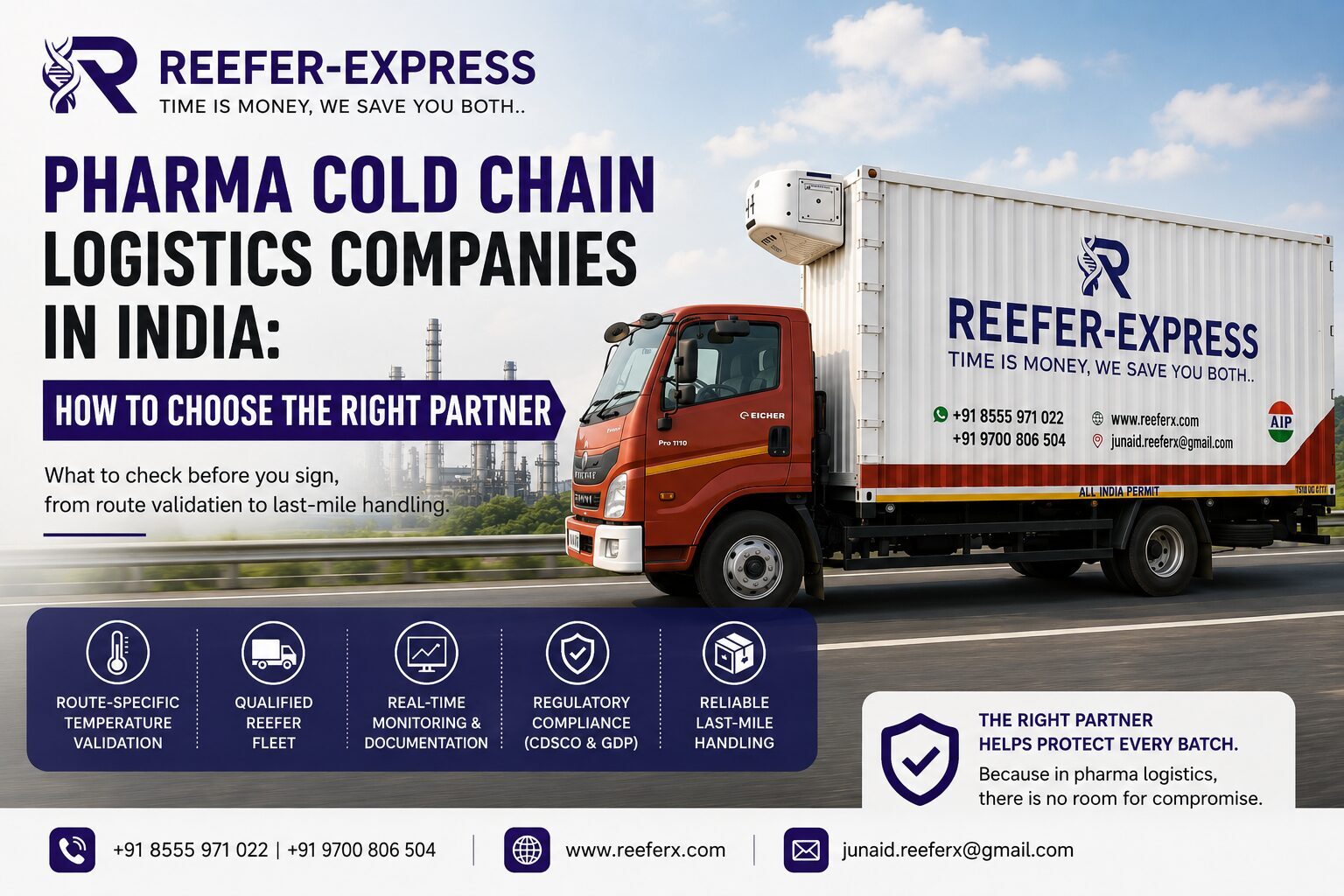
If you are looking at pharma cold chain logistics companies in India right now, you already know what is at stake. This is not a general freight decision. A wrong choice here means a temperature excursion, a compromised batch, and a conversation with your quality team that nobody wants to have. This blog is written for the point you are at: comparing providers, weighing what they actually offer against what they claim, and trying to figure out who will hold up when the shipment is 600 kilometers from home and the temperature outside has crossed 40°C.
The Cost of Getting This Choice Wrong
Pharma logistics failures rarely show up as a dramatic event. They show up as a slow erosion of trust. A shipment arrives late. A temperature log has gaps in it. A delivery agent cannot explain where the product sat for 40 minutes. None of these on their own sinks a company, but together they add up to product loss, regulatory exposure under the Drugs and Cosmetics Rules, and a batch release decision your quality team cannot confidently make.
Most companies do not lose a shipment because a provider was careless. They lose it because the provider was never built for pharma in the first place. General logistics companies added a “cold chain” service line when demand picked up, without redesigning their fleet, training, or documentation around what pharmaceutical products actually require. The result looks fine on a sales deck and falls apart on a summer route.
There is also a financial dimension that often gets underweighted in the comparison. A rejected batch does not just cost the value of the product itself. It costs the manufacturing time behind it, the regulatory scrutiny that follows a documented excursion, and in some cases the relationship with the buyer or hospital network waiting on that delivery. When you weigh that against the marginal savings of choosing a cheaper provider without pharma-specific credentials, the math rarely favors the discount option. Price still matters, but it should be evaluated alongside these risks rather than in place of them.
What Actually Separates Pharma Cold Chain Logistics Companies in India
Route-Specific Temperature Validation
Ask a provider for validation data and most will hand you a lab certificate. That tells you almost nothing about how their vehicles perform on your actual lanes. A Hyderabad-to-Chennai run in May behaves nothing like a Delhi-to-Jaipur run in December. Given how wide India’s climate variation runs, a provider worth considering should be able to show you temperature performance tied to specific routes, seasons, and hold durations, not a single generic number.
This is one of the core requirements under WHO’s good distribution practice guidelines, which call for transport methods to be selected with the local climate and seasonal variation in mind, not assumed to work everywhere equally.
Fleet Standards and Vehicle Qualification
A reefer truck is not automatically pharma-grade. Qualification means the vehicle has been mapped for hot and cold spots, the refrigeration unit has documented calibration records, and there is a pre-cooling protocol before product ever gets loaded. Ask a provider how often their fleet is requalified and whether that record is available to you as the shipper, not just kept internally for their own audits.
Reefer Express covers exactly this in its overview of how a temperature-controlled reefer fleet is expected to hold thermal stability from pickup through delivery, not just at the two endpoints.
Real-Time Monitoring and Documentation
Location tracking without temperature data tells you where a shipment is, not whether it is still usable. A provider handling pharma product should give you continuous temperature visibility during transit, not a report you have to request after delivery. And when you do get that report, it needs to be complete: interval-based readings, not a single reading at pickup and drop.
This standard is close to what IATA’s CEIV Pharma certification evaluates for air cargo handlers, and it applies just as directly to road transport. If a provider cannot produce a temperature log with the same rigor, that is worth pressing on before you sign anything.
Regulatory Alignment With CDSCO and GDP
India’s pharmaceutical distribution is governed by the Drugs and Cosmetics Rules, and good distribution practice principles for transport and storage are laid out clearly by the Central Drugs Standard Control Organisation. A provider that understands this framework builds it into daily operations. One that does not treats it as paperwork to produce only if a regulator asks. You can usually tell the difference within the first conversation, based on how specific their answers are.
The same principles echo in the European Medicines Agency’s guidance on good distribution practice, which is a useful reference point if your pharma cold chain logistics company in India also handles export shipments that need to meet international expectations.
Last-Mile Handling
This is where most providers quietly fall short. The reefer vehicle holds temperature perfectly. The packaging is validated. Then the product sits on a delivery agent’s bike for 40 minutes in direct sun while another drop gets completed. That gap is where a large share of pharma cold chain failures in India actually happen, and it is rarely covered in a provider’s sales pitch.
Ask specifically how a provider handles the handoff between vehicle and recipient. What is the maximum allowable exposure time. Is that window monitored or assumed. If they cannot answer with specifics, they have solved the middle of the chain and left the ends exposed. Reefer Express addresses this directly as part of its pharma supply chain services, where last-mile handling is treated as a controlled step rather than an afterthought.
Infrastructure gaps at this stage are also a known issue at a national level. The National Centre for Cold-chain Development has repeatedly flagged last-mile connectivity as one of the weakest links in India’s broader cold chain network, which is exactly why it deserves direct questions rather than a general assurance.
Specialist Providers Versus General Logistics Companies
Part of the confusion in this market comes from the fact that both specialist pharma cold chain logistics companies in India and large general logistics players will tell you they can handle temperature-sensitive shipments. The distinction is in how central pharma is to their business model. A general logistics company treats cold chain as one line among freight, express parcels, and warehousing. Their reefer fleet exists, but pharma-specific protocols, like excursion response and last-mile handoff limits, are often layered on top of a system built for other cargo types.
A specialist provider builds the opposite way. Fleet qualification, driver training, and documentation are designed around pharmaceutical requirements first, and other cargo types fit into that structure rather than the other way around. This does not automatically mean a specialist is the right fit for every shipper. A company moving small volumes occasionally may find a large multinational logistics provider’s existing pharma network more practical. A company shipping temperature-sensitive product regularly, especially across multiple Indian climate zones, usually gets more consistent outcomes from a provider whose core business is pharma cold chain, since accountability and process depth tend to run deeper.
Questions to Ask Before You Sign
Before you commit to any of the pharma cold chain logistics companies in India you are evaluating, put these questions to them directly and watch how specific the answers are. Can they show validation data tied to your actual route and product temperature range, not a generic certificate. Do they have a documented protocol for what happens during a temperature excursion, including who gets notified and how the product gets quarantined. Do temperature logs come with every shipment automatically, or only when you ask for them. How exactly do they manage the handoff from vehicle to final delivery, and is that window monitored. Have they shipped your specific product category before, and can they show relevant case history.
A provider who answers all of this clearly and backs it with documentation has thought through their operation past the sales pitch. Hesitation or vague responses tell you where the risk sits.
Why Reefer Express Stands Out Among Pharma Cold Chain Logistics Companies in India
Reefer Express was built around pharma supply chain requirements from the start, not adapted from a general freight model after the fact. The fleet is qualified for India’s actual climate zones, so validation reflects road conditions rather than a controlled test chamber. Documentation, including temperature logs, excursion reports, and chain of custody records, is built into every shipment rather than something you have to request afterward.
Where Reefer Express particularly separates itself is on the last leg. Its handling protocols are built to maintain integrity through vehicle-to-recipient handoff, which is exactly the point where most competitors’ coverage quietly ends. You can see this covered in more depth in the breakdown of Reefer Express’s cold chain solutions for pharmaceutical shippers.
Bottom Line
Choosing among pharma cold chain logistics companies in India is not a decision to make on price alone, given what a single compromised batch costs in product value, regulatory standing, and patient safety. Look for route-specific validation, qualified fleet standards, real-time and complete documentation, clear regulatory alignment, and a provider who has actually solved the last mile rather than just the middle of the route.
If you are ready to talk through your specific routes, product categories, and compliance requirements, get in touch with Reefer Express for a direct conversation about what your cold chain actually needs.

Comments2
I've tried many sites but this one has the best win rate so far. Super easy to navigate and very secure. Go for br5588bet45.
The app version is a game changer. No more refreshing pages and the connection is stable as a rock. Just download bd9a999apk and enjoy the ride.