

If you are shipping pharmaceutical products anywhere in India, GDP compliance in cold chain logistics is not a certificate you check once and forget about. It is the operating standard that decides whether your product survives the journey from manufacturing site to patient, and whether you can defend that shipment when a regulator, an auditor, or a client asks for proof. You already know what cold chain means. What you need now is a clear picture of what GDP compliance in cold chain logistics actually requires in an Indian context, where most providers quietly fall short of it, and how to choose a partner who carries that compliance burden instead of handing the risk back to you.
This matters most at the exact moment things go wrong. A vehicle breaks down in traffic outside Chennai in May, or a delivery gets rerouted through an unplanned stop in Nagpur, and suddenly the question is not whether the packaging held up, but whether anyone can prove what temperature the product experienced and for how long. GDP compliance in cold chain logistics is what turns that question into an answered one instead of a guess.
What GDP Compliance Means in Cold Chain Logistics
Good Distribution Practice, usually shortened to GDP, is the quality framework that governs how a pharmaceutical product is handled once it leaves the manufacturing facility. Good Manufacturing Practice covers how a drug is made. GDP covers everything that happens to it afterward, including storage, transport, handling, documentation, and the chain of custody until the product reaches the point of use. The World Health Organization sets out these principles in its guidance on good storage and distribution practices for medical products, and India’s Central Drugs Standard Control Organisation has published its own GDP guidance for pharmaceutical products built on the same core principles.
For temperature-sensitive products, GDP compliance in cold chain logistics adds a layer that non-refrigerated pharma shipments do not have to deal with. Every stage of the journey, from the manufacturing dock to the delivery point, needs documented proof that the product stayed inside its approved temperature range throughout. A missing data logger, an unqualified vehicle, or an undocumented handoff is not a paperwork issue. It is a compliance failure that can end in product write-offs, regulatory findings, or in serious cases, harm to the patient at the end of the chain.
GDP compliance also extends beyond the logistics provider’s own fleet and warehouse. It covers the third parties they work with, the packaging suppliers they source from, and any subcontracted leg of the journey. A pharma company signing with a cold chain provider is effectively signing off on that provider’s entire network, which is why a written quality agreement between shipper and provider, spelling out responsibilities and escalation paths, is considered part of GDP compliance rather than a nice-to-have addition to the contract.
Why GDP Compliance in Cold Chain Logistics Matters More in India Right Now
India’s pharmaceutical exports crossed USD 30 billion in the 2024-25 financial year, according to trade figures compiled by the India Brand Equity Foundation, and the government has set its sights well beyond that figure for the years ahead. Nearly every one of those shipments moves through a distribution chain that regulators in the destination market expect to meet GDP standards, not a domestic-only bar. At the same time, the Government of India has been rolling out the revised Schedule M under the Drugs and Cosmetics Rules, which raises manufacturing and quality expectations across the industry. When manufacturing standards rise, the expectation on logistics and distribution rises with them. A pharma company can invest heavily in GMP-compliant manufacturing and still lose that investment at the distribution stage if the cold chain logistics partner it relies on is not built around GDP compliance.
India’s geography makes this harder than it looks on paper. A shipment moving from Hyderabad to Delhi in June faces ambient conditions that have almost nothing in common with the same route in December. GDP compliance in cold chain logistics in India has to account for that variation at the route level, not just at the product level, which is exactly where a lot of providers stop short.
The Core Requirements of GDP Compliance in Cold Chain Logistics
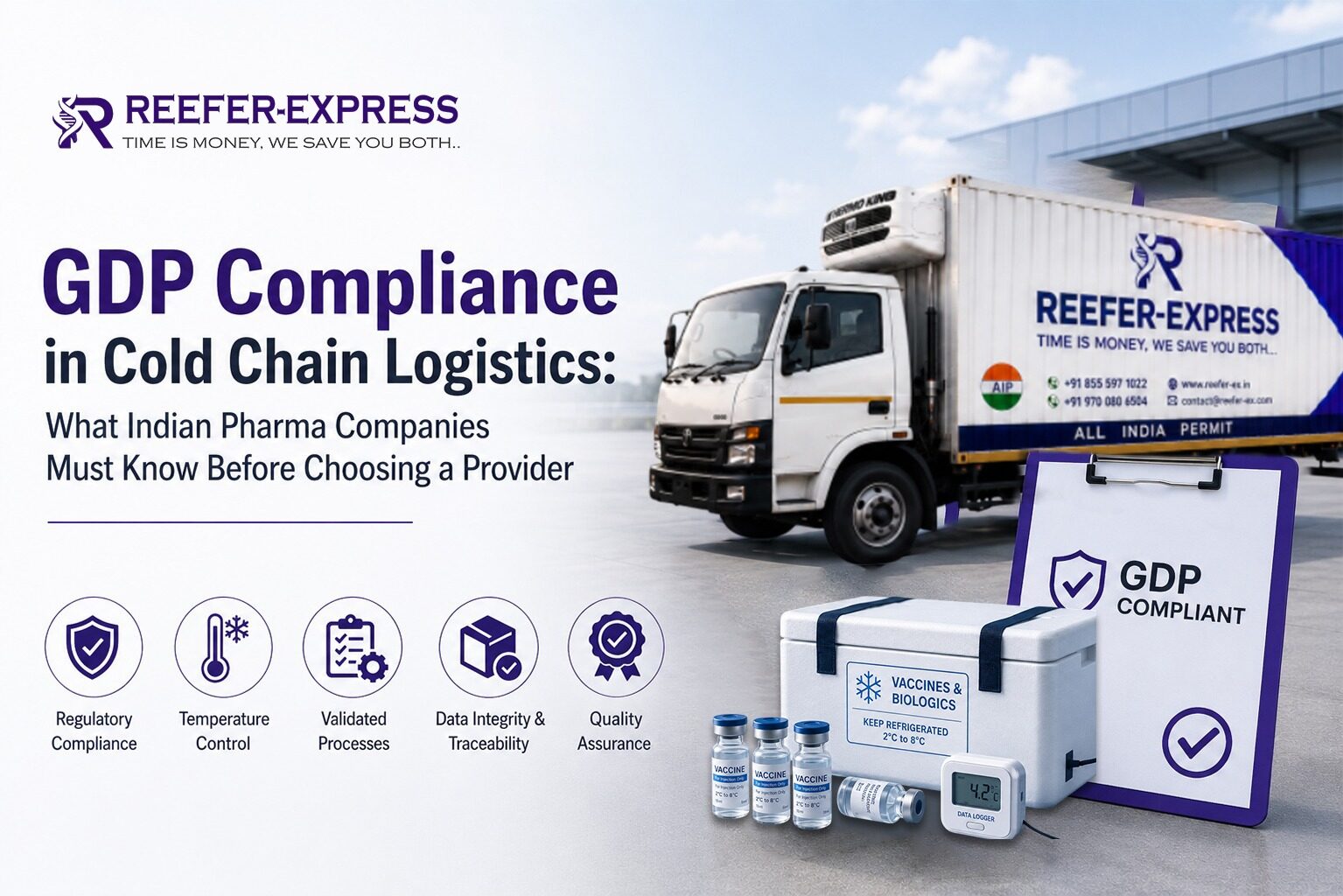
GDP is broad by design, but for a pharma company evaluating a cold chain logistics partner, it comes down to five areas that determine whether compliance is real or just claimed.
Temperature Mapping and Vehicle Qualification
A reefer vehicle is not automatically GDP compliant because it has a refrigeration unit. It needs to be mapped for temperature distribution across its cargo space, under realistic load and route conditions, with the mapping data kept on file and repeated on a defined schedule. A vehicle that has never been mapped for the specific route and season it is running is an unqualified asset, no matter how new the equipment looks.
Documentation, Traceability and Data Integrity
GDP compliance in cold chain logistics depends on a documentation trail that can stand up to an audit. That means continuous temperature logs for the full duration of the shipment, a recorded chain of custody at every handoff, and calibration certificates for the monitoring equipment itself. Manual, paper-based systems are increasingly a liability here, since missing entries and gaps in custody records are among the most common findings when auditors review distribution records.
Personnel Training and Quality Management Systems
GDP treats people as part of the compliance system, not just the vehicles and packaging. Drivers, warehouse staff, and delivery personnel need documented training on temperature-sensitive handling, and the company needs a quality management system that defines responsibilities, tracks deviations, and drives corrective action when something goes wrong. A provider who cannot produce training records for the staff handling your shipment has a gap that no amount of good packaging will cover.
Storage and Warehousing Standards
Between transport legs, product often sits in a warehouse or distribution hub, and GDP applies there just as much as it does on the road. That means validated storage temperature ranges, continuous monitoring with alarms, and controlled access so that only authorized personnel handle pharmaceutical stock. Reefer Express builds this into its temperature controlled logistics operations rather than treating storage as a separate, less-monitored part of the chain.
Transport, Handling and the Last-Mile Gap
Most GDP compliance failures in Indian cold chain logistics happen at the handoff points, not in the middle of the route. A reefer vehicle can be fully compliant and a shipment can still fail if it sits on a delivery agent’s bike in direct sun for even a short window. We covered this problem in detail in our piece on the challenges of long-distance refrigerated transport, and it remains one of the biggest blind spots for providers who have solved the middle leg but never addressed the first and last mile.
GDP Compliance for Vaccines, Biologics and Cell and Gene Therapies
Not every temperature-sensitive shipment carries the same risk if GDP compliance slips. Vaccines and biologics typically have narrower stability windows than conventional formulations, and cell and gene therapies often have almost no tolerance for deviation at all, since a single excursion can render an entire patient-specific batch unusable. For these product categories, GDP compliance in cold chain logistics is not just about staying within 2 to 8 degrees Celsius. It is about continuous chain of custody, verified identity at every handoff, and a logistics partner who has actually built a process around cell and gene supply chain requirements rather than adapting a standard pharma process and hoping it holds.
A provider that treats every temperature-sensitive shipment the same way, regardless of what it actually is, is not applying GDP correctly. The compliance burden for a bulk shipment of tablets and the compliance burden for a single patient dose of a cell therapy are not comparable, and a partner who cannot explain that distinction has not thought through what GDP compliance actually demands of them.
Where GDP Compliance Breaks Down in Indian Cold Chain Logistics
A lot of what gets sold as GDP-compliant cold chain logistics in India is closer to passive insulated shipping with a compliance label attached. The most common gaps show up in the same places. Providers offer generic validation data instead of route-specific temperature mapping. Packaging is chosen based on what is in stock rather than what the product’s stability profile actually requires. Temperature logs are available only on request instead of being attached to every shipment by default. And when a temperature excursion happens in transit, there is no documented protocol for who gets notified, how the product is quarantined, and what decision gets made about its disposition.
We wrote more about how to spot these gaps in cold chain packaging specifically in our earlier article on cold chain packaging in India, and the same pattern holds for GDP compliance more broadly. The gap is rarely in the equipment. It is in the process and the documentation behind it.
There is also a structural reason these gaps persist. Many logistics providers in India built their cold chain offering as an extension of general freight operations, adding a refrigerated vehicle and calling it a pharma solution. GDP compliance in cold chain logistics was never designed into the operation from the start, so it gets bolted on wherever a client specifically asks for it, rather than applied consistently across every shipment. That inconsistency is exactly what shows up during an audit, when one batch of records looks complete and another has visible gaps.
How to Evaluate Whether a Cold Chain Logistics Partner Is Actually GDP Compliant
Ask a provider to show you their temperature mapping reports for the specific route your product will travel, not a generic certificate from a controlled test environment. Ask whether every shipment comes with a full temperature log by default, or whether that data has to be requested separately after delivery. Ask for their written standard operating procedure for a temperature excursion, including who is notified and how a decision gets made on the product. Ask how they handle the last mile, specifically what happens between the reefer vehicle and the final recipient, and whether that window is monitored. And ask to see training records for the personnel who will actually be handling your shipment, not just a summary slide about company-wide training programs.
A provider who has genuinely built its operations around pharma supply chain solutions will answer all of this without hesitation, because the documentation already exists as part of how they run every shipment. A provider who treats cold chain as one service line among many will usually need to go looking for it.
Why Reefer Express for GDP Compliant Cold Chain Logistics in India
Reefer Express is built around pharma cold chain requirements in India, not adapted from a general logistics model. The reefer fleet is mapped for the routes and seasons it actually runs, and temperature continuity is maintained across the full journey, not just at pickup and delivery. Documentation, including temperature logs, chain of custody records, and excursion reports, is generated for every shipment as standard practice rather than provided on request.
On the last mile, where most GDP compliance failures in Indian cold chain logistics actually occur, Reefer Express has specific handling protocols designed to hold temperature integrity through the final leg. That is the stage of the chain that determines whether the compliance work done earlier actually counts for anything by the time the product reaches its destination.
What to Ask Before You Sign With a GDP Compliant Cold Chain Logistics Partner
Before committing to a provider, get direct answers to a short set of questions. Can they show route-specific temperature mapping data for your product’s temperature range? What is their written procedure for handling a temperature excursion in transit? Do temperature logs come with every shipment automatically, or only when requested? How exactly do they manage last-mile delivery for temperature-sensitive products, and is that window monitored? Have they shipped products in your category before, and can they share relevant records? A provider who answers all of this clearly, with documentation to back it up, is worth taking seriously. Hesitation or vague answers on any single point tells you where the risk sits.
Bottom Line
GDP compliance in cold chain logistics is not a checkbox exercise in India anymore. It is the difference between a shipment that clears regulatory scrutiny and one that becomes a quarantine decision, a financial write-off, or worse. Choose a partner based on documented, route-specific validation, transport and storage that hold to the same standard, and a provider who treats the last mile as seriously as the highway leg. If you are shipping pharmaceutical or biologic product in India and want to talk through your route, your product category, and what GDP compliant cold chain logistics actually looks like for your shipments, contact Reefer Express for a route-specific assessment.
Frequently Asked Questions
What is GDP compliance in cold chain logistics?
GDP compliance in cold chain logistics means a pharmaceutical shipment is stored, transported, and handled under documented, validated conditions that preserve the product’s approved temperature range from the manufacturing site to the point of use, with records available to prove it at every stage.
Who regulates GDP compliance for pharma logistics in India?
The Central Drugs Standard Control Organisation, under the Ministry of Health and Family Welfare, is India’s national regulatory authority for pharmaceutical distribution, and its GDP guidance works alongside the Drugs and Cosmetics Act and Rules that govern manufacturing and supply chain quality across the country.
What is the difference between GMP and GDP?
Good Manufacturing Practice governs how a pharmaceutical product is produced inside the manufacturing facility. Good Distribution Practice governs everything that happens after the product leaves that facility, covering storage, transport, documentation, and chain of custody until it reaches the patient or end user.
How does temperature mapping support GDP compliance?
Temperature mapping records how temperature varies across a vehicle or storage space under real load and route conditions. It proves that a reefer vehicle or warehouse can actually hold the required range for a specific route and season, rather than relying on the refrigeration unit’s rated performance alone.
Does GDP compliance apply to last-mile delivery?
Yes. GDP compliance applies to the entire distribution chain, including the final handoff between the delivery vehicle and the recipient. Most temperature excursions in Indian cold chain logistics happen during this last-mile window, which makes it one of the most heavily scrutinized parts of an audit.
How can I confirm a cold chain logistics provider is GDP compliant?
Ask for route-specific temperature mapping data, a written excursion protocol, training records for handling staff, and confirmation that temperature logs are provided with every shipment by default. A provider that can produce all of this without delay is operating a genuine GDP compliant process rather than claiming one.