

If you have reached the stage of comparing vendors, you already understand what cold chain packaging is. What you need now is a way to tell a provider who has actually validated their process from one who is selling a thermocol box with a gel pack and calling it compliance. Cold chain packaging in India carries real consequences when it fails: a compromised batch, a missed regulatory window, a conversation with your quality team about who signs off on the loss. This guide is built to help you make that decision with evidence instead of a sales pitch.
What Cold Chain Packaging in India Actually Involves
Cold chain packaging is the layer of protection that keeps a temperature-sensitive product within its approved range from the moment it leaves a facility to the moment it is handed to the recipient. In India, that layer has to work against conditions most global packaging standards were never tested for: 45°C summers in the north, humidity swings on the coast, multi-day road transit between manufacturing hubs and tier two or tier three cities, and handling by people who may not have been trained on what the box in front of them actually protects.
A validated cold chain solution in India accounts for all of this before the shipment leaves the dock. It is not a single product. It is a combination of insulation material, coolant type, packaging configuration, and route-specific testing that together hold a product within its labeled range for a defined duration under defined conditions. When any one of those elements is generic instead of validated, the whole system is only as strong as its weakest assumption.
Why Generic Packaging Fails on Indian Pharma Routes
Most packaging failures in India do not happen because a provider used bad materials. They happen because the packaging was validated somewhere else, under conditions that have nothing to do with the route it is now being used on. A box tested at 25°C ambient in a lab tells you very little about how it performs on a Chennai to Hyderabad delivery in May, or a Delhi to Patna route where transit time doubles because of highway congestion.
This gap matters more in the pharma supply chain in India than in almost any other sector. Biologics, vaccines, diagnostics, and clinical trial materials carry strict temperature tolerances, and a single excursion outside the validated range can render a batch unusable. The World Health Organization defines a temperature excursion as any exposure of a time and temperature sensitive product outside its approved storage or transport range, and its own guidance stresses that even short exposures can compromise a product’s stability (WHO Vaccine Management Handbook). In India, where road transit often runs longer than the packaging’s tested hold time, that risk is not theoretical. It is a scheduling problem that shows up in transit.
The market backing this segment is expanding fast, which means more providers are entering the space with packaging that has never been stress tested on Indian conditions. Industry estimates put India’s cold chain logistics market at over USD 24 billion in 2026, growing at close to 6 percent annually through 2031 (Mordor Intelligence). Growth of that scale brings volume, but it does not automatically bring rigor. That is on you to check before you sign.
What Separates a Validated Cold Chain Solution in India From the Rest
Route-Specific Validation Data
Ask a provider for validation data and pay attention to what they hand you. A generic test certificate from a controlled lab environment tells you almost nothing about performance on your actual route. What you want is documentation tied to specific ambient temperature profiles, transit duration, and the seasonal conditions your shipment will face. If a provider cannot produce this, or if their answer is “it’s tested to industry standard,” that is a gap worth taking seriously before you commit volume to them.
Packaging Matched to the Product, Not the Inventory
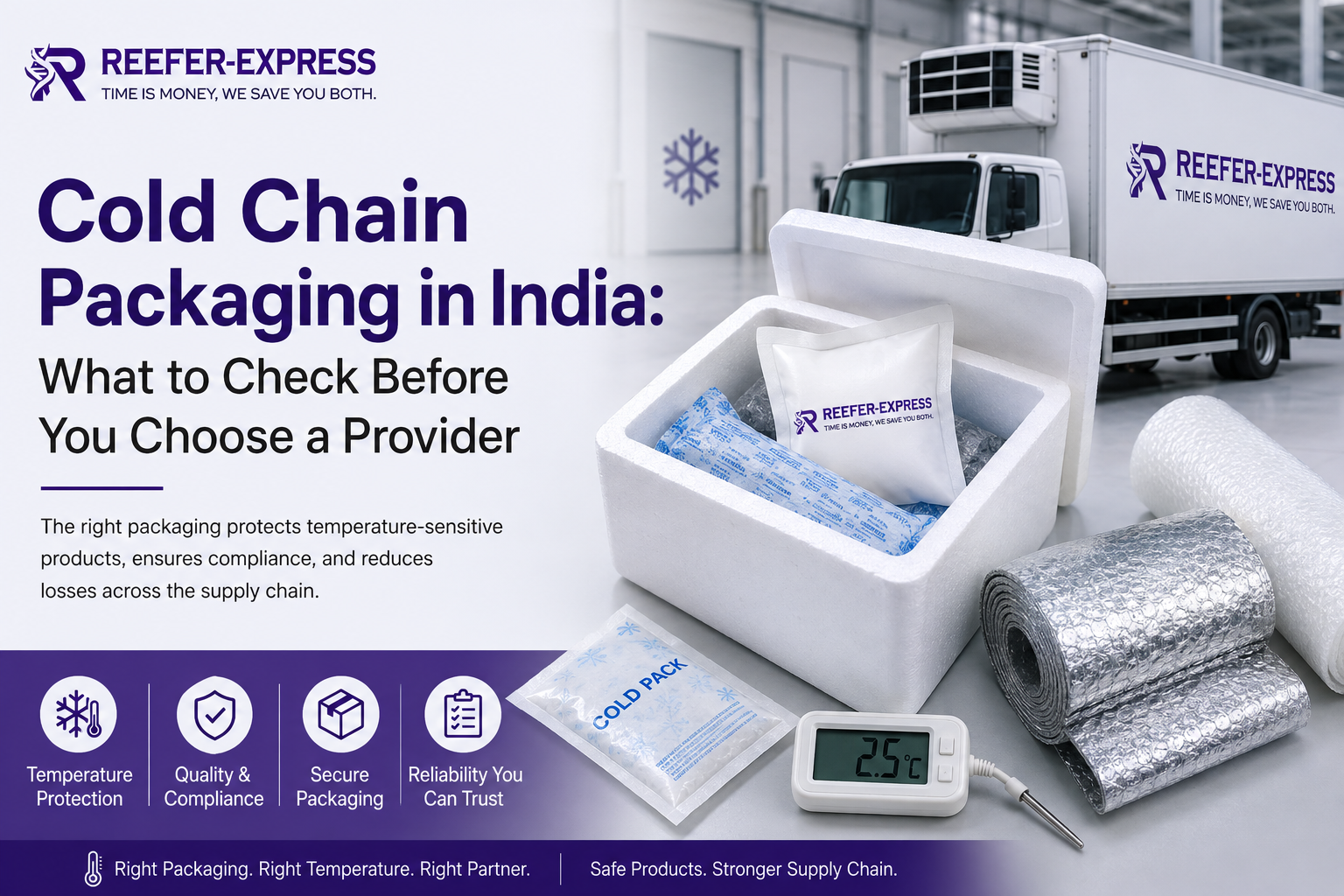
EPS foam, vacuum insulated panels, and phase change material systems each have a performance profile suited to a specific temperature range and hold time. A provider who offers one packaging format for everything, from 2 to 8°C vaccines to frozen biologics to 15 to 25°C diagnostics, is cutting corners somewhere. The packaging should be selected based on what your product needs to survive the route, not on what happens to be sitting in the provider’s warehouse.
Real-Time Temperature and Location Visibility
Location tracking without temperature data tells you where a shipment is, not whether it is still safe to use when it arrives. A cold chain solution in India worth paying for builds monitoring into the packaging itself, not just the vehicle, and gives you access to that data as the shipment moves rather than a report you have to request after delivery. This is also where regulatory expectations are tightening. CDSCO’s Good Distribution Practices guidelines call for documented temperature monitoring and investigation of any deviation across the distribution chain, not just at the warehouse stage (CDSCO GDP Guidelines).
A Documented Temperature Excursion Protocol
Ask any provider what happens when a shipment goes outside its approved range in transit. If they do not have a written answer covering who gets notified, how the decision to release or quarantine the product is made, and how it is documented, that is a serious gap. A written excursion protocol is not an admission that failures happen. It is evidence that the provider has actually thought through what happens when they do, instead of hoping they will not.
The Last-Mile Gap Most Providers Ignore
Most cold chain failures in India do not happen in the reefer vehicle. They happen at the handoff. The truck is compliant, the packaging is validated, and then the shipment sits on a delivery agent’s bike in direct sun for forty minutes while another drop gets completed first.
This is a structural weak point in how last-mile delivery works across India, and most cold chain providers have not solved it because it is the hardest leg to control. They have engineered the middle of the journey well. The first and last mile, where the product changes hands the most and is monitored the least, is where the real risk sits.
When you evaluate a cold chain solution in India, ask specifically how the product moves from the vehicle to the recipient. Ask what the maximum allowable time is between vehicle and delivery, and whether that window is actually monitored or just assumed. The answer tells you whether a provider has engineered the full chain or only the parts that were easy to control.
How Cold Chain Packaging Fits Into Your Larger Pharma Supply Chain in India
Packaging does not operate in isolation. It is one component in a pharma supply chain in India that also includes warehousing, reefer transport, documentation, and regulatory compliance, and a weak link anywhere in that chain undermines the parts that are working well. A provider who treats packaging as a standalone product, separate from the transport and documentation around it, is asking you to manage the integration risk yourself. Reefer Express approaches this differently by building pharma supply chain services around the full journey rather than a single leg of it, so packaging decisions are made with the transport mode, route, and handling protocol already factored in.
This matters because packaging that performs well on paper can still fail if it is paired with a transport plan that was not designed around it. A vacuum insulated container rated for 96 hours does not help if the reefer truck it travels in has documented cooling gaps, or if the warehouse it sits in before dispatch runs its own temperature excursions. The National Centre for Cold-chain Development, the government body tasked with strengthening India’s cold chain infrastructure, has repeatedly flagged this kind of fragmentation, where individual components meet standards but the chain as a whole does not, as one of the sector’s persistent weaknesses (NCCD). Choosing a provider who owns the full chain, not just the box, removes that fragmentation risk from your side of the table.
Why Reefer Express for Cold Chain Packaging in India
Reefer Express builds its packaging and transport around pharma supply chain requirements specific to India, not adapted from a general logistics model built somewhere else. That distinction shows up in three places.
First, packaging is qualified against India’s actual climate zones, which means validation reflects the ambient conditions your product will face on the road rather than a controlled test chamber. Second, temperature-controlled logistics is built into the transport leg with continuous monitoring, not spot checks at pickup and delivery, so packaging performance and vehicle performance are tracked together instead of separately. Third, documentation, including temperature logs, excursion reports, and chain of custody records, is generated with every shipment as a default, not something you request after the fact.
Reefer Express also runs its distribution practices in line with the compliance standards regulators expect from pharma logistics providers in India, covered in more detail in the breakdown of GDP compliance in cold chain logistics. On last-mile handling specifically, Reefer Express maintains handling protocols designed to hold cold chain integrity through the final leg, which is where most competitors’ coverage quietly ends. If your product needs to arrive compliant rather than merely arrive, this is the leg that decides whether the effort put into the earlier parts of the chain actually holds.
The broader logistics landscape in India includes established players operating at scale alongside specialized cold chain providers, and understanding where each fits is useful context before you commit to one; a rundown of how the major names compare is covered in this list of cold chain logistics companies in India. What separates a logistics company that offers cold chain as a service line from a provider built around cold chain is that the second one has already worked through the failure modes before your shipment becomes the test case.
Cost Considerations: Why the Cheapest Quote Usually Costs More
Cold chain packaging quotes in India can vary widely for what looks like the same specification on paper, and the gap almost always comes down to what is included. A low quote often excludes route-specific validation, monitoring hardware, and documentation, all of which get billed separately once you are already committed, or worse, simply are not provided at all. The real comparison is not packaging cost per shipment. It is packaging cost plus the cost of a single compromised batch, which for biologics and vaccines can run into the value of the entire shipment, plus the regulatory and customer-trust fallout that follows.
When you compare quotes, ask what is actually included in the base price: validation data, monitoring, documentation, and last-mile handling. A provider whose quote already bundles these in is pricing for compliance from the start. A provider whose quote is lower because these are add-ons is asking you to discover the real cost later, usually at the worst possible moment.
Questions to Ask Before You Sign With Any Cold Chain Provider
Before committing volume to a provider, run these questions in a direct conversation and pay attention to how specifically they answer, not just whether they answer. Can they show validation data specific to your route and your product’s temperature range, or only a generic certificate? What is their written procedure for a temperature excursion during transit, and who actually owns that decision when it happens at 2 a.m.? Do temperature logs come standard with every shipment, or only when you ask for them? How is last-mile delivery handled for temperature-sensitive product, and is that leg actually monitored? Have they shipped your specific product category before, and can they share real case data rather than a general capability statement?
A provider who answers all of this clearly, with documentation to back it up, is one worth taking seriously. Vague answers, or answers that shift to “we can look into that,” tell you exactly where the gaps are before you find out the hard way.
Frequently Asked Questions
What is the difference between cold chain packaging and cold chain logistics?
Cold chain packaging refers specifically to the insulated containers, coolants, and monitoring devices that protect a product’s temperature during transit. Cold chain logistics is the broader system, including reefer transport, warehousing, documentation, and last-mile handling, that the packaging operates within. Packaging alone cannot guarantee compliance if the logistics around it are not equally validated.
How long does validated cold chain packaging in India need to hold temperature?
It depends on the route and the product, not a fixed industry number. A same-city delivery may only need a four to six hour hold time, while an interstate shipment during summer may require 48 to 96 hours of validated performance. A provider should size the packaging to your actual transit time plus a safety margin, not sell you a single format for every route.
What temperature range applies to most pharma cold chain shipments in India?
Most vaccines, biologics, and temperature-sensitive drugs are held between 2°C and 8°C, with some diagnostics and specialty products requiring 15°C to 25°C or deep-frozen conditions as low as minus 20°C to minus 80°C depending on the compound. The applicable range should always come from the product’s own approved specification, not a general assumption about the category.
Who is responsible if a temperature excursion happens during transit?
Responsibility typically depends on the terms agreed with the provider before shipment, which is exactly why a documented excursion protocol matters. A serious provider will specify in writing how excursions are investigated, who is notified, and how liability is determined, rather than leaving that conversation for after a loss has already occurred.
Is real-time temperature monitoring mandatory for pharma shipments in India?
Regulatory guidance from CDSCO increasingly expects documented, monitored temperature control across the distribution chain for pharmaceutical products, particularly biologics and vaccines. While specific monitoring requirements can vary by product category and state-level enforcement, working with a provider who builds real-time monitoring into every shipment as a default keeps you ahead of tightening compliance expectations rather than catching up to them.
Does IATA certification matter for road-based cold chain shipments in India?
IATA’s CEIV Pharma certification is built primarily for air cargo handling, but the underlying standard, covering temperature control, trained personnel, and quality management, reflects the same rigor a serious road-based provider should apply (IATA CEIV Pharma). Even where formal certification does not directly apply to road transport, asking whether a provider’s internal processes are built to that standard is a useful benchmark during evaluation.
Bottom Line
Cold chain packaging in India is not a commodity purchase, and treating it like one is how batches get compromised. The provider you choose affects product integrity, batch release decisions, your regulatory standing, and your liability if something goes wrong mid-route. Price matters, but it should never be the primary filter when the cost of getting this wrong is a written-off shipment and a compliance conversation you did not want to have.
Choose based on documented, route-specific validation, packaging matched to your product’s actual temperature range, real-time visibility that covers the full journey including last-mile, and a provider who answers hard questions with evidence instead of reassurance. If you are shipping pharmaceutical product in India and want to talk specifics, including your routes, product categories, and turnaround requirements, Reefer Express is ready to have that conversation.
Looking for cold chain packaging in India built for pharma supply chain compliance? Contact Reefer Express for a route-specific assessment.