

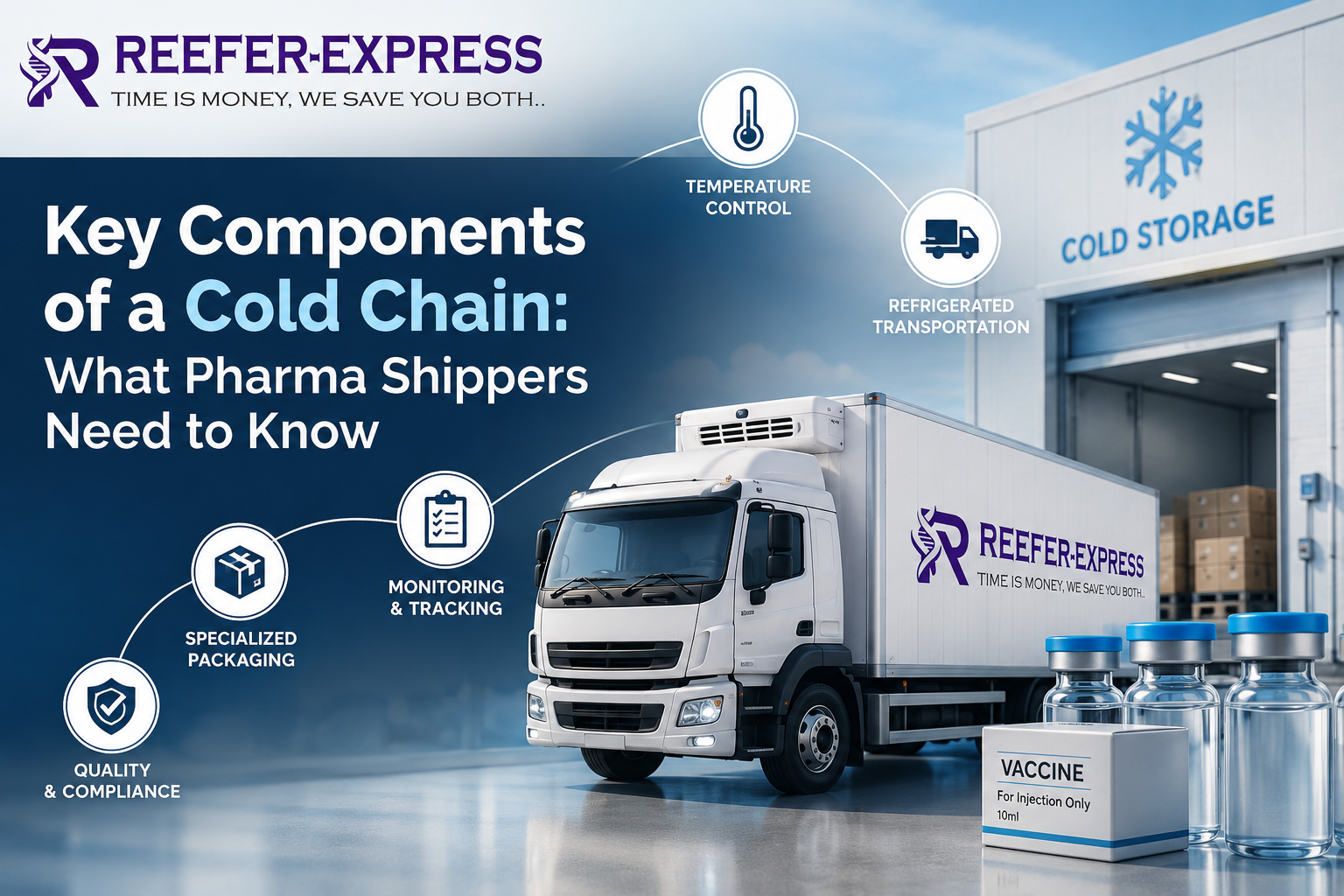
Every key component of a cold chain has to work together without a single weak link. Pharma shipments do not get a second chance once temperature control fails. A vaccine batch that sits two degrees outside its label range for even an hour can lose potency long before anyone notices the deviation on a delivery report. A pharma company evaluating logistics partners today needs to ask a sharper question than “do you handle cold chain?” The real test is whether a vendor can show, point by point, how each stage of that chain gets built, monitored, and documented well enough to survive an audit.
This guide walks through each component a pharma shipper should check before signing a contract. It also covers what a serious cold chain partner should prove, not just promise.
Why Every Component of the Cold Chain Matters for Pharma Shipments
Pharma products differ from frozen vegetables or dairy in one critical way. A short excursion outside the ideal range might only affect taste or shelf life for food, but it can render a biologic, a vaccine, or an insulin shipment unusable, or even unsafe. Regulators know this, which is why they never evaluate pharma cold chain logistics as one single service. They look at storage, transport, packaging, monitoring, documentation, and personnel training as separate, auditable components, each with its own failure points.
Price comparisons between logistics vendors often mislead pharma shippers for the same reason. Two companies can quote a similar rate per kilometer for a 2°C to 8°C shipment. One maintains validated reefer vehicles with 15-minute logging intervals. The other relies on a driver checking a dial thermometer twice a day. That gap only becomes visible when something goes wrong, and by then the shipment has already been compromised.
Temperature-Controlled Storage
Storage is where most pharma cold chain failures actually begin, long before a truck leaves the warehouse. A facility that claims to offer cold storage needs more than a room with an air conditioner running at a low setting. It needs mapped temperature zones, redundant refrigeration units, and backup power that kicks in within seconds of a grid failure.
Cold Rooms and Walk-In Coolers
Most pharma products, including the vast majority of vaccines, biologics, and insulin, require storage between 2°C and 8°C. Temperature inside a large room is rarely uniform, so a properly designed cold room places multiple sensors at different heights and corners rather than relying on one thermostat near the door. Reefer Express structures its own cold storage and transportation solutions around this same principle of zone-level accuracy, not a single average reading for the whole facility.
Deep-Freeze and Ultra-Cold Storage
Certain biologics, some APIs, and specific vaccine formulations need frozen storage at -18°C or below. A smaller category of advanced therapies, including some cell and gene products, requires ultra-low or cryogenic conditions. Shippers working with sensitive biologics should ask a potential partner directly whether they operate deep-freeze capacity in-house or subcontract it. Subcontracted deep-freeze often introduces an extra handover point where custody and temperature history can get fuzzy.
Validated Reefer Vehicles and Fleet
Once a product leaves storage, the vehicle becomes the temperature-controlled environment. This is where many logistics providers cut corners that shippers never see until an excursion report lands on their desk.
Vehicle Qualification and Mapping
A reefer truck is not automatically reliable just because it has a working compressor. Serious operators run temperature mapping studies on each vehicle type, identifying hot spots near the rear doors or cold spots near the evaporator. They also requalify vehicles periodically rather than once at purchase. Ask any potential partner for their vehicle qualification records before you ask about fleet size. A fleet of 50 unmapped trucks carries more risk than a fleet of 10 properly validated ones.
Multi-Temperature Compartments
Many pharma shipments today combine products with different temperature requirements in a single consignment, for instance a 2°C to 8°C biologic alongside a 15°C to 25°C controlled-ambient product. Vehicles with multi-temperature compartments, physically separated and independently monitored, let a shipper consolidate loads without forcing every product into the same zone. Reefer Express builds its temperature-controlled logistics services around this segmented capability. A single dispatch does not have to mean one fixed temperature setting for everything on board.
Packaging and Insulation Systems
Even the best reefer vehicle cannot protect a product during loading, unloading, or the last mile to a hospital or clinic. Packaging becomes the second line of defense at exactly these moments.
Passive Packaging
Insulated shippers, gel packs, and phase-change material containers keep a product within range for a defined window without any external power source. These work well for smaller pharma shipments, last-mile hospital deliveries, and situations where continuous power supply cannot be guaranteed. Insulation quality, not ice pack quantity, determines how long a passive system holds its range. Shippers should ask for validated hold-time data rather than a vendor’s general assurance.
Active Packaging for High-Value Shipments
High-value biologics, clinical trial materials, and long-haul international shipments often need active packaging systems with their own compressor or thermoelectric unit. These maintain a set temperature regardless of ambient conditions for much longer periods. They cost more to deploy, but they become necessary when a single unit of lost product represents a significant financial and regulatory loss. Reefer Express supports both approaches through its packaging and distribution services, matched to the value and sensitivity of what is actually being shipped.
Real-Time Temperature Monitoring and Data Logging
Monitoring turns a cold chain from a set of assumptions into a set of evidence. Without continuous, time-stamped temperature data, nobody, including the shipper, actually knows whether the product stayed in range. Everyone just knows it arrived and looked fine.
Modern data loggers record readings at short intervals, typically every 15 minutes. Many now transmit that data live over cellular or satellite networks instead of only storing it for download after arrival. Live monitoring matters because it lets a logistics team catch a developing excursion and intervene, rerouting a shipment or swapping a vehicle before the product actually gets damaged. A logger that only reports after delivery can confirm a failure. Live monitoring can sometimes prevent one.
Pharma shippers should also confirm what happens when a deviation gets detected. A serious partner has a documented excursion response protocol with defined escalation steps, not a general promise to “look into it.” This single detail often separates vendors who understand pharma logistics from vendors who simply added a cold chain option to a general freight business.
Documentation and Chain of Custody
Regulatory bodies do not accept “the product arrived cold” as proof of compliance. Documented evidence must cover every handoff from the manufacturing site to the point of use, and this paper trail has become as important as the physical refrigeration itself.
That evidence includes temperature logs for the full journey, signed handover records at every custody change, calibration certificates for monitoring equipment, and the vehicle qualification data mentioned earlier. Good Distribution Practice guidance from the World Health Organization treats this documentation trail as a core requirement, not an optional add-on. It describes storage, handling, and record-keeping obligations that apply at every stage of distribution, not just at the warehouse.
In the United States, USP General Chapter <1079> lays out a similar risk-based framework for storage and transportation documentation. Pharma companies operating in multiple markets increasingly expect their India logistics partners to know both standards, since the destination market often decides which framework an audit will reference. Reefer Express structures its pharma supply chain solutions to generate this documentation automatically at each stage, rather than reconstructing it after the fact when a client asks for it.
Trained Personnel and Standard Operating Procedures
A cold chain is ultimately operated by people. A driver who does not understand why a door has to stay closed during a delivery stop can undo everything a validated vehicle and a calibrated logger were designed to protect.
Pharma-specific training covers loading sequences that minimize door-open time, correct handling of dry ice and gel packs, recognition of early warning signs on a data logger display, and the documentation steps required at each handover. Staff turnover in general logistics can run high. A partner that treats pharma handling as a specialized skill set, with its own onboarding and refresher training, will consistently outperform one that rotates drivers between general freight and pharma loads without distinction.
Regulatory Compliance: GDP, CDSCO, and Global Standards
Compliance ties every other component together. None of the physical infrastructure matters if a vendor cannot demonstrate it to a regulator or an auditor on request.
In India, the Central Drugs Standard Control Organisation sets the national regulatory framework for pharmaceuticals. Any logistics partner handling regulated products needs to operate within its requirements for storage and distribution. Internationally, the WHO’s Good Distribution Practices guidance, published as part of its Technical Report Series, remains the reference point most global pharma companies expect their logistics vendors to follow, covering premises, vehicles, shipment handling, and documentation in detail. For pharma products moving by air, IATA’s CEIV Pharma certification has become a recognized benchmark for cold chain handling at airports and among freight forwarders, evaluating everything from facility infrastructure to staff training against a detailed checklist.
India’s own vaccine cold chain, run through the Universal Immunization Programme under the National Health Mission, offers a useful reference point too. It operates one of the largest public cold chain networks in the world. The operational discipline built into that system, including digital stock and temperature tracking through the Electronic Vaccine Intelligence Network, reflects the same principles commercial pharma shippers should expect from a private logistics partner.
How to Evaluate a Cold Chain Logistics Partner for Pharma Shipments
Understanding these components changes how you should evaluate a vendor. Instead of asking for a general quote, request their vehicle qualification and mapping reports. Ask what monitoring technology they use and whether it transmits live data or only stores it for later download. Ask to see a sample of the documentation package they provide after a completed shipment, not just a description of what it includes. Ask specifically how they handle deviations, including their escalation timeline and who gets notified first.
A vendor that answers with specifics, including named systems, actual data intervals, and real documentation samples, is operating a genuine pharma cold chain. A vendor that answers in general terms about “quality service” and “reliable delivery” is likely running a standard freight operation with a cold chain label attached.
Pricing also reveals a lot about a vendor’s setup. A quote that only lists distance and weight, without any reference to temperature range, packaging type, or monitoring level, usually means the pricing model was never built around pharma requirements in the first place. A genuine pharma cold chain quote should shift based on whether the shipment needs 2°C to 8°C validated transport with active packaging and live monitoring, versus a simpler ambient-controlled load. If two quotes look identical regardless of these variables, one of them is almost certainly missing a component covered in this guide.
Contract terms deserve the same scrutiny. Ask what compensation or liability terms apply if a documented excursion damages your product. Ask how disputes over temperature data get resolved, since the answer reveals whether the vendor genuinely stands behind their monitoring records or treats them as a formality. A partner confident in their own infrastructure will usually have clear, pre-agreed terms for this scenario, not a case-by-case discussion after something has already gone wrong.
Why Pharma Companies Choose Reefer Express for Cold Chain Logistics
Reefer Express was built specifically around pharma and healthcare cold chain requirements, not as a general freight company that later added a refrigerated option. Every component covered in this guide, from validated storage and mapped reefer vehicles to real-time monitoring and audit-ready documentation, shapes how shipments move through the network from origin to destination.
Pharmaceutical manufacturers and distributors evaluating a cold chain logistics partner in India can rely on healthcare logistics and cell and gene supply chain services built around the specific handling requirements of sensitive biologics, vaccines, and advanced therapies, rather than a generic temperature range applied to every shipment type.
A direct conversation before your next shipment goes out is worth the time if your current logistics setup cannot answer the evaluation questions above with specifics. Reach out to the Reefer Express team to walk through your product’s exact storage, packaging, and monitoring requirements and get a documented plan instead of a general assurance.
Frequently Asked Questions
What are the main components of a pharmaceutical cold chain?
The main components are temperature-controlled storage, validated reefer vehicles, passive or active packaging, real-time temperature monitoring, documentation and chain of custody records, trained personnel, and regulatory compliance with frameworks like WHO GDP and CDSCO requirements.
What temperature range do most pharma products require during transport?
Most vaccines, biologics, and insulin require 2°C to 8°C. Some products need frozen storage at -18°C or below, and controlled-ambient products typically stay between 15°C and 25°C. The exact range always depends on the manufacturer’s label, never a general assumption.
How often should temperature data be logged during pharma transport?
Most GDP-aligned operations log temperature at intervals of 15 minutes or shorter throughout the journey. Increasingly, this data gets transmitted live rather than only stored for download after delivery.
What happens if a temperature excursion occurs during transport?
A properly run cold chain operation follows a documented excursion response protocol. This includes immediate notification, an assessment of how far outside range the product went and for how long, and a decision on whether the shipment can still be used based on the manufacturer’s stability data.
Why does packaging matter if the vehicle is already temperature controlled?
Packaging protects the product during loading, unloading, and any point where it leaves the vehicle’s controlled environment, including last-mile delivery to a hospital or pharmacy. Think of it as the backup layer for the moments when the primary temperature control is not active.
How is a pharma cold chain different from a food cold chain?
Pharma cold chain requirements run stricter and get backed by regulatory frameworks like WHO GDP, CDSCO, and USP <1079>, with mandatory documentation and audit trails. A food cold chain failure usually affects quality, while a pharma cold chain failure can affect patient safety and product efficacy directly.