

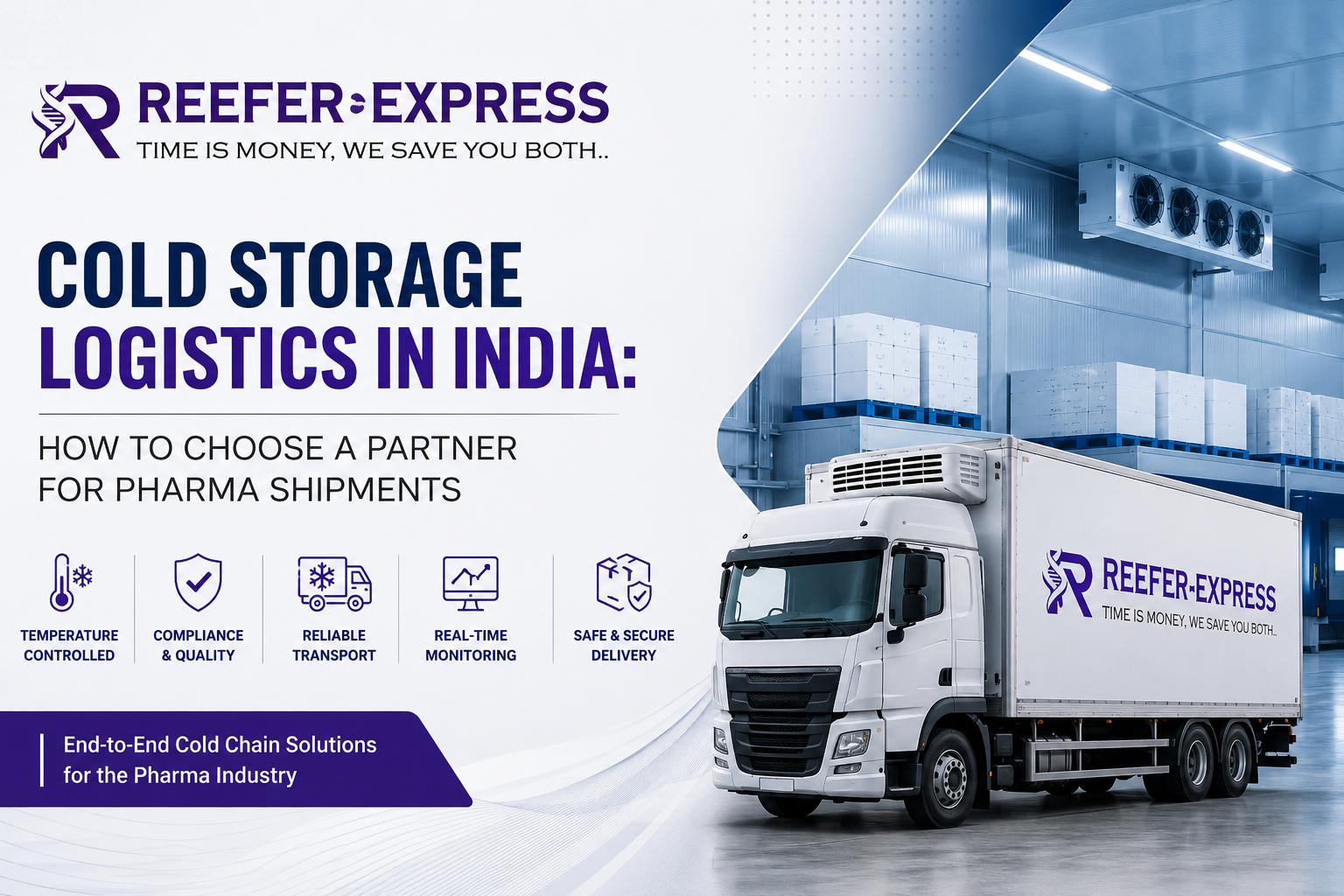
If you are shopping for cold storage logistics in India, you already know what is at stake. A biologic sitting outside its temperature band for even an hour can turn a shipment into a write-off, a compliance flag, or in the worst case, a patient safety problem. This guide walks through what separates a cold storage logistics provider you can rely on from one that only sounds capable on a sales call, and why pharmaceutical companies across India are turning to Reefer Express to move temperature-sensitive product from origin to last mile.
What Cold Storage Logistics Actually Means for a Pharma Shipment
Cold storage logistics covers more than a refrigerated warehouse and a reefer truck. For pharmaceutical shipments, it means an unbroken chain of temperature control from the moment product leaves the manufacturing site to the moment it reaches the pharmacy, hospital, or clinic. That chain includes validated packaging, temperature-mapped storage, monitored transport, and a last-mile handoff that does not undo everything done right earlier in the journey.
The distinction matters because a lot of providers in India sell warehousing and call it cold storage logistics. A cold room with a working compressor is not the same as a system built around continuous temperature control, documentation, and accountability at every handoff. When you evaluate temperature controlled logistics for pharmaceutical product, you are evaluating a system, not a single facility. Every link in that system, from the storage racks to the delivery bike, has to hold the same standard.
For a closer look at how packaging fits into that system, see our earlier guide on cold chain packaging in India, which covers what to demand from a packaging validation report before you rely on it.
Why Pharma Cold Storage Logistics Is Held to a Different Standard
Cold storage logistics for food, dairy, or FMCG products is not the same discipline as cold storage logistics for pharmaceuticals, even though the two get lumped together in vendor pitches. A short excursion on a crate of frozen vegetables might affect shelf life or texture. The same excursion on a batch of biologics can mean the product is no longer safe to administer, which turns a logistics failure into a regulatory and patient safety event.
That difference shows up in what a provider needs to be able to prove. Food cold chain logistics is largely judged on whether the product still looks and tastes fine on arrival. Pharma cold storage logistics is judged on data: a continuous, auditable temperature record that a quality team can hand to a regulator without gaps. If a provider cannot produce that record on demand, the shipment’s integrity is effectively unproven, regardless of how it looks when the box is opened.
This is also why pricing conversations in pharma cold storage logistics look different from general cold chain quotes. You are not just paying for refrigerated cubic meters and kilometers driven. You are paying for validation work, monitoring infrastructure, documentation systems, and a level of last-mile discipline that a food distributor rarely needs to invest in. Providers who quote pharma shipments at food-cold-chain rates are usually cutting one of those corners somewhere in the chain. Our pharma cold chain logistics page breaks down what should be included in a legitimate pharma quote versus a general freight quote.
Why Cold Storage Logistics Breaks Down So Often in India
India’s cold storage logistics sector has grown quickly, but capacity has not kept pace with demand. The National Centre for Cold-chain Development estimates that the country needs roughly 35 to 40 million metric tons of cold storage capacity, against around 32 million metric tons currently available. That gap shows up as a shortage of qualified capacity in exactly the corridors where pharmaceutical shippers need it most.
Layer India’s climate variation on top of that shortage and the picture gets harder. A route that runs fine in December can fail in May once ambient temperatures cross 40 degrees Celsius for hours at a stretch. Regulatory expectations have tightened too, and pharmaceutical logistics providers are increasingly expected to demonstrate storage and transport practices in line with international benchmarks such as the WHO’s model guidance on time and temperature sensitive pharmaceutical products, which lays out the storage, transport, and documentation standards that pharma cold storage logistics should be built around.
You can review that guidance directly through WHO Technical Report Series 961, Annex 9, which most serious cold storage logistics providers will reference when you ask about their standards.
Most failures do not happen inside the warehouse. They happen at the handoffs, when a shipment moves from cold room to reefer vehicle, or from vehicle to delivery agent. The middle of the journey is usually well controlled. The edges are where cold storage logistics in India tends to fall apart, and that is exactly where a provider’s real capability shows up.
There is also an accountability gap that follows from all of this. When a shipment arrives compromised and there is no continuous temperature record, no route validation, and no clear handoff log, there is rarely a clean answer for who is responsible. The receiving pharmacy or hospital is left holding a product they cannot use, the shipper is left explaining a loss to a regulator, and the logistics provider often walks away with no consequence because nothing was ever documented well enough to pin down where the failure happened. Choosing a cold storage logistics partner is, in large part, choosing who will own that accountability if something goes wrong.
What to Check Before You Choose a Cold Storage Logistics Provider
Every provider will tell you they handle temperature-sensitive product. Fewer can prove it. Before you commit your pharma supply chain to a cold storage logistics partner, run through the following checks, and compare them against how refrigerated logistics companies in India typically position themselves versus what a pharma-specific provider actually delivers.
Route-Specific Temperature Validation
Generic validation tells you almost nothing. A packaging or vehicle test run in a controlled lab environment does not reflect a Chennai to Hyderabad route in summer, or a Delhi to Mumbai route in the middle of winter. Ask for validation data tied to the specific route, product category, and season your shipment will travel through. If a provider hands you a single generic certificate for every lane, treat that as a warning sign rather than reassurance.
Storage Infrastructure Matched to India’s Climate Zones
Cold storage logistics providers should be able to explain how their facilities and vehicles are qualified for the specific climate zone your shipment moves through, not just a national average. A facility in coastal Chennai deals with different humidity and heat load than one in Delhi or the Himalayan foothills. Infrastructure that has not been mapped and validated for its actual operating environment is a liability, not a safeguard. Our temperature controlled logistics overview breaks down how that mapping works zone by zone.
Continuous Monitoring, Not Periodic Checks
Real-time visibility should mean temperature and location together, tracked continuously through the journey, not a GPS pin with a temperature reading logged once every few hours. If you can see where a shipment is but cannot confirm whether the cold chain held, you cannot make a confident release decision when it arrives. Ask exactly how often temperature data is captured, how it is stored, and how quickly you can access it if a question comes up during a regulatory audit.
A Documented Excursion Protocol
Ask what happens the moment a temperature excursion is detected in transit. A serious cold storage logistics provider will have a written answer covering who gets notified, how fast, what the decision tree looks like, and how the product is quarantined or disposed of if needed. The absence of a documented protocol does not mean excursions never happen. It usually means nobody has thought through what happens when they do.
Last-Mile Handling That Holds the Chain
This is where most cold storage logistics providers in India quietly stop performing. The reefer vehicle is compliant, the packaging is validated, and then the shipment sits on a delivery agent’s bike in direct sunlight for the better part of an hour while another drop gets completed. Ask specifically how a provider manages the handoff from vehicle to recipient, what the maximum allowable exposure time is, and whether that window is actually monitored or just assumed.
It helps to ask the question in a very concrete way. Request a walk-through of an actual last-mile delivery, start to finish, for a product in your temperature band. A provider who can describe the handoff step by step, including how long the product sits outside active cooling and how that time is tracked, has clearly built a process around it. A provider who answers in general terms about having reliable delivery partners has probably not looked closely at this stage of the chain, which is exactly the stage most likely to cause a failure.
Cold Storage Logistics vs General Warehousing
The two get confused often enough that it is worth spelling out the difference directly, especially since general cold chain logistics companies in India often bundle both under the same pitch.
| Factor | General Warehousing | Cold Storage Logistics for Pharma |
| Temperature control | Set point maintained on average | Continuous, monitored, and logged at every stage |
| Validation | Generic or none | Route and product specific |
| Documentation | Available on request | Built into every shipment |
| Last-mile coverage | Ends at delivery gate | Extends through final handoff to recipient |
Why Pharmaceutical Companies Choose Reefer Express for Cold Storage Logistics
Reefer Express is built around pharma supply chain requirements in India, not adapted from a general freight model. That distinction matters because pharmaceutical cold storage logistics carries compliance requirements, documentation needs, and failure consequences that a generalist logistics provider is not designed to absorb.
Every shipment moves under standards consistent with recognized pharmaceutical distribution practice, including the storage and handling principles set out by the WHO’s guidelines on good storage and distribution for medical products, and in line with the framework enforced domestically by the Central Drugs Standard Control Organisation. Documentation, including temperature logs, excursion reports, and chain of custody records, is generated for every shipment as standard practice, not produced on request after the fact.
To see how Reefer Express structures pharmaceutical logistics across origin, transit, and delivery, visit our pharmaceutical logistics services page.
What You Get When You Work With Reefer Express
Temperature-Controlled Fleet
The reefer fleet maintains temperature continuity across the full route, not just at pickup and delivery. Vehicles are qualified for India’s actual climate zones, so validation reflects the ambient conditions your product will face on the road rather than a test chamber. Details on how the fleet is configured for different product categories are covered on our temperature-controlled transport page.
Validated Packaging and Storage
Packaging is matched to the product rather than applied as a one-size-fits-all solution. Vaccines held at 2 to 8 degrees Celsius, diagnostics at 15 to 25 degrees, and frozen biologics each get packaging and storage validated for their specific hold time and temperature band.
Real-Time Visibility
Temperature and location are tracked together throughout transit, with data available in a format you can act on, not a spreadsheet you have to request after the fact. That visibility supports faster, better-informed release decisions when a shipment arrives.
Last-Mile Protocols
Reefer Express has specific handling protocols for the final leg of delivery, the stage where most competitors’ coverage quietly ends. Maximum exposure windows are defined and monitored, so the effort put into the earlier legs of the journey is not undone in the last few kilometers.
Questions to Ask Before You Sign With Any Cold Storage Logistics Provider
Before committing your pharma supply chain to a cold storage logistics partner, run through a direct conversation covering the essentials. Can they show validation data specific to your route and your product’s temperature range. What is their written procedure for a temperature excursion during transit. Do temperature logs come with every shipment or only when requested. How do they handle last-mile delivery for temperature-sensitive product, and is that window actually monitored. Have they shipped your product category before, and can they share relevant case data to back that up.
A provider who answers all of this clearly, with documentation behind it, is one worth taking seriously. Hesitation or vague answers on any of these points tells you exactly where the gaps sit.
Get a Route-Specific Cold Storage Logistics Assessment
Cold storage logistics is not a line item to shop on price alone. The provider you choose affects product integrity, batch release decisions, regulatory standing, and your liability if something goes wrong in transit. If you are shipping pharmaceutical product in India and want to talk specifics, including routes, product categories, and turnaround times, get in touch with Reefer Express for a route-specific assessment built around your actual shipment, not a generic quote.
Frequently Asked Questions
What is cold storage logistics in the pharmaceutical industry?
Cold storage logistics in pharma refers to the full system of temperature-controlled storage, transport, and handling used to move drugs, vaccines, and biologics without breaking their required temperature range. It covers validated packaging, temperature-mapped warehousing, monitored reefer transport, and controlled last-mile delivery, all backed by documentation that proves the chain held from origin to destination.
How is cold storage logistics different from regular refrigerated transport?
Regular refrigerated transport moves goods at a set temperature but often stops short of full documentation and route-specific validation. Cold storage logistics for pharma goes further, requiring continuous monitoring, written excursion protocols, and chain of custody records that meet regulatory expectations, since a temperature deviation can compromise product safety and trigger compliance issues.
What temperature ranges do pharma cold storage logistics providers need to support?
Most pharmaceutical shipments fall into a few standard bands: 2 to 8 degrees Celsius for vaccines and many biologics, 15 to 25 degrees for diagnostics and some formulations, and below zero for frozen products. A capable provider validates packaging and vehicles separately for each band rather than offering one solution for every product type.
How does Reefer Express handle temperature excursions?
Reefer Express follows a documented excursion protocol that defines who is notified, how quickly, and what happens to the product, including quarantine or disposal steps if needed. Every shipment is monitored continuously, so an excursion is flagged in real time rather than discovered after delivery.
Does Reefer Express provide documentation for regulatory audits?
Yes. Temperature logs, excursion reports, and chain of custody records are generated for every shipment as standard practice, not produced only when requested. This documentation is built to support batch release decisions and regulatory review without delay.
How much does cold storage logistics cost in India?
Cost depends on route, product temperature band, packaging requirements, and shipment volume, so there is no single number that applies across the board. What matters more than the headline price is what is included: validation, monitoring, documentation, and last-mile handling should all be part of the quote, not add-ons billed later. A route-specific assessment from Reefer Express will give you an accurate figure based on your actual shipment profile.
Which industries and product categories does Reefer Express serve?
Reefer Express moves temperature-sensitive pharmaceutical product across categories including vaccines, biologics, diagnostics, insulin, and clinical trial materials, each handled under packaging and monitoring specific to its temperature band. The focus stays on pharma cold storage logistics rather than general refrigerated freight, which keeps the fleet, protocols, and documentation aligned to what pharmaceutical shippers actually need.