



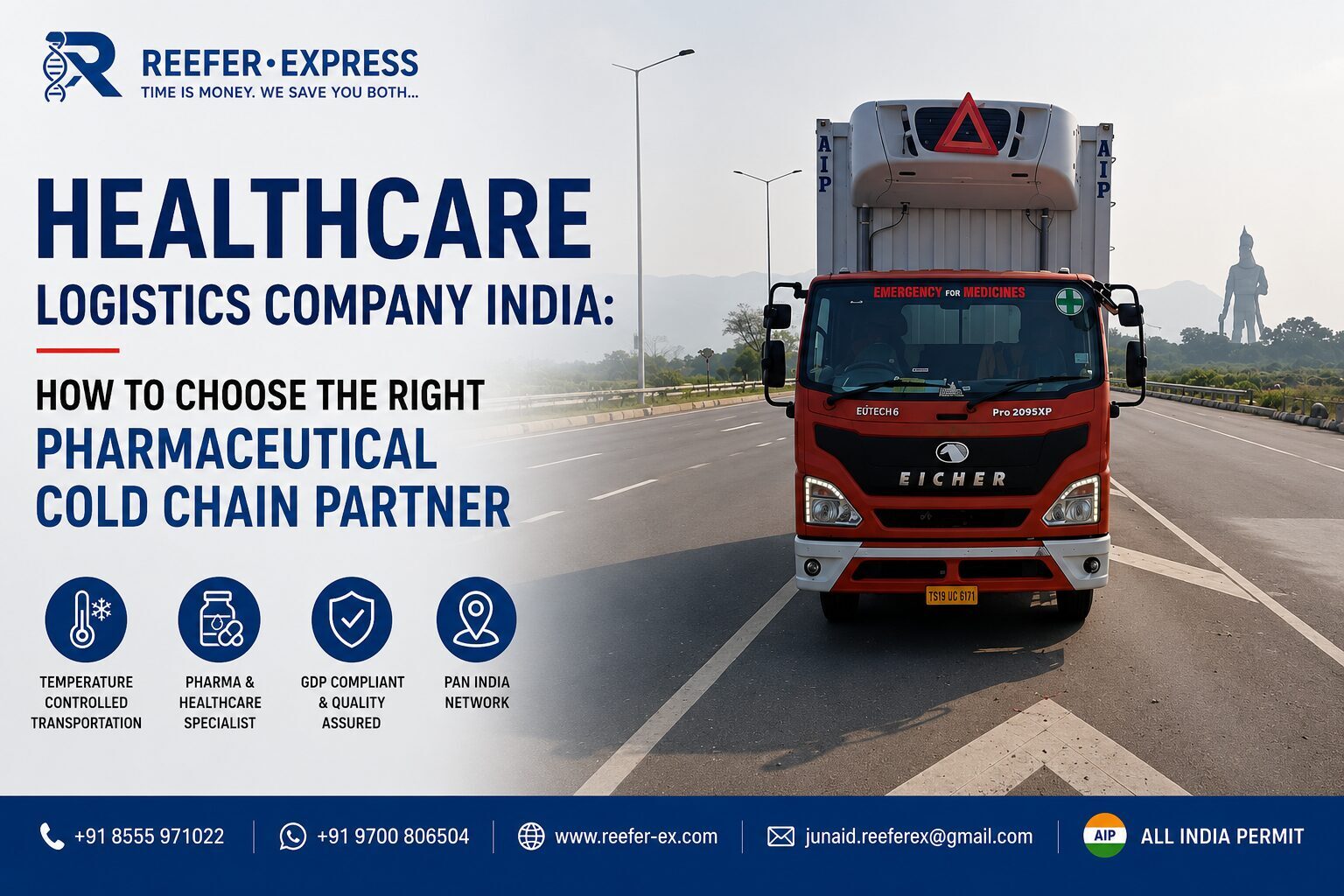
If you are evaluating a healthcare logistics company in India right now, you are not looking for an explanation of what cold chain means. You already know that. What you need is a way to separate the providers who can actually hold temperature across a real Indian route from the ones who sound capable in a sales call and fall apart the moment a shipment sits in traffic at 40 degrees Celsius.
This is written for that decision. Not the research phase, the decision phase.
Why the “Healthcare Logistics” Label Gets Misused in India
A lot of companies in India call themselves a healthcare logistics company because they carry medical goods occasionally, alongside general freight, e-commerce parcels, and industrial cargo. That is not the same thing as being built for pharmaceutical cold chain transportation.
A true healthcare logistics company designs its fleet, its packaging, its documentation, and its escalation process around one requirement: the product has to arrive within its validated temperature range, every time, with a record that proves it. General logistics providers add refrigeration as a feature. Healthcare logistics providers build the entire operation around it. That difference shows up the first time something goes wrong, because one of them has a protocol ready and the other is improvising.
When you are shortlisting providers, ask directly what percentage of their fleet and operations is dedicated to temperature-sensitive pharma freight. A vague answer is itself an answer.
Cold Chain Transportation India: What the Route Actually Demands
Cold chain transportation in India is not one problem. It is several different problems depending on geography, season, and distance. A Delhi to Jaipur route in June behaves nothing like a Bangalore to Chennai route in December. Humidity, ambient heat, road quality, and handling delays at state borders all affect how long a reefer unit or a packaging solution can hold its range.
This is where generic validation data becomes a liability rather than a reassurance. A cold chain shipping company that shows you a single test certificate from a controlled chamber is not showing you anything relevant to your actual shipping lane. What you need is validation tied to the specific route, the specific season, and the specific product category you are shipping, whether that is a 2 to 8 degree vaccine, a frozen biologic, or a 15 to 25 degree diagnostic reagent.
Ask for route-specific data before you ask about pricing. Pricing is easy to compare. Route performance is not, and it is the number that actually determines whether your shipment survives the trip.
What Separates Real Cold Chain Shipping Companies From the Rest
A Reefer Fleet That Holds Temperature Continuity, Not Just Refrigeration
A reefer vehicle with a working compressor is not the same as a reefer vehicle that maintains continuous temperature control from pickup to delivery, including during loading, unloading, and any transfer points along the way. Ask how temperature continuity is maintained during vehicle-to-vehicle transfers, not just while the truck is moving. That handoff moment is where a lot of providers quietly lose control of the shipment.
Real-Time Visibility That Includes Temperature, Not Just GPS Location
Knowing where a shipment is tells you nothing about whether it is still compliant. A provider offering genuine pharmaceutical cold chain logistics in India should give you temperature and location together, in a format you can act on immediately, not a report you have to request after delivery. If a release decision depends on knowing whether a shipment stayed within range, you need that data in real time, not retroactively.
Documentation Built Into Every Shipment
Temperature logs, chain of custody records, and excursion reports should come standard with every delivery, not be available only if you ask. If documentation is treated as an add-on rather than a default, that tells you how the provider prioritizes compliance versus convenience.
A Written Protocol for Temperature Excursions
Every provider will tell you they take excursions seriously. Few can show you a documented protocol that specifies who gets notified, how fast, what the decision tree looks like, and how the product gets quarantined or disposed of. Ask for this in writing before you sign anything. If they cannot produce it, assume it does not exist.
Last-Mile Handling That Does Not Undo Everything Before It
Most cold chain failures in India do not happen on the highway. They happen in the last thirty minutes, when a shipment moves from a reefer vehicle to a delivery agent and sits in direct sun while another drop gets completed first. A provider who cannot answer specific questions about maximum allowable time between vehicle and delivery, and whether that window is actually monitored, has not solved this problem. They have just avoided talking about it.
What Indian Regulation Actually Requires
Pharmaceutical distribution in India falls under the Central Drugs Standard Control Organisation, and the expectations closely mirror international Good Distribution Practice standards published by the World Health Organization. CDSCO’s own guidance on Good Distribution Practices sets out requirements for storage, transport, temperature monitoring, and documented handling of pharmaceutical products, and distributors are held accountable under these standards, not just manufacturers.
The revised Schedule M framework has also pushed Indian pharmaceutical manufacturing and distribution closer to global GMP expectations, which means the logistics partner you choose needs to be able to support that level of scrutiny, not work around it. For providers moving pharma freight through air cargo touchpoints, alignment with IATA’s CEIV Pharma certification is a useful signal that a provider has been independently assessed against recognized handling standards, rather than just claiming compliance on their website.
None of this is optional reading for a provider that is serious about pharmaceutical cold chain logistics in India. If a company cannot speak fluently about how their operations map to these standards, that is worth noting before you commit volume to them.
Why Reefer Express Operates as a Healthcare Logistics Company, Not a General Carrier
Reefer Express was built around pharmaceutical supply chain requirements in India specifically, not adapted from a general freight model with refrigeration bolted on. That distinction is not marketing language. It shows up in how the reefer fleet is qualified for India’s actual climate zones, how packaging is matched to product category rather than offered as a single generic option, and how documentation, including temperature logs and chain of custody records, is standard on every shipment rather than something you have to request.
On the last-mile leg, where most competitors’ coverage quietly ends, Reefer Express maintains specific handling protocols designed to protect cold chain integrity through final delivery. That is usually the part of the chain that determines whether the rest of the effort actually held.
If you want to see how this plays out on a route similar to yours, our team can walk you through recent shipment case data rather than a generic capability deck.
Questions to Ask Before You Sign With Any Provider
Before committing volume to a cold chain transportation partner in India, get direct answers to a few things. Can they produce validation data specific to your route and your product’s temperature range, not a generic certificate. What is their written standard operating procedure for a temperature excursion during transit, and can they show it to you rather than describe it. Do temperature logs come standard with every shipment, or only when requested. How exactly do they handle last-mile delivery for temperature-sensitive products, and is that window monitored. Have they shipped your specific product category before, and can they share relevant performance data rather than general claims.
A provider who answers all of this clearly and backs it with documentation is one worth moving forward with. Vague or defensive answers on any of these points tell you exactly where the risk sits.
Bottom Line
Choosing a healthcare logistics company in India is not a price comparison exercise. It is a decision about who is accountable when your product’s compliance status is on the line during transit. The cost of a failed shipment, in wasted product, regulatory exposure, and lost trust with your own customers, is almost always higher than the difference in quote between a real cold chain provider and a general carrier offering refrigeration as an extra.
If you are shipping pharmaceutical product in India and need a partner who can answer these questions with documentation instead of reassurance, talk to Reefer Express about a route-specific assessment for your shipping lanes.
If you also want to understand the packaging side of this decision in more depth, our earlier piece on cold chain packaging in India covers what to look for from a materials and validation standpoint.
Frequently Asked Questions
What makes a company a genuine healthcare logistics company in India rather than a general freight provider?
A genuine healthcare logistics company builds its fleet, packaging, monitoring, and documentation around pharmaceutical temperature requirements as the default operating model, not as an add-on service. General freight providers usually offer refrigeration as one option among many, without the validation data, excursion protocols, or last-mile handling built specifically for pharma products.
How is cold chain transportation in India different from cold chain logistics in other countries?
India’s climate variation across zones, road infrastructure differences between states, and last-mile delivery conditions create route-specific risks that generic international validation data does not account for. A provider needs data tied to the actual Indian routes and seasons your product will travel through, not a single controlled-environment test.
What documentation should come with every pharmaceutical cold chain shipment in India?
At minimum, expect a temperature log for the full route, a chain of custody record, and an excursion report if any deviation occurred. If a provider treats these as optional extras rather than a standard part of delivery, that is a sign their compliance process is not built for pharma freight.
How do cold chain shipping companies in India typically handle the last-mile delivery problem?
Most do not handle it well. The common failure point is the handoff from a reefer vehicle to a delivery agent, where the product can sit outside temperature control for extended periods. Providers who have solved this will have a specific, monitored maximum time window for that handoff and can explain it clearly.
Why does Reefer Express focus specifically on pharmaceutical cold chain logistics in India?
Because pharma supply chains carry compliance requirements, documentation demands, and failure consequences that general logistics models are not designed to handle. Reefer Express is structured around those requirements from the ground up, covering route-qualified fleet operations, product-matched packaging, standard documentation, and dedicated last-mile protocols.
Comments7
Top notch service and the graphics are amazing. I feel like I have a much better chance of winning here. Check out boga88login for sure.
The community here is great and the promotions are always exciting. It feels like a premium experience every time I log in to phjilipark22.
The variety of games here is insane. I love how easy it is to navigate through the lobby. I'm spending most of my free time on idsgo777 these days.
Finally found a site that actually pays out on time. The winning experience here is top notch and the games are super exciting. pk7888win
I've been trying a few different sites lately and this one really stands out. The interface is smooth and the payouts are fair. Definitely giving kcwin33 a go for my nightly sessions.
I have filed away countless posts across the years yet only a rare handful earned it as instantly and fully as this one. You have a knack for spotting the small overlooked truth and gently holding it up to the light for all of us to see. I am leaving here recharged and ready to move so thank you sincerely for the honest spark of motivation you handed me.
Finally found a platform that doesn't lag during peak hours. The payouts are fair and the support team is actually helpful. Definitely recommend ak168com.