



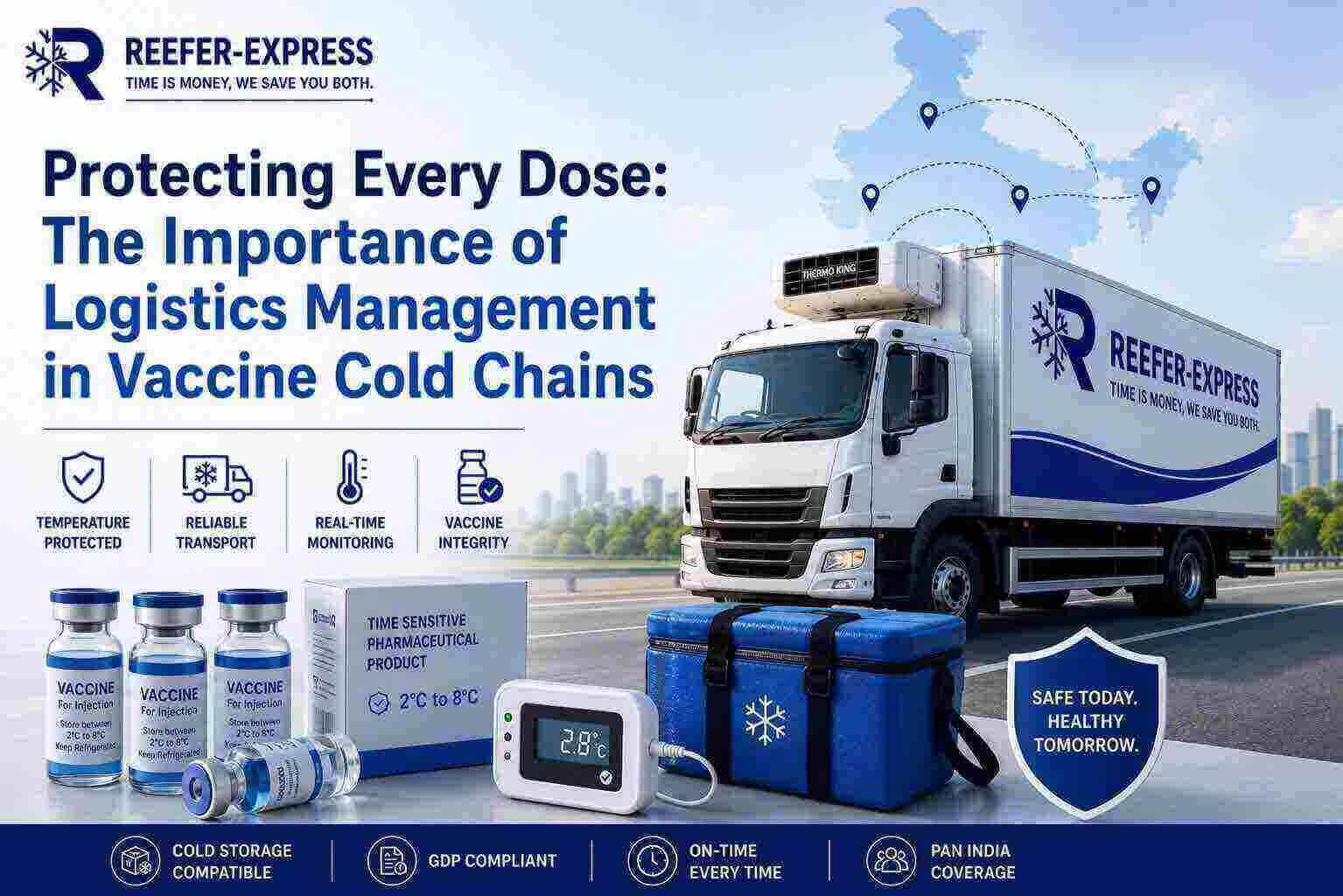
india is one of the world’s largest producers and consumers of vaccines. Every year, millions of vaccine doses travel across this country, through warehouses, refrigerated trucks, and health centres in remote corners of states like Rajasthan, Odisha, and the Northeast. And yet, a significant portion of these doses never reach patients in working condition. The reason is almost always the same: a break in the cold chain because of poor logistics management.
This blog explains why logistics management is not just an operational concern but a patient safety issue, what makes certain vaccines so vulnerable to heat, and what a proper cold chain logistics system actually looks like in practice.
What Is the Cold Chain and Why Does It Matter
The cold chain is the system that keeps temperature-sensitive products within a required temperature range from the point of manufacturing to the point of use. According to the World Health Organization (WHO), maintaining temperature integrity throughout transportation and storage is critical for vaccine effectiveness.
For vaccines, insulin, and biologics, even a short deviation from the required range can reduce effectiveness permanently. The damage from heat exposure is cumulative and irreversible. A vaccine that experiences multiple small temperature excursions across its journey loses potency each time, and there is no way to restore it.
You can learn more about global vaccine cold chain standards from the WHO: https://www.who.int
In India, where summer temperatures regularly cross 45 degrees C in cities like Nagpur, Jaipur, and Lucknow, and where road freight accounts for over 70% of pharma distribution, maintaining an unbroken cold chain is genuinely difficult. That difficulty is exactly why logistics management matters so much.
The Most Heat Sensitive Vaccine: Why OPV Is in a Category of Its Own
When discussing heat-sensitive vaccines, the conversation often starts with OPV. These products require specialized Pharmaceutical Cold Chain Transportation Services to ensure temperature integrity throughout transit.
Information about India’s immunisation programmes can also be found through the National Health Mission: https://nhm.gov.in
It is a live attenuated vaccine, meaning it contains a weakened but living form of the poliovirus. Live vaccines are inherently more fragile than inactivated or subunit vaccines because the virus itself can be destroyed by heat.
OPV must be stored between 2 and 8 degrees C, though it can also be stored frozen to extend shelf life. A Vaccine Vial Monitor (VVM) is attached to every OPV vial, which is a small chemical label that changes colour when the vaccine has been exposed to excessive heat over time.
WHO’s Vaccine Vial Monitor guidance remains one of the most trusted resources for understanding vaccine heat exposure tracking: https://www.who.int
Once the inner square of the VVM matches or darkens beyond the outer circle, the dose is no longer safe to use.
The consequences of using a heat-damaged OPV dose are serious. The child receives no protection, a vaccine-preventable disease remains possible, and because the damage is not visible to the naked eye, health workers may not even know the dose was compromised.
Heat Sensitive Vaccines List: At a Glance
| Vaccine | Type | Storage Temp | Heat Sensitivity |
| OPV (Oral Polio) | Live attenuated | 2 to 8 degree C (or frozen) | Highest |
| MMR | Live attenuated | 2 to 8 degree C | High |
| BCG | Live attenuated | 2 to 8 degree C | High |
| DPT | Inactivated | 2 to 8 degree C | Moderate |
| Hepatitis B | Subunit | 2 to 8 degree C | Moderate |
| Insulin | Biologic | 2 to 8 degree C | High |
All live attenuated vaccines, including OPV, MMR, and BCG, carry the highest risk from heat exposure because the biological material loses viability once the cold chain breaks.
Why Logistics Management Determines Cold Chain Outcomes
Good packaging alone does not protect a vaccine the importance of Cold Chain Transportation Services in India comes down to four things. A validated thermocol box with gel packs does its job only up to the point where it is packed correctly, loaded into the right vehicle, transported on a route that has been validated, and handed off through a documented process at every link.
The importance of logistics management in cold chain comes down to four things: planning the right route, maintaining the right equipment, monitoring conditions in real time, and responding correctly when something goes wrong.
In India specifically, poor logistics management shows up in predictable ways. Reefer trucks are not pre-cooled before loading. Cargo sits on a loading dock in direct sun while paperwork is processed. The last-mile delivery happens on a two-wheeler with no temperature monitoring at all.
None of these failures are accidents. They are the result of systems that were not designed with cold chain requirements in mind.
What Strong Logistics Management Looks Like in Practice
A logistics provider that takes cold chain seriously operates very differently from one that treats it as an add-on service.
Strong providers use continuous monitoring systems, validated routes, written SOPs, documented handoffs, and complete traceability throughout the supply chain.
For pharmaceutical transportation compliance in India, companies often refer to CDSCO guidelines available here: https://cdsco.gov.in
The Last-Mile Problem in India’s Vaccine Supply Chain
Most cold chain failures in India do not happen inside a warehouse or a reefer truck. They happen during handoffs and particularly during the final delivery stage.
This is not a rare edge case. It is the default experience in many parts of India’s pharma and vaccine distribution network.
A logistics provider that actually understands cold chain will have written protocols for last-mile handling. They will know the maximum time a product can be outside controlled temperature, they will have a process for that handoff, and they will monitor or document it.
The Cost of Getting Logistics Management Wrong
India’s pharma and cold chain industry loses thousands of crores every year due to temperature excursions and product spoilage.
Beyond the financial loss, the public health cost is harder to quantify. A child who receives a heat-damaged OPV dose is not protected against polio. A diabetic patient who uses insulin that was frozen and then thawed may experience unpredictable dosing.
UNICEF also provides extensive resources on vaccine storage and transportation best practices: https://www.unicef.org/india
The importance of logistics management in cold chain is not an abstract operational concern. It is the difference between a dose that works and a dose that does not.
What to Ask a Cold Chain Logistics Provider Before You Commit
Before signing with any logistics provider for pharma or vaccine distribution in India, ask:
Is route validation specific to my route?
Do you provide real-time monitoring?
What is your SOP for temperature excursions?
Do temperature logs come with every shipment?
How do you manage last-mile delivery?
Have you transported similar pharmaceutical products before?
A provider who answers all of these with documentation should be taken seriously.
Why Reefer Express Is Built for This
Reefer Express was designed specifically around pharma supply chain requirements in India.
The reefer fleet maintains temperature continuity across the full route, not just at loading and unloading points. Packaging is qualified for India’s climate zones, and documentation is built into every shipment.
Temperature logs, excursion records, and chain-of-custody documentation are delivered with the shipment, ensuring complete transparency and compliance.
The difference between a logistics company that offers cold chain as a service and a provider built around cold chain is that the second one has thought through the failure modes.
If you are shipping vaccines, biologics, or any temperature-sensitive pharmaceutical product in India, Reefer Express can help you maintain compliance, product integrity, and patient safety from origin to destination.
Comments5
Really impressed with the graphics and the overall feel of the site. It feels very premium and secure. You should visit ph311jilipark.
The affiliate program is actually transparent and rewarding. It's a great way to earn while sharing a platform that actually works r7betsafiliados
Solid platform with a very professional feel. I feel safe depositing my funds here. Check out br3366bet today.
Solid platform with a great selection of games. I had a big win last weekend and the withdrawal was processed almost instantly. bdck777bet
I love how stable the connection is. No lagging even during peak hours which is rare for these kinds of sites. aajililogin is my new go-to spot for gaming.