

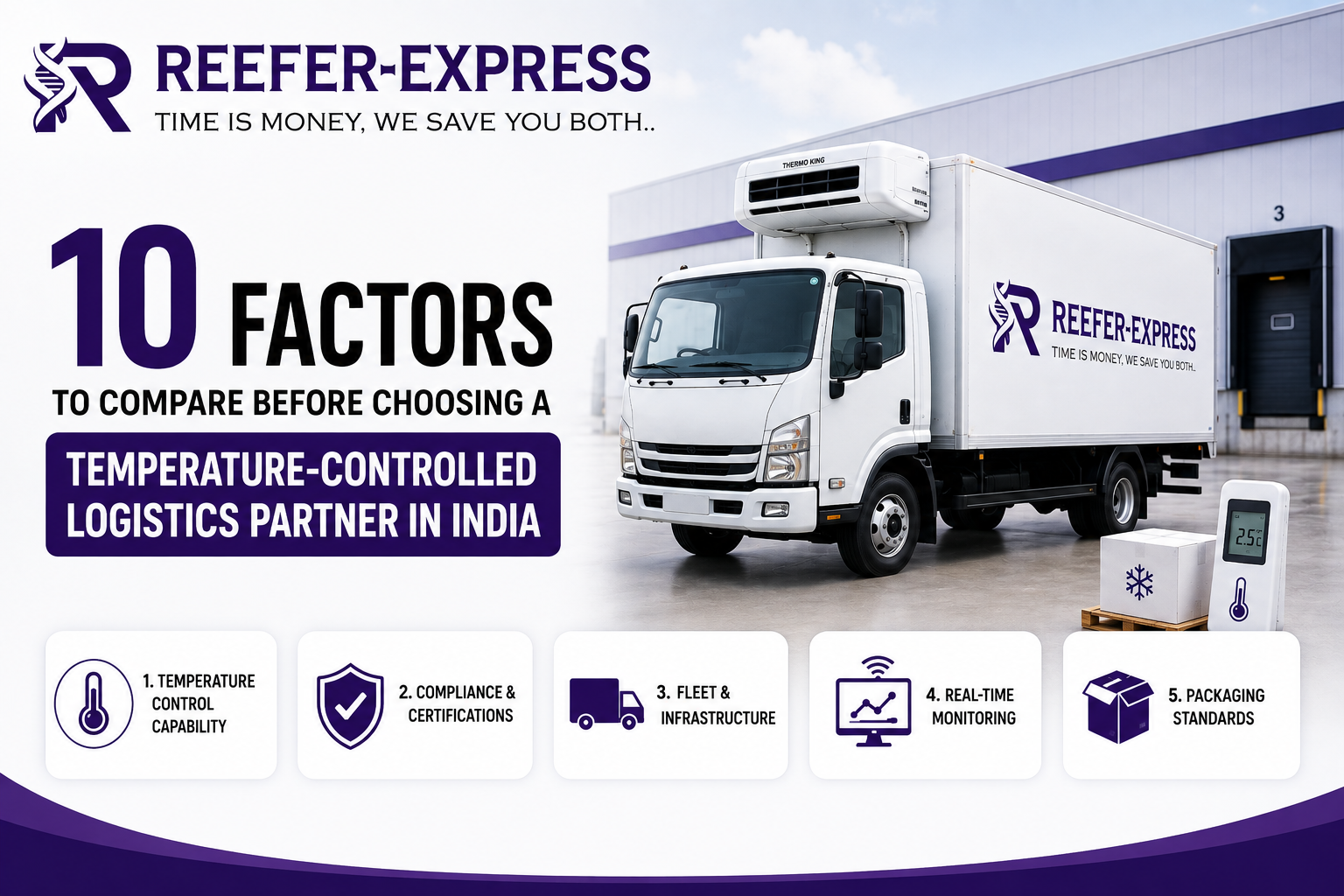
Businesses that ship pharmaceuticals, biologics, diagnostics, or other temperature-sensitive products know that even a small deviation in temperature can compromise product safety, efficacy, and compliance. That makes selecting the right temperature controlled logistics partner a decision with real consequences, not just another vendor comparison.
India adds its own layer of complexity. Climate variation across zones, long transit distances, and a last-mile network that is hard to monitor all increase the risk of a shipment failing somewhere between pickup and delivery. A route that performs well in December can behave very differently in May, and a provider who has not accounted for that difference is passing the risk on to you without telling you. Below are ten factors worth comparing in detail before you commit to a provider, along with the questions each one should prompt you to ask.
1. Proven Expertise in Pharma Cold Chain Logistics
Not every logistics provider is built to handle temperature-sensitive pharmaceutical cargo. A lot of companies that advertise cold chain services are general freight operators who added a reefer truck or two to their fleet without building the operational discipline that pharma shipments require. Real expertise shows up in specifics, not in marketing language.
Ask a potential partner how many years they have specifically handled pharmaceutical or life sciences cargo, as opposed to food or general perishables. Ask which product categories they have shipped before, whether that includes vaccines, biologics, clinical trial materials, or diagnostic reagents, and whether they can share relevant case data or references from that experience. A provider with genuine expertise will answer these questions with specifics rather than general reassurance. They will also be comfortable discussing the differences in handling requirements between, say, a temperature-stable generic drug and a cold-chain biologic, because that distinction matters operationally, not just on paper.
Experience also shows up in how a provider talks about failure. A team that has actually managed a temperature excursion will describe the process calmly and specifically. A team that has not thought seriously about failure scenarios will either dismiss the question or give you a vague answer about best practices.
2. Range of Temperature Zones Supported
Different products need different temperature ranges, and a provider who only supports one range is not equipped to handle a diverse product portfolio. Vaccines and biologics often require a tight 2 to 8°C range. Some diagnostics and over-the-counter products need a controlled ambient range between 15 and 25°C. Certain products, including some vaccines and specialty biologics, need deep frozen conditions well below zero.
Your partner should support the full range your product portfolio needs, ideally spanning from around -25°C up to +30°C, rather than offering one fixed setup and expecting every product to fit into it. This matters even if you currently ship only one product category, because business needs change, and a provider who cannot scale with your temperature range requirements will become a bottleneck later.
It is also worth asking how a provider manages multiple temperature zones within a single shipment or a single vehicle. Some cold chain operations use multi-compartment vehicles capable of maintaining different zones simultaneously, which is useful if you consolidate shipments across product categories. Others simply run separate vehicles for each range, which can affect cost and scheduling flexibility. Neither approach is inherently wrong, but you should know which one you are getting and whether it fits how you actually ship.
3. Infrastructure and Temperature Controlled Container Quality
Reliable cold storage facilities, GPS-enabled reefer vehicles, and the right temperature controlled container for each product category form the foundation of a working cold chain. This is also where a lot of providers cut corners, because good infrastructure is expensive to build and maintain, and it is easy to describe infrastructure that looks good on paper without it actually performing under real conditions.
Ask how packaging is qualified for your specific product and route. A generic validation certificate from a controlled lab environment tells you very little about how a temperature controlled container performs on a Chennai to Bengaluru route in peak summer versus a Delhi to Jaipur route in winter. Providers who take infrastructure seriously will have validation data segmented by route, season, and ambient temperature band, and they should be willing to walk you through it rather than just handing over a document.
It is also worth understanding the physical condition of the fleet itself. Reefer vehicles that are not properly maintained lose cooling efficiency over time, and a vehicle that technically has refrigeration capability is not the same as one that reliably holds a set range for the full duration of a long-haul trip. Ask about maintenance schedules, backup power for extended transit, and how often equipment is calibrated and tested. Weak infrastructure is where most temperature excursions start, often well before a shipment ever reaches the more visible parts of the journey like last-mile delivery.
4. Real-Time Temperature and Location Visibility
Location tracking alone does not tell you whether a shipment has stayed within its required range. A truck can be exactly where it is supposed to be on the map while the cargo inside has already drifted outside its safe temperature window. This is one of the most common gaps between what looks like a modern cold chain service and what actually functions as one.
A dependable partner should provide real-time temperature data alongside GPS tracking, delivered in a format you can act on immediately rather than a report you have to request after delivery. Ask specifically how this data reaches you. Is it a live dashboard you can check at any point during transit, or a passive data logger that only gets read once the shipment arrives? The difference matters enormously if something starts to go wrong mid-route, because a live system gives you the chance to intervene, reroute, or prepare for a release decision before the product even reaches you.
This visibility is also what lets you make a fast, confident release decision when the shipment arrives. If you can see a continuous temperature record showing the product stayed within range the entire journey, your quality team can clear it quickly. If you have to wait for a data logger to be manually downloaded and reviewed, you are adding delay to every single shipment, which compounds over time if you are moving high volumes.
5. Compliance with Regulatory Standards
Cold chain logistics for pharmaceuticals operates under strict regulatory oversight, and this is not an area where you want a partner who treats compliance as optional paperwork. In India, this includes requirements set by the Central Drugs Standard Control Organisation, which enforces the Drugs and Cosmetics Act and expects distribution partners to maintain records that hold up under audit. Globally, most serious providers also align their handling procedures with the World Health Organization’s guidance on good storage and distribution practices for medical products, which covers everything from environmental mapping in storage facilities to how deviations should be investigated and documented.
Confirm that your partner’s documentation and handling procedures actually meet these standards rather than simply referencing them. Ask to see a sample of the documentation they provide with a typical shipment, including temperature logs, chain of custody records, and any excursion reports. If a provider struggles to produce sample documentation on request, that is a signal their compliance posture may be weaker than their sales materials suggest.
It is worth remembering that regulatory gaps become your liability, not just theirs. If a shipment reaches its destination with incomplete documentation and that shipment is later questioned during an audit or investigation, your business is the one answering for it, regardless of whose vehicle carried the product.
6. End-to-End Cold Chain Coverage, Including Last-Mile
A strong partner should manage the full journey, from pickup and storage through transit and final delivery, rather than handing off responsibility partway through the route. Fragmented handling increases risk at every transfer point and makes it much harder to hold anyone accountable when something goes wrong, because each party in the chain can point to the others.
This is particularly important for the last-mile leg, which is where most cold chain failures in India actually happen. A shipment can travel for hours in a fully compliant, well-monitored reefer vehicle and still be compromised if it then sits outside controlled conditions for even 30 to 40 minutes while a delivery agent completes other stops before reaching your location. Ask specifically how last-mile delivery is managed. What is the maximum allowable time a product can spend outside a controlled environment during the final leg? Is that time actually tracked, or is it simply assumed to be within limits because the overall delivery arrived on schedule?
Providers who have genuinely solved this problem will have specific protocols for the handoff between the vehicle and the recipient, not a general assurance that delivery is handled carefully. This is also an area worth probing during reference checks, since customers who have shipped with a provider for a while will usually know whether last-mile issues have come up in practice.
7. Documented SOPs and a Temperature Excursion Protocol
Standard operating procedures for loading, unloading, and in-transit handling reduce the chances of a costly mistake, and they matter more than they might seem, because a lot of temperature failures come down to small handling errors rather than equipment failure. A door left open too long during loading, a container left on a loading dock in direct sun for a few extra minutes, or a mismatch between product and packaging can all trigger a deviation that shows up much later.
Just as important as day-to-day SOPs is a written protocol for what happens if a temperature excursion actually occurs. This protocol should clearly define who gets notified and how quickly, what the decision tree looks like for quarantining or disposing of affected product, and how the incident gets documented for your quality team. A provider without a clear, specific answer to what happens if a shipment breaches its range has not actually thought this through, no matter how confident they sound about the rest of their operation.
It is reasonable to ask for a copy of this protocol before you sign a contract. A provider who is comfortable sharing it, and who can walk you through a real example of how it has been applied, is demonstrating a level of operational maturity that is hard to fake.
8. Scalability and Network Coverage Across India
As your shipment volumes grow or you expand into new markets, your logistics partner needs to scale with you without a drop in service quality. Look for a provider with genuine network coverage across the regions you currently operate in and the regions you expect to enter, rather than a provider who covers your current routes well but has limited reach elsewhere.
It is worth asking directly how a provider handles a region outside their core network. Do they subcontract to a third-party carrier for those routes, and if so, does that carrier meet the same temperature control and documentation standards? A cold chain is only as strong as its weakest link, and an otherwise excellent provider can still fail you if they quietly hand off part of a shipment’s journey to a partner who does not maintain the same standards.
Scalability also matters for seasonal demand. If your shipment volumes spike around certain times of year, whether due to vaccination drives, clinical trial enrollment periods, or seasonal product launches, your partner needs the operational capacity to absorb that increase without compromising temperature control or delivery timelines.
9. Risk Management and Contingency Planning
Traffic delays, monsoon disruptions, road closures, and equipment issues are a normal part of moving goods across India, and no provider can eliminate these risks entirely. What separates a dependable partner is how well they plan for these disruptions rather than simply hoping they do not happen.
Ask what contingency measures are in place for a vehicle breakdown mid-route. Is there a backup vehicle that can be dispatched, and how quickly? Ask how the provider handles a major delay caused by weather or road conditions, particularly during monsoon season when parts of the country can become difficult to navigate for extended periods. A provider with mature risk management will have clear escalation steps and will proactively communicate with you when a disruption is likely to affect a shipment, rather than waiting for you to notice a delay and ask what happened.
This is also where insurance and liability terms become relevant. Understand what happens contractually if a shipment is compromised due to a disruption that was outside the provider’s direct control, and make sure that arrangement is documented clearly before you need to rely on it.
10. Track Record and Customer Support
A partner’s performance history and the responsiveness of their support team tell you a great deal about how they will handle a problem when one actually comes up, and this is often where the gap between marketing claims and operational reality becomes most visible. Ask for references from customers who ship similar products on similar routes, and ask those references directly about their experience during a disruption, not just during normal operations, since any provider looks good when nothing goes wrong.
For temperature-sensitive shipments, slow communication during an issue can be almost as costly as the issue itself. A delayed response to a temperature alert, or a support team that is difficult to reach outside standard business hours, turns a manageable deviation into a bigger problem simply because of lost time. Evaluate how quickly a provider responds to inquiries during your initial conversations, since this is a reasonable preview of how they will behave once you are a customer and something urgent comes up.
It is also worth asking whether you will have a dedicated point of contact for your account or whether you will be routed through a general support queue each time. For high-value or high-volume shipments, a dedicated contact who already understands your product requirements and shipping history can significantly reduce response time during an actual incident.
Final Thoughts
Choosing the right temperature controlled logistics partner protects your product, your compliance standing, and the trust of whoever is waiting on that delivery. Comparing providers on these ten factors gives you a much clearer picture than comparing price alone, and it surfaces the operational gaps that only tend to show up once a shipment is already in transit and it is too late to change course.
None of these factors exist in isolation. A provider with excellent infrastructure but no documented excursion protocol is still a risk. A provider with strong compliance credentials but weak last-mile handling still leaves a gap in the chain. The strongest partners perform well across all ten areas, and the questions above are designed to help you find out which category a provider actually falls into before you commit to working with them.
Frequently Asked Questions
What is the most important factor when choosing a temperature-controlled logistics partner?
There is no single factor that matters most on its own, but real-time temperature visibility combined with a documented excursion protocol tends to matter more than the rest, because together they determine whether a problem gets caught and managed before it becomes a total loss. Infrastructure and compliance set the baseline, but visibility and response are what protect a shipment when something actually goes wrong mid-route.
How do I verify a provider’s temperature controlled logistics claims before signing a contract?
Ask for route-specific validation data, sample shipment documentation including temperature logs and chain of custody records, and references from customers shipping similar products on similar routes. A provider confident in their operations will share these without hesitation, while vague or delayed responses to these requests are usually a sign the claims are stronger than the actual practice.
Why does last-mile delivery cause more cold chain failures than long-haul transport in India?
Long-haul transport is usually handled by dedicated reefer vehicles with active monitoring, while last-mile delivery often depends on smaller vehicles or two-wheelers where a product can sit outside controlled conditions during a handoff or multi-stop route. This gap is frequently unmonitored, which is why a shipment can pass through hours of compliant transit and still fail in the final 30 to 40 minutes before it reaches the recipient.
What temperature range should a cold chain logistics partner in India support?
Most pharmaceutical and healthcare shipments in India require a range spanning from around -25°C for frozen products up to +30°C for controlled ambient products, covering vaccines, biologics, diagnostics, and temperature-stable pharmaceuticals. The exact range depends on your specific product portfolio, so confirm a provider’s actual supported range rather than assuming it matches your requirement.
What should be included in a temperature excursion protocol?
A complete excursion protocol should specify who gets notified when a deviation occurs, how quickly that notification happens, the decision criteria for quarantining or disposing of the affected product, and how the incident is documented for audit and quality purposes. Ask any potential partner to walk you through this protocol with a real example before you sign a contract.
Strengthen Your Cold Chain with Reefer Express
Reefer Express is built specifically around pharma cold chain requirements in India, not adapted from a general freight model with a reefer truck added on. The temperature controlled logistics fleet operates across a range of -25°C to +30°C, with GPS-enabled tracking and temperature monitoring built into every vehicle rather than added as an afterthought. Cold chain logistics solutions are qualified against India’s actual climate zones, so validation data reflects real road conditions rather than a single test chamber reading, and documentation, including temperature logs, chain of custody records, and excursion reports, comes with every shipment as standard practice.
On last-mile delivery, where most competitors’ coverage quietly stops, Reefer Express has specific protocols to maintain product integrity through the final leg of the journey. If you are comparing partners for your pharmaceutical or healthcare cold chain and want to see how Reefer Express performs against the factors above, get in touch with Reefer Express for a route-specific assessment.
On last-mile delivery, where most competitors’ coverage quietly stops, Reefer Express has specific protocols to maintain product integrity through the final leg of the journey. If you are comparing partners for your pharmaceutical or healthcare cold chain and want to see how Reefer Express performs against the factors above, get in touch with Reefer Express for a route-specific assessment.