



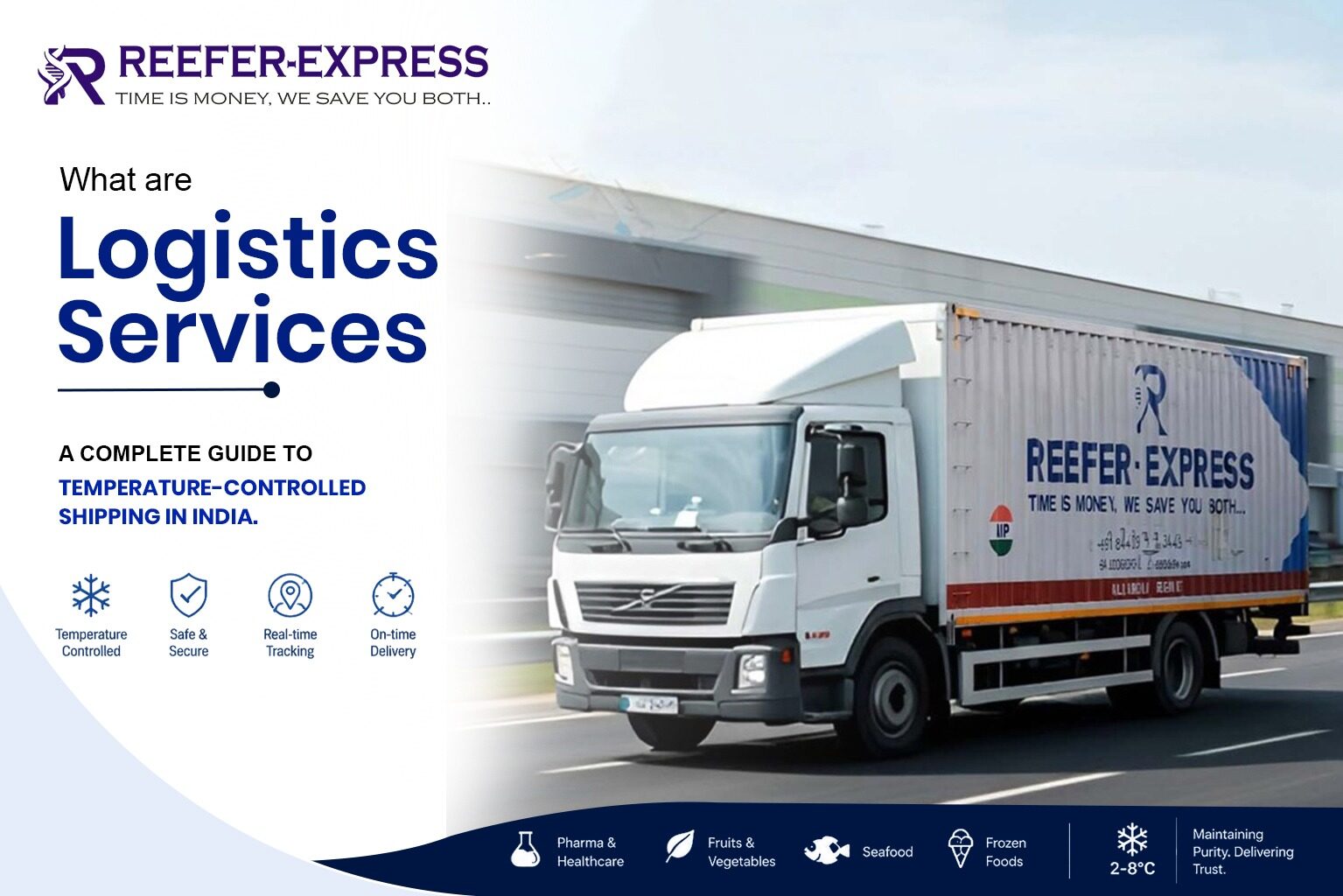
If you’ve started looking into logistics services for your business, chances are you’re past the theoretical stage. You’re trying to move product maybe pharmaceutical goods, biologics, vaccines, or food and you need a provider who can actually deliver, literally and figuratively. This guide cuts through the noise and focuses on what logistics services mean in practice, specifically when temperature matters and when failure is not an option.
India’s supply chain landscape is complex. Growth in infrastructure hasn’t always kept pace with standards. And when you layer in temperature-controlled requirements cold chain logistics companies in India are still catching up to the sophistication that pharma and food exporters need. So let’s go through what logistics services actually cover, and then focus on the piece most businesses get wrong: temperature controlled logistics.
What Logistics Services Actually Cover
At its core, logistics services refers to the end-to-end management of goods movement from the point of origin to the final destination. That includes warehousing, transportation, inventory management, order fulfillment, customs clearance, packaging, and last-mile delivery. A good logistics provider doesn’t just move boxes. They manage the entire chain so that the product arrives on time, intact, and in compliance with any applicable standards.
For most businesses, the definition of logistics services stops there. But for industries dealing with perishables, pharmaceuticals, vaccines, or chemicals, the definition extends further. These businesses need temperature controlled logistics a specialized subset where maintaining a defined temperature range isn’t a preference, it’s a compliance requirement. A broken cold chain doesn’t just mean spoiled product. It means regulatory exposure, batch write-offs, and liability.
According to the Indian Pharmaceutical Alliance, India’s pharma industry is among the world’s largest by volume. The demand for robust, validated cold chain logistics is growing fast and the gap between what’s needed and what’s available on the ground remains a serious operational risk.
The Core Components of Logistics Services
Any serious logistics provider will cover the following functions, though the depth and quality vary significantly.
Transportation
Transportation is the spine of logistics services. It involves moving goods between origin, warehouses, distribution centers, and final delivery points. For temperature-sensitive shipments, transportation must include reefer vehicles refrigerated trucks and containers that maintain a defined climate throughout the journey. A temperature controlled container isn’t just a cold truck; it’s a controlled environment that needs to be validated for performance against the ambient conditions of the route.
Warehousing and Storage
Warehousing covers storage at one or more points in the supply chain. For cold chain logistics, this means cold rooms, walk-in freezers, and temperature-monitored storage bays. The critical factor is continuity temperature should be controlled from the moment the product enters storage to the moment it leaves. Any gap in monitoring creates a compliance risk.
Inventory Management
Inventory management ensures that the right product is available at the right time without over-stocking or under-stocking. For pharma shipments, this is linked directly to batch management, expiry tracking, and FEFO (first expired, first out) protocols. A logistics provider without granular inventory visibility introduces risk at the warehouse level before the product even hits the road.
Order Fulfillment
Order fulfillment covers pick, pack, and dispatch. For temperature-sensitive goods, the pack stage is where packaging quality becomes a logistics decision, not just a procurement one. Using a thermocol box and a generic gel pack for a validated pharmaceutical shipment isn’t fulfillment it’s a liability.
Last-Mile Delivery
Last-mile delivery is where most cold chain failures happen in India. The reefer vehicle completes the main route. The shipment transfers to a delivery agent. And then for 30 to 60 minutes it’s in a vehicle that was never designed for temperature control, potentially sitting in 40°C heat. This is the structural problem that separates a logistics company offering cold chain as an add-on from one that has built cold chain logistics around last-mile reality.
Temperature Controlled Logistics What It Actually Requires
Temperature controlled logistics is not a product category. It’s a capability that either exists end-to-end or has gaps. Here’s what it requires in practice, especially for the Indian market.
Route-Specific Validation
A packaging solution that passed a test in a controlled lab at 25°C tells you nothing about how it performs on a Hyderabad-to-Bengaluru route in June. India’s climate zones vary enough that route-specific qualification is non-negotiable. Any provider who hands you a generic validation certificate is signalling a gap worth taking seriously.
The WHO guidelines on cold chain management are explicit: validation must reflect the ambient conditions the product will actually face. That standard should be the baseline for any logistics services provider in India operating in the pharmaceutical or food segments.
Real-Time Temperature and Location Monitoring
Real-time tracking needs to mean both GPS location and temperature data together, not one or the other. Knowing where a shipment is without knowing whether it’s been breached doesn’t help you make a release decision at the receiving end. The data needs to be accessible in real time not as a post-delivery report that arrives after the product is already in use.
A Written Excursion Protocol
Ask any potential cold chain logistics provider what happens when a temperature excursion occurs mid-transit. If they don’t have a documented answer who gets notified, what the decision tree looks like, how the product is quarantined or flagged that’s a serious operational gap. An excursion protocol is evidence that the provider has thought through failure modes. Absence of one is evidence they haven’t.
Packaging Matched to the Product
EPS foam, vacuum-insulated panels, and PCM-based systems are not interchangeable. Each performs differently across temperature ranges and hold times. A logistics provider offering one packaging solution for 2°C to 8°C vaccines, 15°C to 25°C diagnostics, and frozen biologics is either cutting corners or hasn’t invested in the infrastructure to differentiate. The packaging should be chosen based on what the product needs not what the provider has available.
Cold Chain Logistics Companies in India — What the Market Actually Looks Like
The Indian cold chain market has expanded significantly over the past decade, but the gap between infrastructure growth and quality standards is real. Many providers in this space are general logistics companies that have added cold chain as a service line. That means their core infrastructure reefer fleet, monitoring systems, excursion protocols was built as an afterthought rather than as a design principle.
According to IMARC Group’s India Cold Chain Market Report, the Indian cold chain logistics market is growing at a strong clip, driven largely by pharmaceutical export volumes and organised food retail. But growth in the market doesn’t automatically translate into growth in standards.
The distinction that matters when evaluating cold chain logistics companies in India is whether cold chain is their primary design or their secondary capability. A provider built around pharma supply chain has thought through the failure modes route variation, last-mile gaps, documentation trails, regulatory compliance. A provider that added cold chain to an existing general freight business has thought through the product line extension. The operational outcomes of those two approaches are very different.
The Reefer Express cold chain logistics overview gives a sense of what a purpose-built provider looks like in practice — pharma-specific documentation, route-qualified packaging, and last-mile protocols that extend coverage through the delivery leg, not just the trunk route.
How to Evaluate a Logistics Services Provider for Cold Chain
Before signing with any provider, run through these questions in a direct conversation not over email where answers can be vague.
Can they show validation data specific to your route and your product’s temperature range? This is non-negotiable. A generic certificate covers no one.
What is their written SOP for a temperature excursion during transit? Ask for the document. If there isn’t one, that’s your answer.
Do temperature logs come with every shipment automatically, or only on request? The answer tells you how their documentation culture actually works.
How do they handle last-mile delivery for temperature-sensitive products? What’s the maximum allowable time between the reefer vehicle and the final handoff? Is it monitored?
Have they shipped your product category before? Can they share relevant case data or route performance records?
A provider who can answer all of these clearly with documentation is one worth taking seriously. Vague answers tell you exactly where the gaps are before you commit.
Why Reefer Express for Temperature Controlled Logistics in India
Reefer Express was built around pharmaceutical supply chain requirements in India not adapted from a general freight model. That distinction drives everything from how the reefer fleet is operated to how documentation is structured at the shipment level.
The fleet maintains temperature continuity throughout the route, not just at pickup and delivery. Packaging is qualified for India’s actual climate zones meaning the validation reflects the ambient conditions on the road, not in a test chamber. Documentation temperature logs, excursion reports, chain of custody records is built into every shipment.
On last-mile, Reefer Express has specific handling protocols designed to maintain cold chain integrity through the final leg, which is where most competitors’ coverage ends. If your pharmaceutical or food product needs to arrive compliant, the last mile is the deciding variable.
The difference between a logistics company that offers cold chain and a provider built around cold chain is that the second one has mapped the failure modes. If your product integrity, batch release decisions, or regulatory standing depends on what happens in transit, that difference matters.
Frequently Asked Questions
What is the difference between logistics services and cold chain logistics?
Logistics services is the broad category covering all aspects of goods movement transportation, warehousing, fulfillment, and delivery. Cold chain logistics is a specialized subset where temperature control is maintained throughout every stage. Cold chain adds validation requirements, monitoring systems, excursion protocols, and specialized packaging that general logistics services don’t require.
What does a temperature controlled container do?
A temperature controlled container maintains a defined temperature range for the product inside, regardless of the ambient temperature outside. For pharmaceutical shipments in India, this might mean keeping cargo between 2°C and 8°C while the vehicle travels through 42°C summer heat. The container must be validated for performance across the specific temperature profile of the intended route.
How do I know if a cold chain logistics company in India is actually qualified?
Ask for route-specific validation data, a written temperature excursion SOP, and documentation showing how their last-mile handling works. A qualified provider will have all three readily available. A provider who cannot produce documentation on any of these has gaps that should disqualify them for pharmaceutical or regulated food shipments.
What temperature ranges do cold chain logistics providers in India typically cover?
Most pharmaceutical cold chain requirements fall into three categories: frozen (below -15°C), refrigerated (2°C to 8°C), and controlled room temperature (15°C to 25°C). A capable provider should have validated solutions for all three, with packaging selected based on the specific product need not a one-size-fits-all approach.
Why does last-mile delivery matter so much in cold chain logistics?
Most cold chain failures in India occur at the last mile not in the warehouse or on the main trunk route. The reefer vehicle completes its route. The product transfers to a local delivery agent. And then it may sit in an uncontrolled environment for 30 to 60 minutes during the final delivery. A cold chain provider who hasn’t built protocols for that stage has covered the easy part of the chain and left the hardest part unaddressed.
Is Reefer Express suitable for small volume pharmaceutical shipments?
Yes. Reefer Express handles pharmaceutical shipments across volume ranges, with the same documentation and temperature monitoring standards regardless of shipment size. The compliance requirements don’t change based on volume and neither should the logistics standards.
Looking for temperature controlled logistics built for pharma compliance in India? Contact Reefer Express for a route-specific assessment.
Comments9
The VIP treatment here is the real deal. The exclusive offers are great and the overall experience is very premium. I am staying with 50jilivip
I've tried a few apps lately but this one is definitely the smoothest. The interface is so clean and it's super easy to navigate. Highly recommend 365phapp for anyone looking for a reliable platform!
Finally found a site that actually pays out on time. The winning experience here is top notch and the games are super exciting. pk7888win
Looking for some good odds and reliable service? bet9jashop is where I've landed. Seems like a solid spot to place your bets. Hope I pick the right ones, haha! Check out bet9jashop
Really impressed with the payout speed. No long waits or confusing steps, just straightforward service. Cheers to br777gg for the great experience.
The game variety is just insane and the interface is super easy to navigate. Really enjoying the vibes here. Highly recommend phjilico to everyone!
Finally a login process that doesn't glitch out. Everything is secure and the game library is massive. Loving ssg777login so far.
Really impressed with the VIP treatment here. Everything feels premium and the customer support team is super responsive. Keep up the good work guys. c168avip
Really appreciate the easy registration process. I was able to get started in just a couple of minutes. Highly recommend xx88kjc