



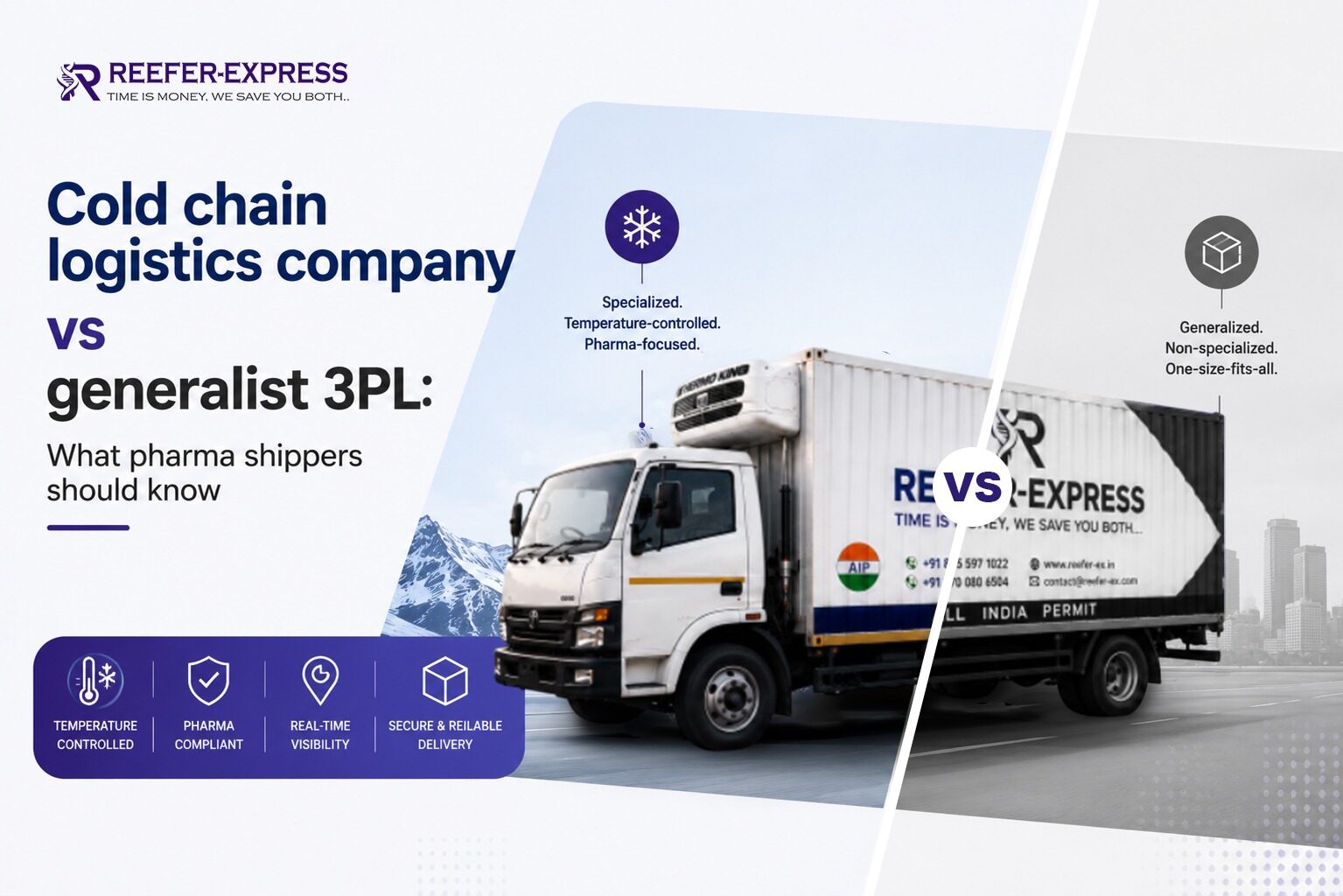
If you’re evaluating a cold chain logistics company against a generalist 3PL for your pharma shipments, you’re at the point where the decision has real consequences. This isn’t a theoretical comparison. It’s the choice that determines whether your biologics arrive within a validated temperature range or become a write-off, and whether you have the documentation to defend a batch release decision if a regulator asks for it.
Most pharma companies don’t start out looking for a specialist. They start with a logistics provider they already use for general freight, because it’s simpler to add a service line than to onboard a new vendor. That decision looks efficient on a quote sheet. It rarely holds up once a shipment actually breaches temperature range in transit and nobody can produce a clean record of what happened.
This blog breaks down what actually separates a cold chain logistics company from a generalist 3PL offering cold chain as an add-on, where the difference shows up in a real shipment, and what questions will expose the gap before you sign a contract.
What a Generalist 3PL Actually Offers Pharma Shippers
A generalist third-party logistics provider, or 3PL, is a company that manages transportation, warehousing, and distribution on behalf of a shipper, without owning the freight itself. The Council of Supply Chain Management Professionals defines a 3PL as a firm that provides multiple integrated logistics services for its customers, covering everything from parts movement between suppliers and manufacturers to finished goods distribution.
That definition covers a wide range of operators, and most of them built their business on dry freight, FMCG, or e-commerce fulfillment. Cold chain, when it exists at all inside a generalist 3PL, is usually a bolt-on: a few reefer trucks added to an existing fleet, a cold room carved out of a general warehouse, or a partnership with a refrigerated carrier they subcontract to when a client asks for it.
None of that is automatically disqualifying. A generalist 3PL can move a temperature-sensitive shipment from point A to point B without incident, especially for lower-risk products with wide temperature tolerances. The problem is what happens when something goes wrong, or when a regulator wants proof that nothing did. Generalist 3PLs are built around throughput and cost efficiency across many product categories. Pharma compliance, batch-level documentation, and route-specific validation are not the core competency, and it shows in the depth of what they can actually produce when you ask for it.
Some generalist 3PLs try to close this gap by partnering with a specialist carrier for the cold chain leg and managing the rest of the relationship themselves. On paper this looks like the best of both worlds. In practice, it adds a layer of coordination risk. Your shipment now depends on a handoff between two organizations with different systems, different accountability structures, and different priorities, and the documentation trail often breaks exactly at that seam. When something goes wrong, you end up with two parties pointing at each other instead of one provider who can walk you through the full chain of custody.
What Makes a Cold Chain Logistics Company Different
A cold chain logistics company is built around temperature-sensitive product from the ground up. The fleet, the warehousing, the monitoring systems, and the documentation processes exist because the entire business model depends on getting cold chain right, not because it’s one more service on a longer list.
This shows up in specific, checkable ways, similar to the operational standards behind certifications like IATA’s CEIV Pharma program, which independently validates that a provider’s temperature control, quality management, and handling processes meet pharma-grade standards rather than general freight standards. A specialist cold chain provider validates packaging and routes against the actual temperature profile of the shipment, not a generic ambient assumption.
It builds temperature and location monitoring into the shipment itself rather than treating tracking as a warehouse-only feature. It maintains a documented excursion protocol that specifies who gets notified, how the product is quarantined, and what the decision tree looks like when a deviation happens. And it treats the last mile, the point where most cold chain failures actually occur, as part of the core service rather than an unaddressed handoff.
Reefer Express operates as this kind of specialist. Our cold chain logistics solutions and pharma supply chain solutions are built specifically around pharmaceutical and healthcare shipments, not adapted from a general freight model after the fact.
Where the Difference Shows Up During an Actual Shipment
The gap between a specialist and a generalist rarely shows up on a sales call. Both will tell you they handle cold chain. It shows up once a shipment is actually moving.
Temperature Continuity Across the Full Route
A generalist 3PL can usually maintain temperature control between two fixed points, pickup and delivery, using a reefer vehicle. What frequently breaks down is continuity across transfers: cross-docking, vehicle changes, and warehouse handoffs where the product sits outside active temperature control for a window that never gets documented. A cold chain logistics company builds continuity into every leg of the route, including the transfer points, because that’s where excursions actually happen.
The Documentation Trail
When packaging fails and product is compromised, the difference between a specialist and a generalist is usually visible in what happens next. A generalist 3PL often has no clean documentation trail: no temperature log tied to the specific shipment, no route validation record, no excursion report. A specialist provider builds temperature logs, chain of custody records, and excursion reports into every shipment by default, not as something you have to request after a problem surfaces. This is the difference between having evidence for a batch release decision and having a conversation about who’s liable, and it mirrors the record-keeping standard the FDA’s current good manufacturing practice regulations expect from anyone handling finished pharmaceuticals, even outside US jurisdiction.
Last-Mile Handling
Most cold chain failures in India don’t happen at the warehouse or on the highway. They happen at the handoff, when a compliant reefer vehicle completes delivery and the product sits with a delivery agent for the final stretch, sometimes in direct sunlight, sometimes for far longer than the packaging was validated for. Generalist 3PLs have largely solved the middle leg of the journey and left the first and last mile unaddressed. A cold chain logistics company treats last-mile handling as a defined, monitored part of the service, not a gap between two better-managed segments.
Comparison at a Glance
| Factor | Generalist 3PL | Cold Chain Logistics Company |
| Fleet design | General freight fleet with some reefer capacity added | Purpose-built reefer fleet for temperature-sensitive product |
| Route validation | Generic or unavailable | Route-specific, tied to actual ambient conditions |
| Monitoring | GPS location only, temperature tracked separately if at all | Combined temperature and location visibility per shipment |
| Documentation | Available on request, often incomplete | Built into every shipment by default |
| Excursion protocol | Informal or nonexistent | Documented decision tree with defined ownership |
| Last-mile handling | Treated as a standard delivery | Monitored, time-bound, built into the process |
| Regulatory familiarity | Limited pharma-specific compliance knowledge | Structured around GDP, CDSCO, and batch release requirements |
Cost Isn’t the Right First Filter
It’s tempting to shortlist providers by rate card, especially when a generalist 3PL can often quote a lower price for the same lane. That comparison misses what you’re actually buying. A cheaper shipment that arrives outside its validated temperature window isn’t cheaper. It’s a lost batch, a regulatory question, and in some cases a supply gap for patients who depend on the product.
The World Health Organization’s guidelines on good distribution practices for pharmaceutical products make the underlying principle clear: every party in the distribution chain is responsible for maintaining product quality according to good storage and distribution practice, not just the manufacturer. That responsibility doesn’t disappear because a logistics provider quoted a lower number. If your provider can’t produce validation data or documentation, the liability for a failure still traces back to your decision to use them.
Price matters, but it belongs later in the evaluation, after you’ve confirmed the provider can actually do what a cold chain shipment requires. Reefer Express’s packaging and distribution services are built around this order of priorities: validated performance first, competitive pricing on top of that, not instead of it.
There’s also a liability dimension that rarely shows up on a quote comparison. If a shipment fails and the provider can’t produce validation data or a clear excursion record, the burden of proof often falls back on the shipper during a regulatory inquiry or an insurance claim. A lower freight rate that leaves you exposed during that kind of review isn’t actually the cheaper option once you account for what a failed audit or a rejected batch costs. Providers who invest in documentation and route validation are pricing that risk reduction into their rate, and it’s worth treating that as part of the value rather than an add-on cost.
Questions to Ask Before You Sign With Either Type of Provider
Before committing to any provider, generalist or specialist, ask for validation data specific to your product’s temperature range and your actual route, not a generic test certificate. Ask what their written standard operating procedure is for a temperature excursion during transit, and who is notified when one happens. Ask whether temperature logs come with every shipment automatically or only when requested after the fact. Ask specifically how they handle the last leg of delivery, including the maximum time a product can sit outside active temperature control and whether that window is actually monitored. And ask whether they’ve shipped your specific product category before, with case data to back it up.
A provider who answers all of these clearly and can produce documentation to support the answers is one worth taking seriously. Vague answers, or a provider who needs to check with someone else before responding, tell you where the gaps are before you’ve committed to anything.
Why Pharma Shippers in India Are Moving Toward Specialist Providers
India’s pharma supply chain has gotten more complex, not less, over the past several years. Regulatory oversight from the Central Drugs Standard Control Organisation continues to tighten, climate variation across the country’s shipping zones makes generic validation increasingly unreliable, and the growth of biologics and cell and gene therapies has raised the stakes for what a temperature excursion actually costs.
Generalist 3PLs built their infrastructure and their internal processes around a different problem: moving high volumes of varied freight efficiently. That’s a legitimate business model, but it isn’t built to answer the specific questions a pharma compliance team needs answered. As more shippers get burned by gaps in documentation or last-mile handling, the shift toward specialist cold chain providers has become less of a preference and more of a risk-management decision. Our guide on choosing a pharmaceutical cold chain logistics partner covers this shift in more detail, including how to evaluate a provider’s actual track record rather than their marketing claims.
Why Reefer Express
Reefer Express was built around pharma supply chain requirements from the start, not adapted from a general logistics model after cold chain became profitable. Our reefer fleet maintains temperature continuity across the full route, not just at pickup and delivery. Packaging is qualified against India’s actual climate zones, so the validation data reflects real road conditions instead of a controlled test chamber. Documentation, including temperature logs, excursion reports, and chain of custody records, is built into every shipment by default.
On the last mile, where most cold chain failures actually happen, we run specific handling protocols designed to maintain product integrity through the final leg of delivery, the part of the journey where most generalist providers’ coverage quietly ends. Our healthcare logistics and cell and gene supply chain services extend this same standard to the more sensitive, higher-stakes categories of product, where the margin for error is even smaller.
If you’re currently shipping through a generalist 3PL and want a second opinion on whether your product is actually protected end to end, contact Reefer Express for a route-specific assessment. We’ll walk through your current setup, your product’s temperature requirements, and where the gaps are likely sitting, before you make a change.
Frequently Asked Questions
What’s the main difference between a 3PL and a cold chain logistics company?
A 3PL manages logistics broadly across many product categories, with cold chain often added as one service among many. A cold chain logistics company is built specifically around temperature-sensitive product, with fleet design, packaging validation, monitoring, and documentation processes designed for that requirement from the start rather than adapted later.
Can a generalist 3PL handle pharma cold chain shipments safely?
A generalist 3PL can move a temperature-sensitive shipment without incident in many cases, particularly for lower-risk products. The risk shows up in documentation gaps, weaker route-specific validation, and unaddressed last-mile handling, which become serious problems the moment a temperature excursion or regulatory audit occurs.
Why does last-mile handling matter so much in cold chain logistics?
Most cold chain failures in India happen during the handoff between the reefer vehicle and final delivery, not during the main transport leg. A specialist cold chain logistics company builds monitored, time-bound protocols for this stage, while many generalist providers leave it as an unmanaged gap between two better-controlled segments of the journey.
What documentation should a cold chain provider give with every pharma shipment?
At minimum, expect a temperature log tied to the specific shipment, a chain of custody record, and an excursion report if any deviation occurred. This documentation should come standard with every shipment, not something you have to request after the fact or reconstruct following a problem.
Is a specialist cold chain logistics company always more expensive than a generalist 3PL?
Not necessarily, but even where the rate is higher, it typically reflects route-specific validation, dedicated reefer capacity, and built-in documentation rather than markup alone. The more relevant comparison is the cost of a failed shipment, a lost batch, or a compliance gap against the price difference, not the quoted rate in isolation.
How do I know if my current provider is actually pharma-specialized or just offering cold chain as an add-on?
Ask for route-specific validation data, their written excursion protocol, and whether temperature logs are automatic or provided only on request. A specialist provider will have clear, documented answers ready. A generalist offering cold chain as an add-on will often need to check internally or provide a generic answer that doesn’t address your specific product or route.
Comment1
[8175]kwiff Official Login | বিকাশ দিয়ে সেরা অনলাইন স্লট গেমস খেলুন,kwiff অফিসিয়াল লগইন করে সেরা অনলাইন স্লট গেমস উপভোগ করুন। বিকাশ দিয়ে সহজ ডিপোজিট এবং রুলেট খেলার নিয়ম শিখে আজই অ্যাপ ডাউনলোড করে শুরু করুন। visit: kwiff