

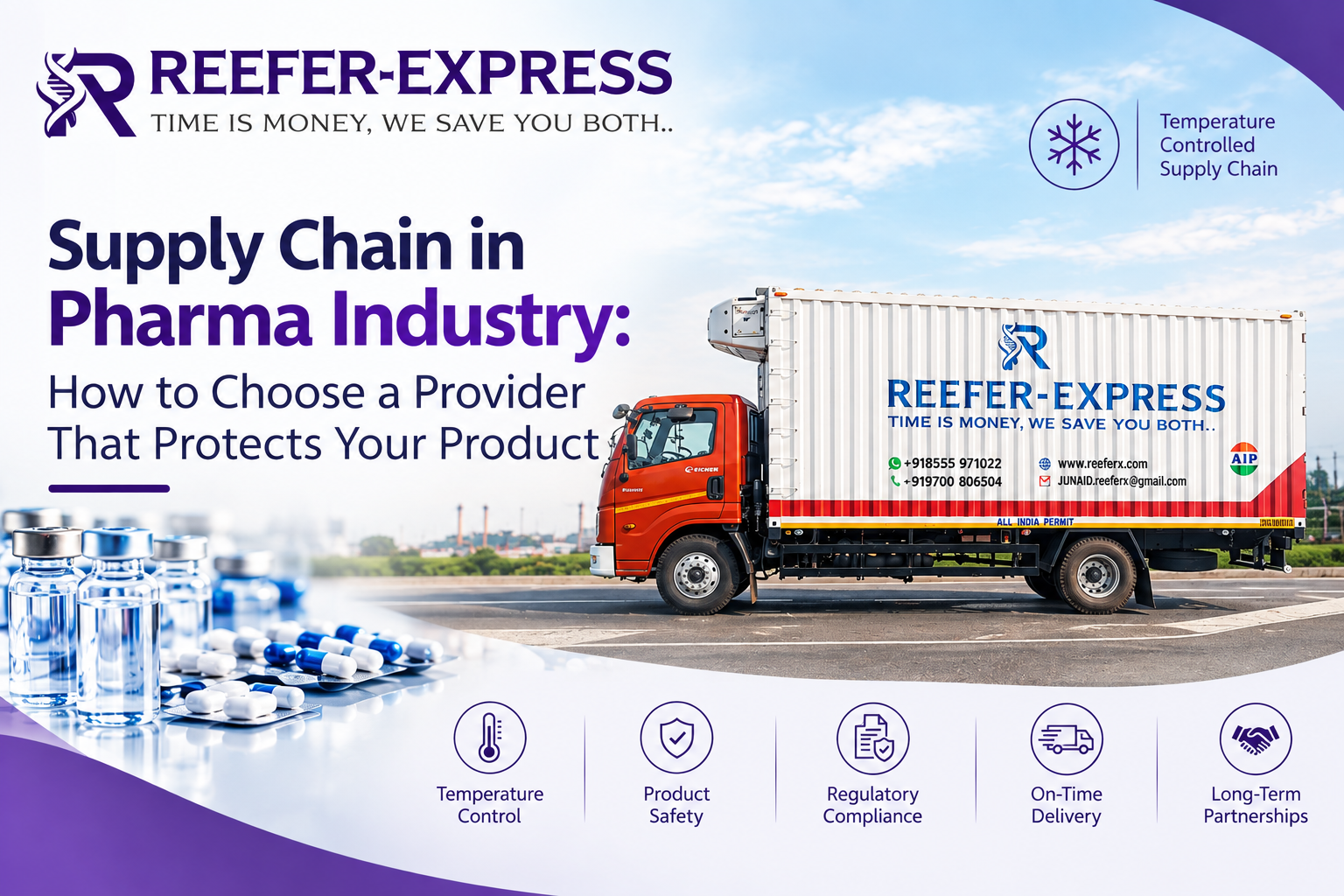
The supply chain in pharma industry operations is where a good batch either stays good or turns into a write-off. If you are at the stage of shortlisting partners, you already know that a drug is only as safe as the last leg it travels. This guide covers what a pharma supply chain provider must prove, where India’s routes break down, what quotes tend to hide, and how Reefer Express runs pharma supply chain services in India from first pickup to final delivery.
Key Takeaways
• The supply chain in pharma industry covers sourcing, storage, transport, delivery and the documentation that proves quality was maintained.
• Most Indian pharma cold chain failures happen at pickup, transfer hubs and the last mile, not on the highway.
• Compare providers with a pilot lane in a hot month, and read quotes for exclusions such as loggers, waiting time and last-mile handling.
• Reefer Express provides temperature-controlled vehicles, climate-zone-qualified packaging, per-shipment documentation and defined last-mile protocols.
What Is the Supply Chain in Pharma Industry?
The supply chain in pharma industry is the connected network of sourcing, manufacturing, storage, transport and delivery that moves medicines from raw material suppliers to patients. It includes temperature control, documentation and regulatory compliance at every step, because drug quality depends on handling conditions as much as on production.
In practice, the chain covers API and excipient inbound movement, finished goods transfer from plants to distribution centres, storage, primary and secondary distribution, hospital and pharmacy delivery, and reverse logistics for returns and recalls.
Buyers often reduce this to “transport,” and that is the first mistake. A pharma supply chain has three layers that need to work together. The physical layer is vehicles, warehouses and packaging. The control layer is temperature monitoring, route planning and exception handling. The documentation layer is the paperwork that proves the product stayed within its labelled conditions. A provider that is strong on the first layer and thin on the other two will leave you exposed at release time, when your quality team asks for evidence and there is none.
Temperature matters because pharma products are not forgiving. Vaccines and many biologics need 2°C to 8°C. Many tablets, diagnostics and reagents sit in a controlled room temperature band of 15°C to 25°C. Some biologics and cell-based products travel frozen. Each band demands different equipment, packaging and monitoring logic, which is why one generic service rarely fits a full portfolio.
Why Is the Pharma Supply Chain in India Harder Than in Other Markets?
Pharma logistics in India is harder because of wide climate swings, tightening regulation and weak last-mile control. Summer temperatures above 42°C, long multi-zone routes and handovers outside controlled environments all shrink the thermal margin that packaging and vehicles are validated to protect.
India is one of the largest suppliers of generic medicines and vaccines in the world, and Invest India’s pharmaceuticals sector page and the India Brand Equity Foundation both track how central the industry is to national exports. That scale creates pressure on logistics. Volumes are high, timelines are tight and the geography does not help.
Climate swings across a single route
A truck leaving a plant in Himachal Pradesh in winter can end its journey in coastal Tamil Nadu in humid heat. Packaging and vehicle settings that were fine for one zone can fail in another. Route-level thinking matters more here than in almost any other market.
A regulatory environment that keeps tightening
The Central Drugs Standard Control Organisation sets the regulatory framework for drug quality and distribution in India, and audits increasingly look at distribution practices, not only manufacturing. Global partners also expect alignment with World Health Organization guidance on good distribution practices. If your logistics partner cannot produce records that stand up to an audit, the risk lands on your marketing authorisation, not theirs. Our guide on GDP compliance in cold chain logistics in India breaks down what auditors actually ask for.
The first mile and last mile problem
Most providers manage the middle of the journey well. Trouble starts at pickup and at the final handoff, where product moves from a controlled vehicle to a delivery agent, a clinic reception desk or a pharmacy counter. A carton that waits 40 minutes on a loading bay in summer can lose its temperature margin before the real journey even begins. This is a process problem, and it needs a process answer.
Where Do Pharma Supply Chains Break?
Pharma supply chains most often break at five points: skipped pre-conditioning, underestimated dwell time at transfer hubs, passive temperature monitoring, weak handover discipline and documentation assembled after the fact. Each point is preventable with defined procedures, real-time visibility and records generated with every shipment.
Pre-conditioning gets skipped. Gel packs and phase change materials need to be conditioned to a precise temperature before packing. When a busy dispatch team rushes this step, the box starts its journey with less thermal buffer than the validation assumed.
Dwell time at transfer points is underestimated. Consolidation hubs, airport cargo terminals and inter-city transfers add hours that never appear on the route sheet. Every hour outside a controlled environment eats into passive packaging hold time.
Monitoring is passive. A data logger that is read only after delivery tells you something went wrong, but it cannot help you fix it. Real-time visibility lets a control room reroute, swap a pack or alert the consignee while the product can still be saved.
Handover discipline is weak. Vehicles are compliant, packaging is validated, and then a delivery executive carries the parcel through a crowded market in the afternoon sun. The chain is only as strong as its least supervised leg.
Documentation is reconstructed after the fact. When logs, chain of custody sheets and excursion reports are assembled after a complaint rather than generated with the shipment, gaps appear exactly where you need certainty.
If a provider cannot describe how they control each of these five points, you are looking at a transport vendor, not a pharma supply chain partner.
What Should a Pharma Supply Chain Services Provider in India Offer?
A pharma supply chain services provider in India should offer route-specific validation, packaging matched to each temperature band, real-time temperature and location tracking, documentation with every shipment, a written excursion protocol and proven backup capacity. Missing any of these leaves a gap your quality team will eventually have to explain.
Route-specific validation, not a generic certificate
Ask for qualification data tied to your lanes, your season and your product’s temperature band. A test done in a chamber at a standard ambient temperature says little about a summer run from Ahmedabad to Guwahati. Good providers can show profile-based testing across summer and winter conditions, with duration windows that include realistic delays. If all you receive is a generic packaging certificate, treat it as a gap.
Equipment matched to product category
A cold chain operation that uses one solution for vaccines, room temperature drugs and frozen biologics is cutting corners somewhere. Reefer vehicles with multi-zone control, insulated passive shippers for small parcels and validated cold storage should each be used where they fit. Your provider should explain why a specific solution was chosen for a specific product, not simply what is available that day.
Temperature and location visibility together
GPS alone tells you where a vehicle is. It does not tell you whether the product is safe. You need temperature and location on the same view, with alerts that reach a person who is authorised to act. Ask who receives the alert, how quickly, and what they are allowed to do. Our overview of temperature controlled logistics in India explains the monitoring stack in more detail.
Documentation that ships with the consignment
Temperature logs, calibration certificates for loggers, chain of custody records and delivery confirmations should be part of every shipment, not something you request after a query. This is what your QA team will use when deciding whether to release a batch. It is also what protects you in an inspection or an insurance claim.
A written excursion protocol
Ask what happens when a truck’s temperature drifts at 2 a.m. on a highway. A provider with a proper answer will describe who is notified, what the decision tree looks like, how product is quarantined and how the incident is documented. A vague reply means the protocol lives in someone’s head, which is not a protocol.
Capacity, backup and lane depth
Capacity failures show up at the worst time, usually during a seasonal peak or a large tender delivery. Ask how many temperature-controlled vehicles the provider can commit to your lanes, what the backup plan is when a vehicle breaks down, and whether they have handled your volume before. For a deeper look at choosing between logistics models, read our comparison of 3PL logistics in India for pharma cold chain shipments and our explainer on the 5PL pharma supply chain.
How Do You Compare Pharmaceutical Supply Chain Companies in India?
Compare pharmaceutical supply chain companies in India by running a pilot on one representative lane in a hot month, then reviewing temperature data, delivery timing, documentation quality and quote exclusions. Price alone hides costs such as loggers, waiting time and last-mile handling, so compare the total cost of a compliant delivery.
Start with a pilot lane, not a full contract
Choose one representative route and one product category. Ask two or three shortlisted providers to run it under real conditions, during a hot month if possible. Compare temperature data, delivery timing, documentation quality and how each team behaved when something small went wrong. A pilot shows you the operating culture of a company in a way no sales presentation can.
Read quotes for what they leave out
Two quotes for the same lane can differ by a wide margin, and the gap usually sits in exclusions. Check whether pre-conditioned packaging is included, whether logger costs are billed separately, whether waiting time at pickup and delivery is charged, and whether last-mile handling for temperature-sensitive drugs is covered or passed to a general courier. Ask how excursions are compensated and whether insurance covers temperature failure or only physical loss. A lower quote that excludes monitoring and documentation is not lower once you add those items back.
Test how they answer hard questions
Send your quality team into the conversation. Ask for a sample temperature report, a sample excursion report and the standard operating procedure for handling a breach. Providers that respond with documents in a day or two run a disciplined operation. Providers that need a week to check with the team usually do not have the documents ready.
Look at accountability
Check who owns the shipment at every stage. Contracts that pass liability to a sub-contractor or a franchise partner at the last mile leave you with no clear owner when something fails. A single accountable provider, with a named operations contact for your account, saves time when minutes matter.
Why Choose Reefer Express for Pharma Supply Chain Services in India?
Reefer Express is a pharma-focused cold chain provider in India that runs temperature-controlled vehicles, climate-zone-qualified packaging, per-shipment documentation and defined last-mile protocols. Its process is designed around failure modes rather than adapted from general freight, which separates a specialist from a logistics firm with a cold chain line.
The Reefer Express fleet maintains temperature continuity through the route, not only at pickup and delivery. Packaging is qualified for India’s actual climate zones, so the validation reflects what your product will face on the road and not what it would face in a test chamber. Each shipment carries its own documentation, including temperature logs, excursion reports where relevant and chain of custody records, so your QA team has evidence without chasing for it.
Last-mile handling is treated as part of the service and not as an afterthought. Reefer Express uses defined handling protocols for the final leg, which is where many providers’ coverage ends. If your product is a vaccine, a biologic or any drug that cannot tolerate an unplanned hour in the sun, this is the part of the chain that decides whether your earlier effort holds.
Reefer Express also supports regional lanes with dedicated coverage, including cold chain logistics solutions in Visakhapatnam. For a wider view of the market, see the top cold chain logistics companies in India and our guide to pharmaceutical cold chain logistics in India.
The practical difference between a logistics company with a cold chain division and a provider built around cold chain comes down to failure planning. Reefer Express designs its process around what can go wrong, and that shapes everything from packing to dispatch to delivery confirmation.
How Does Onboarding With a Pharma Supply Chain Partner Work?
Onboarding with a pharma supply chain partner runs in four stages: a requirements call, a route and packaging assessment, a pilot, and scaled operations with a named contact. Each stage produces written output your quality team can review before volume moves.
It starts with a requirements conversation. You share product categories, temperature bands, monthly volumes, origin and destination pairs and any compliance requirements from your quality team. This takes one call and one shared document.
Next comes a route and packaging assessment. The team reviews your lanes against seasonal conditions and recommends packaging and vehicle configurations for each product band. You receive this in writing, with the reasoning behind each choice, so your QA team can review it before anything moves.
After that, a pilot shipment or a short set of trial runs is agreed. Temperature data, timing and documentation from these runs are shared with you. If anything falls outside your expectations, the process is adjusted before you commit to volume.
Once the pilot is approved, regular operations begin with a named point of contact, agreed alert thresholds and a defined escalation path. Reviews happen on a set schedule, and the data from those reviews is used to improve lanes and packaging choices over time.
Who Is This Service For?
Reefer Express suits manufacturers and distributors of vaccines, biologics, insulin, oncology drugs, diagnostics and other temperature-sensitive pharmaceuticals in India. It also fits pharma exporters that need a reliable domestic first leg to airports and ports, hospital chains and diagnostic networks that need scheduled temperature-controlled replenishment, and clinical trial sponsors that need documentation-heavy movement of samples and investigational products. If your product moves at ambient temperature with no compliance exposure, a general freight partner may be cheaper and perfectly adequate. The value of a specialist grows as the cost of failure grows.
What Does Pharma Supply Chain Service Cost in India?
Pharma supply chain service cost in India depends mainly on lane distance, temperature band, vehicle size or parcel format, shipment frequency and monitoring level. Packaging type, logger use and last-mile requirements add to the base rate, and seasonal peaks can shift pricing on busy lanes.
Rather than chasing a single rate per kilometre, ask for a lane-wise quote that lists what is included. Compare the total landed cost of a compliant delivery, including documentation and the risk of loss, and not only the transport line. One avoided batch loss usually outweighs years of small savings on freight.
Frequently Asked Questions
What is the supply chain in pharma industry?
The supply chain in pharma industry is the connected network of sourcing, manufacturing, storage, transport and delivery that moves medicines from raw material suppliers to patients. It includes temperature control, documentation and regulatory compliance at each step, because product quality depends on conditions during handling and transit, not only during production.
Why is cold chain important in the pharma supply chain?
Many pharmaceuticals lose potency or become unsafe when exposed to temperatures outside their labelled range. Vaccines, biologics and insulin are especially sensitive. Cold chain controls protect efficacy, patient safety and regulatory standing, and give manufacturers evidence that quality was maintained until delivery.
How do I choose among pharmaceutical supply chain companies in India?
Start with route-specific validation data, written excursion procedures, real-time temperature and location tracking, and documentation supplied with every shipment. Then run a pilot on one representative lane in a hot month and compare temperature data, delivery timing and how each provider handled small issues.
What temperature ranges do pharma shipments need?
Most vaccines and biologics travel at 2°C to 8°C. Many tablets, diagnostics and reagents move at 15°C to 25°C. Some biological and cell-based products need frozen or ultra-low conditions. Always follow the storage condition printed on the product label and stability data.
What happens if a temperature excursion occurs during transit?
A qualified provider follows a written protocol. The control room is alerted, the consignee and quality team are notified, and affected product is quarantined pending review. The event is documented with logger data, and the QA team decides on release, retest or disposal.
Does Reefer Express handle last-mile delivery for temperature-sensitive drugs?
Yes. Reefer Express applies defined handling protocols to the final leg of delivery, since the handoff from vehicle to recipient is a common point of temperature failure. Ask the team about maximum allowable handover time and how it is monitored on your routes.
How long does it take to start working with a pharma logistics partner?
Timelines vary with the number of lanes and product categories. A single-lane pilot can often be arranged within a couple of weeks once requirements and packaging are agreed. Broader multi-lane rollouts take longer, mainly because of validation and documentation review.
Can a single provider cover both domestic distribution and export first-mile?
Yes, if the provider maintains temperature control from the plant to the airport or port and hands over with complete documentation. Confirm how they coordinate with freight forwarders and airline pharma handling programmes such as IATA’s pharma logistics programme, and check that handover times are built into validation.
Next Step: Get a Route-Specific Assessment
Choosing a partner for your supply chain in pharma industry work is a quality decision as much as a logistics one. The right provider gives you validated packaging, continuous monitoring, clear documentation and an answer for every failure mode you can think of. The wrong one gives you a low quote and a difficult conversation with your QA head later.
If you are shipping pharmaceutical products and want to discuss specific routes, product categories and turnaround expectations, contact Reefer Express for a route-specific assessment. Share your lanes and temperature bands, and the team will come back with a written plan you can hand straight to your quality team. You can also explore more at Reefer Express.