

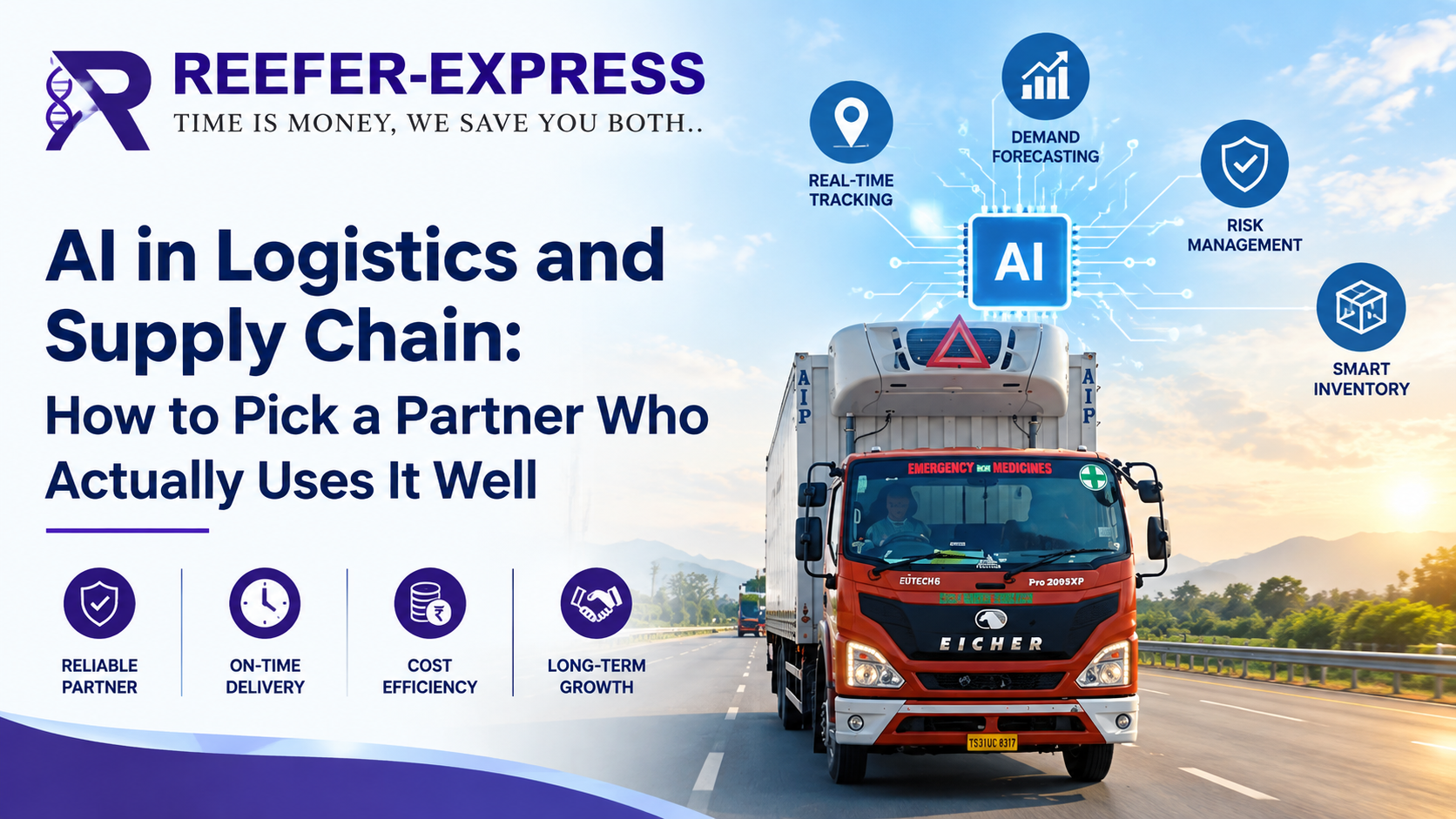
If you are comparing logistics providers right now, you have probably noticed that almost every one of them claims to use AI. AI in logistics and supply chain has gone from a buzzword on a homepage to a real operational requirement, especially if you move temperature-sensitive goods where a two-hour delay or a three-degree temperature swing can wipe out an entire shipment. The question you are actually trying to answer is not whether AI matters. It is which provider is using it in a way that protects your product, your compliance record, and your bottom line, and which one is just repeating the word in a pitch deck.
This article walks through what AI genuinely does inside logistics and supply chain management today, where it makes the biggest difference for temperature-controlled and pharma freight, and what you should check before you sign a contract with any provider claiming to be “AI-powered.”
What AI in Logistics and Supply Chain Actually Means Today
Strip away the marketing language and AI in logistics comes down to three capabilities working together: prediction, automation, and continuous monitoring.
Prediction means the system studies historical shipment data, weather patterns, traffic conditions, and demand cycles to forecast what is likely to happen before it happens. That could be a delayed customs clearance, a spike in demand for a particular SKU, or a route that is about to get congested.
Automation means the system acts on that prediction without waiting for a human to notice the pattern first. A route gets rerouted, a reorder gets triggered, a driver gets an alert.
Continuous monitoring means sensors, GPS devices, and data loggers feed information back into the system in real time, so the prediction model keeps improving and any deviation gets flagged immediately rather than discovered after the damage is done.
DHL describes this shift as AI becoming a kind of co-pilot, taking over routine but essential tasks so teams can focus on bigger decisions instead of manually watching every shipment. That framing matters because it tells you what good AI adoption looks like in practice. It is not a chatbot bolted onto a website. It is decision-making embedded into the daily operation of the fleet, the warehouse, and the cold room.
Why Logistics and Supply Chain Management Is Under More Pressure Than Ever
Logistics and supply chain management has always been a margin business, but the pressure on that margin has grown sharply over the past two years. Fuel costs remain volatile, driver shortages have not gone away, and customers now expect delivery visibility that used to be reserved for premium accounts. On top of that, regulatory requirements for pharmaceutical and healthcare shipments have only gotten stricter, particularly around temperature excursions and chain-of-custody documentation.
This is exactly why so many providers moved toward AI in the first place. McKinsey’s research on agentic AI in supply chains describes a pattern many operators are already seeing on the ground, where AI is being asked to do more than generate reports and is increasingly expected to help run day-to-day operational decisions. When margins are thin and compliance requirements are strict, a provider that can predict a problem before it happens has a structural advantage over one that only reacts after a customer calls to ask where their shipment is.
If your current provider still relies mainly on phone calls and spreadsheets to manage exceptions, you are paying for a level of risk that AI-enabled competitors have already reduced. That gap tends to show up exactly when you can least afford it, during a peak season surge or a cold chain excursion that nobody caught in time.
How AI Changes Logistics and Supply Chain Management Function by Function
Demand Forecasting and Inventory Planning
Traditional forecasting relied on last year’s numbers plus a bit of guesswork. AI models pull in a much wider set of signals, including seasonal demand shifts, regional consumption patterns, and even macroeconomic indicators, to predict what inventory needs to be where and when. McKinsey’s work with distributors found that AI-powered tools can unlock meaningfully more usable capacity across warehouse networks simply by identifying spare capacity and variability in resource availability that human planners tend to miss. For a business managing perishable or temperature-sensitive stock, that translates directly into less spoilage and fewer emergency shipments.
Route and Fleet Optimization
Route optimization used to mean picking the shortest path on a map. Modern systems factor in live traffic, weather, vehicle load, driver hours, and even port congestion data to recalculate the most efficient route continuously, not just once at dispatch. This matters even more for reefer trucks, where every extra hour on the road is an extra hour the refrigeration unit has to work, burning fuel and increasing the chance of a mechanical issue mid-transit.
Warehouse and Storage Automation
Inside the warehouse, AI is used for slotting decisions, predictive maintenance on cold storage equipment, and automated stock rotation based on expiry dates. For cold chain operators, predictive maintenance is particularly valuable because a compressor failure discovered by a technician doing rounds is a compressor failure that has probably already put product at risk. A system that flags an abnormal vibration pattern or a slow temperature drift days before failure gives the operations team time to act.
Cold Chain and Temperature Monitoring
This is where AI has the most direct impact on product integrity. Instead of relying on a driver checking a dial every few hours, connected data loggers stream temperature and humidity readings continuously. AI models trained on historical excursion data can distinguish between a brief, harmless fluctuation and the start of a genuine compliance breach, and trigger an alert before the product is compromised. The World Health Organization’s guidance on controlled temperature chains shows how tightly regulated this space already is, since even vaccines licensed for limited excursions above the standard 2 to 8 degree range require documented, monitored conditions to stay compliant. Any provider handling pharma or biologics freight without this level of monitoring is operating with a real gap.
Risk Management and Visibility
Finally, AI is used to give shippers a single, real-time view of where a shipment is and what condition it is in, rather than a status update that only gets refreshed once a day. This kind of visibility is what allows a logistics and supply chain management partner to intervene during an event instead of explaining it after the fact.
Why Cold Chain and Pharma Logistics Need This More Than Most Industries
Not every supply chain carries the same level of risk. A delayed shipment of furniture is inconvenient. A delayed or mishandled shipment of vaccines, biologics, or temperature-sensitive pharmaceuticals can mean a product that is no longer safe to use, a regulatory violation, and a financial loss that is very hard to recover from.
Deploying AI in food and pharma supply chains carries unique technical demands because of product perishability, strict regulatory standards, and narrow profit margins, which is why continuous real-time monitoring is necessary to protect both safety and compliance. That is precisely the environment cold chain logistics and pharma freight operate in every single day. There is no room for a monitoring gap of even a few hours, because the cost of a single excursion can exceed the entire value of the shipment.
This is also why generic logistics providers, even good ones, often struggle when they take on pharma or healthcare freight without dedicated infrastructure. Their AI systems may be tuned for general freight patterns, not for the tight tolerances that temperature-controlled logistics demands.
What to Look For Before You Choose an AI-Enabled Logistics Partner
When you are evaluating providers, the word “AI” on its own tells you almost nothing. What actually matters is where in the operation the AI is applied and how much control it hands to your team.
Start by asking whether the provider’s temperature monitoring is continuous and automated, or whether it still depends on manual checks logged into a spreadsheet. A real-time data logger paired with automated alerting is a fundamentally different level of protection than a paper log reviewed at the end of a shift.
Next, ask how the provider handles exceptions. A mature system does not just record that a temperature excursion happened. It flags it immediately, documents it with a timestamp, and gives you a clear escalation path. If a provider cannot show you a sample exception report, that is a warning sign.
Ask about fleet visibility. You should be able to see where your shipment is and what condition it is in without calling anyone. If the answer to “can I track this live” is a phone number instead of a dashboard, the technology gap is bigger than the sales pitch suggested.
Finally, ask about compliance documentation. For pharma supply chain solutions and healthcare logistics, every shipment needs a defensible paper trail. AI-driven systems that automatically generate and store this documentation save you from the scramble that happens during an audit.
How Reefer Express Applies AI-Driven Logistics and Supply Chain Management
Reefer Express was built around the reality that temperature-sensitive freight cannot be managed with guesswork. Every storage unit in the network comes with a data logger that tracks temperature and humidity in real time, and that data feeds directly into monitoring systems rather than sitting in a logbook waiting for someone to check it. This is the same principle behind healthcare logistics done correctly, where the monitoring has to be constant, not periodic.
On the transportation side, route planning accounts for live conditions rather than a fixed plan set the night before, which keeps reefer units running efficiently and reduces the time perishable or pharmaceutical products spend in transit. For cell and gene supply chain shipments, where tolerances are even tighter, this level of monitoring is not optional. It is the baseline requirement for keeping the product viable.
The result is a network with 12 warehouses, more than 130,000 pallets of capacity, a fleet of over 50 vehicles, and coverage across more than 100 cities, all operating under the same data-driven monitoring standard rather than a patchwork of manual processes. You can see how these pieces fit together on the full range of services or read more about the company’s background on the About Us page.
The Cost of Sticking With a Provider That Is Behind on This
It is worth being direct about what happens if you delay switching to a logistics partner with real, working AI capability. Every quarter you stay with a provider that manages temperature manually is a quarter of exposure to undetected excursions, slower exception response, and weaker documentation if a regulator or client ever asks for proof of compliance.
DHL’s most recent trend research points out that AI adoption in logistics is no longer confined to pilot projects and is becoming an operational essential embedded into everyday planning, routing, and fulfillment decisions. That shift means the providers who have not made this change are not just behind on technology. They are behind on the basic reliability that shippers now expect as standard, not as a premium feature.
For businesses moving pharmaceuticals, biologics, or perishable food products, that gap translates into real financial risk. A single spoiled batch of temperature-sensitive product, a single missed compliance deadline, or a single client lost because a shipment could not be tracked in real time will usually cost more than the switching effort ever would.
How to Measure Whether an AI-Enabled Provider Is Actually Delivering
Signing with a provider that talks about AI is only half the job. You also need a way to check, month over month, whether that technology is producing measurable results for your shipments rather than sitting quietly in the background. A few practical measures make this easy to track.
Look at excursion frequency first. If a provider’s monitoring is genuinely automated, the number of undetected or late-flagged temperature excursions should trend toward zero within the first few shipment cycles. If that number stays flat, the monitoring is not doing what it claims.
Look at response time next. When an alert fires, how long does it take for a human to act on it? A well-built system should shrink that window from hours to minutes, because the entire point of automated monitoring is to remove the lag between a problem occurring and someone noticing it.
Finally, look at documentation turnaround. When you request compliance records for an audit or a client review, a provider with real AI-driven systems can produce a complete, timestamped report almost immediately. A provider still assembling records by hand will take days, and that delay alone tells you how much of their “AI-powered” claim is real infrastructure versus marketing language.
Tracking these three measures for even one quarter will tell you more about a provider’s actual capability than any sales conversation.
Getting Started With a Cold Chain Partner Built on AI-Driven Monitoring
If you are currently evaluating logistics and supply chain management partners for temperature-sensitive freight, the practical next step is simple. Ask your shortlisted providers for a walkthrough of their monitoring dashboard, their exception handling process, and their documentation output. If they cannot show you these in a live demonstration, treat that as your answer.
Reefer Express has spent more than six years building infrastructure specifically for pharmaceutical, healthcare, and perishable freight across India, with monitoring and reporting built into every shipment rather than added as an afterthought. If you want to see how this works for your specific product and route, get in touch with the team and ask for a walkthrough of the monitoring setup before you commit to a contract. You can also browse recent case notes and updates on the Reefer Express blog to see how the network handles real shipments in practice.
Frequently Asked Questions
What is the difference between AI in logistics and traditional supply chain software?
Traditional supply chain software follows fixed rules set by a human, such as reordering stock when it hits a certain level. AI in logistics and supply chain goes further by learning from patterns in the data and adjusting its predictions and actions as conditions change, without needing someone to rewrite the rules every time.
Does AI replace the need for a skilled logistics team?
No. AI handles the repetitive monitoring and pattern recognition that humans are slow at, but decisions around client relationships, contract terms, and unusual exceptions still need experienced people. The strongest logistics and supply chain management operations combine both.
How does AI help specifically with cold chain and pharma shipments?
AI enables continuous temperature and humidity monitoring instead of periodic manual checks, flags abnormal readings before they become compliance breaches, and automatically generates the documentation regulators expect. This reduces spoilage, protects product integrity, and shortens the time needed to respond to an issue.
How can I tell if a logistics provider’s AI claims are genuine?
Ask for a live demonstration of their monitoring dashboard, their exception alert process, and a sample compliance report. Providers with real AI-driven systems can show these immediately. Providers repeating the term without real infrastructure usually cannot.
Is switching to an AI-enabled logistics partner expensive or disruptive?
Most reputable providers, including Reefer Express, manage onboarding without disrupting your existing shipment schedule. The bigger cost is usually staying with a provider that lacks real-time monitoring, since that exposes you to spoilage and compliance risk that AI-enabled providers have already reduced.
What should I ask a logistics provider before signing a contract?
Ask how temperature data is captured and how often it updates, how exceptions are detected and escalated, whether you get live shipment visibility without calling support, and how compliance documentation is generated and stored. Their answers will tell you more than any marketing claim about AI.