

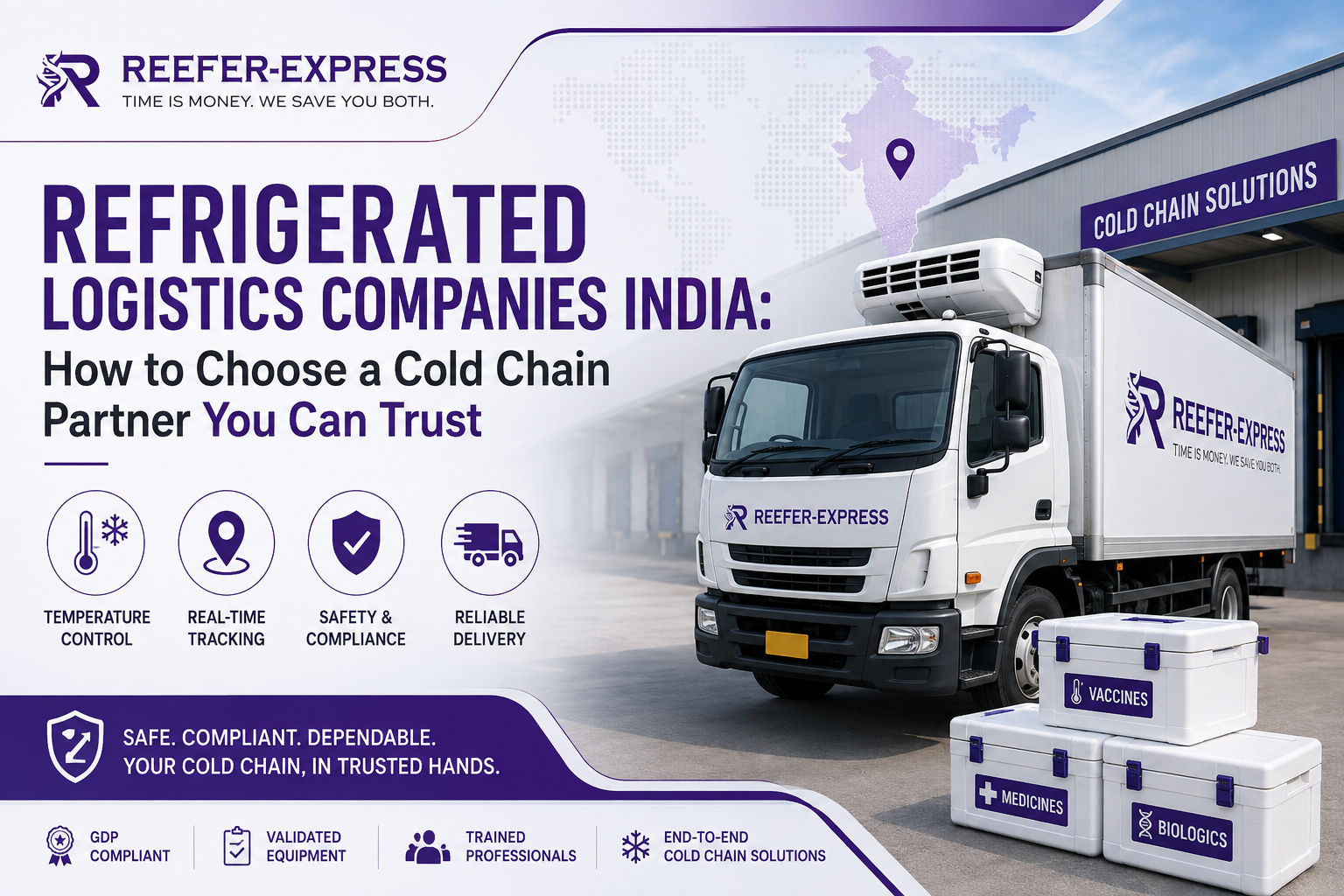
If you are shortlisting refrigerated logistics companies in India for a pharma shipment, you are past the stage of wondering what cold chain means. You already know the risks. A missed temperature window does not just delay a delivery. It compromises a batch, triggers a regulatory flag, and creates a loss that is hard to explain to anyone above you. This guide is written for that decision. It breaks down what actually separates dependable refrigerated logistics companies in India from providers who look identical on a proposal deck but fail once the route gets difficult, the weather turns, or the last mile gets messy.
The Gap Between India’s Cold Chain Growth and Its Cold Chain Standards
India’s cold storage capacity has expanded steadily over the past decade, and the National Centre for Cold-chain Development projects it will keep growing at a compound annual rate of roughly 2.2 percent through 2031, reaching close to 440 lakh metric tons of capacity. That growth looks good in a slide deck. It says almost nothing about whether the refrigerated transport layer connecting that storage to hospitals, pharmacies, and distribution points is actually reliable.
Refrigerated storage and refrigerated transport are not the same problem, and treating them as one is where a lot of buying decisions go wrong. A cold store with a validated 2 to 8°C chamber tells you nothing about what happens to a shipment during a six hour reefer run between Chennai and Bengaluru in June, or during a last-mile handoff in Lucknow in July.
The pharma market this transport layer serves is not small either. India’s pharmaceutical industry is projected to cross roughly 60 billion dollars in 2026, and a meaningful share of that output depends on temperature integrity from the manufacturing floor to the patient. When the cold chain breaks, the cost is never abstract. It is a batch write-off, a compliance investigation, and in some cases a public health risk. This is the environment refrigerated logistics companies in India are operating in: rising demand, rising regulatory scrutiny, and a transport network that has not caught up uniformly. Some providers have. Most have not.
What Pharma Cold Chain Logistics Companies in India Actually Need to Get Right
A Fleet Built to Hold Temperature, Not Just Carry It
There is a real difference between a truck with a refrigeration unit bolted on and a reefer fleet engineered for pharma cold chain. The first keeps cargo cool when everything goes right. The second maintains temperature continuity through loading delays, traffic stoppages, driver breaks, and the kind of unpredictable Indian road conditions that never show up in a proposal document. Ask any provider how their fleet performs when a delivery gets stuck for two extra hours in peak summer traffic. If the answer is vague, that is your answer.
Route-Specific Validation, Not a Generic Certificate
A packaging or vehicle solution validated in a lab under standard ambient conditions tells you very little about performance on an actual Indian route. A Delhi to Mumbai run in January behaves nothing like a Chennai to Hyderabad run in May. Pharma cold chain logistics companies in India that take this seriously will show you validation data tied to specific lanes, durations, and seasonal conditions, not a one-size-fits-all test certificate.
Documentation That Travels With the Shipment
Regulators do not accept documentation that only exists on request. The CDSCO good distribution practice guidelines for pharmaceutical products call for documented temperature monitoring and a clear reporting process the moment a deviation occurs. A refrigerated logistics company that treats temperature logs as an optional add-on rather than a default part of every shipment is not built for pharma work, whatever else is on their website.
Temperature Controlled Logistics India: The Standards That Actually Separate Providers
Global frameworks are a useful filter when you are comparing providers on paper. WHO guidance on storage and transport of pharmaceutical products sets out expectations for temperature mapping, monitoring, and excursion handling that most serious providers align to even outside formal certification. On the air freight side, IATA’s CEIV Pharma certification has become close to an industry benchmark, assessing an organisation’s quality management, personnel training, and temperature control processes against a detailed audit checklist. Not every refrigerated logistics company in India holds this certification, and it is not the only signal of competence, but a provider who understands what these frameworks require, and can speak to them specifically, is operating at a different level than one who has never heard of them.
Temperature controlled logistics in India is not just about the refrigeration unit on the truck. It is monitoring that captures temperature and location together, in a format you can access without filing a request. If a provider can show you where a shipment is but not whether it has been breached, that system is built for tracking parcels, not for making a release decision.
What Different Product Categories Need From a Refrigerated Logistics Company
Not every pharma shipment needs the same handling, and a provider offering one solution across categories is usually cutting corners somewhere. Vaccines and biologics held at 2 to 8°C need continuous active monitoring and almost no tolerance for excursions, since even a brief breach can affect potency. Frozen shipments, often held between minus 15°C and minus 25°C, need packaging and vehicles qualified specifically for sustained sub-zero performance, which is a different engineering problem from standard refrigeration. Diagnostics and some formulations held at 15 to 25°C, generally described as controlled room temperature, still need active monitoring even though the range looks less demanding on paper, because India’s ambient heat can push an unmonitored shipment out of range quickly. A refrigerated logistics company worth considering will ask which of these categories your product falls into before quoting you a rate, not after.
This also affects how a provider should structure their fleet and packaging inventory. A company running a single type of insulated container across every temperature band is telling you, indirectly, that they have not built category-specific processes. The providers worth shortlisting will usually walk you through which vehicle type, packaging format, and monitoring frequency applies to your specific product before they ever send a formal quote.
The Real Cost of Choosing the Wrong Refrigerated Logistics Company
A failed cold chain shipment rarely shows up as a single, isolated cost. The product itself is written off, which is the most visible part of the loss but often the smallest. Behind it sits a quality investigation that pulls in your compliance team, a review of whether the batch needs to be reported to a regulator, and a conversation with the client or hospital that was expecting delivery. If the failure pattern repeats across shipments, it starts affecting your standing with regulators during the next audit, since a provider that cannot produce a clean temperature log is effectively telling an inspector that the chain of custody cannot be proven. None of this shows up on a freight invoice, which is exactly why price alone is a poor way to compare refrigerated logistics companies in India.
The providers who understand this price their service around risk reduction, not just distance and weight. That usually means a slightly higher quoted rate paired with fewer surprises, versus a lower rate from a provider who has not accounted for what happens when a shipment does not go according to plan. Over a year of regular shipments, the second option is almost always more expensive once you count the write-offs.
Where Most Refrigerated Logistics Companies in India Still Fall Short
The Last-Mile Gap
Most cold chain failures in India do not happen on the highway. They happen at the handoff, when a compliant reefer vehicle reaches a delivery point and the product sits with a delivery agent, in a bag or on a bike, for however long it takes to complete the drop. The middle leg is usually solved. The first and last legs, particularly the final delivery, are where most providers have not actually thought the problem through. If you ask a provider how they handle last-mile temperature integrity and get a shrug or a general answer about trained staff, that gap is real and it will show up in your shipment eventually.
The After-the-Fact Documentation Gap
Some providers can tell you a shipment arrived on time. Fewer can tell you, with a continuous temperature log, that it stayed within range the entire time, including during the parts of the journey that did not go according to plan. If documentation only exists when you specifically ask for it, you are relying on the provider’s memory instead of a system. That is not a small distinction when a regulator or an auditor asks you to prove chain of custody months later.
The Communication Gap During an Excursion
Even providers with a written excursion protocol on paper sometimes fail at the part that matters most in the moment, which is telling you quickly. A protocol that takes six hours to notify you of a breach is barely better than no protocol at all, because by the time you find out, the disposition decision has already been delayed past the point where it matters. Ask a provider not just whether they have a notification process, but how fast it actually triggers and who owns it internally.
How to Evaluate a Refrigerated Logistics Company Before You Sign
Run every shortlisted provider through the same set of direct questions rather than comparing brochures side by side. The table below is a starting point for that conversation.
| Question to ask | What a strong answer looks like |
| Can you show validation data specific to my route? | Documented temperature profiles for the exact lanes and seasons you ship on, not a generic lab certificate. |
| What is your written protocol for a temperature excursion? | A defined decision tree covering notification, quarantine, and disposal, not a verbal explanation. |
| Do temperature logs come with every shipment? | Yes, by default, in a format you can review without a separate request. |
| How do you handle last-mile delivery? | A defined maximum time-out-of-cold-chain window that is tracked and enforced, not a claim about trained riders. |
| Have you shipped this exact product category before? | Case data or references specific to your product type and temperature range. |
A provider who answers all of these clearly, with documentation to back it up, has earned a real conversation. Hesitation or a vague answer on any of them tells you exactly where the risk sits.
Why Reefer Express Is the Refrigerated Logistics Partner Pharma Brands Choose in India
Reefer Express was built around pharma cold chain requirements specifically, not adapted from a general trucking model with a refrigeration unit added on. That distinction shows up in three places. The reefer fleet maintains temperature continuity for the full route, not just at pickup and drop-off. Packaging and vehicle performance are qualified against India’s actual climate zones, which means the validation reflects the road, not a test chamber. And documentation, including temperature logs, excursion reports, and chain of custody records, is generated for every shipment automatically, not produced on request. Our breakdown of cold chain transportation challenges in India covers the operational side of this in more depth, and our guide to cold chain packaging in India walks through how packaging validation should actually work.
On last-mile delivery specifically, Reefer Express runs defined handling protocols designed to keep temperature integrity intact through the final leg, which is exactly where most competitors’ coverage stops. That is not a minor feature. It is usually the difference between a shipment that survives the full chain and one that fails in the last thirty minutes after everything else went right.
What Working With Reefer Express Looks Like
Engagement starts with a route and product assessment, not a generic quote. We look at your specific lanes, your product’s temperature range and hold time requirements, and the delivery pattern at the destination end, including whether last-mile handling needs differ from your other routes. From there you get documented validation for those specific conditions, a written excursion protocol before the first shipment moves, and temperature and location visibility built into every delivery by default. Our pharma cold chain logistics services page has more detail on how this is structured across product categories, from 2 to 8°C biologics to frozen shipments and controlled room temperature diagnostics.
Frequently Asked Questions
What makes a refrigerated logistics company suitable for pharma shipments specifically?
A provider suitable for pharma cold chain logistics in India needs route-specific validation data, a documented excursion protocol, temperature and location monitoring built into every shipment, and defined last-mile handling procedures, not just a refrigerated vehicle and a general logistics background.
How is temperature controlled logistics different from cold storage?
Temperature controlled logistics covers the moving parts of the cold chain, meaning the vehicles, packaging, and monitoring systems that keep a product within range while it is in transit. Cold storage covers the stationary parts, meaning warehouses and chambers. A provider can be strong at one and weak at the other, so it is worth evaluating them separately.
What documentation should come with every cold chain shipment?
At minimum, a continuous temperature log covering the full journey, a record of any excursion along with the response taken, and a chain of custody record showing who handled the shipment at each stage. If this is only available on request, treat that as a gap, not a formality.
How much does refrigerated logistics cost in India?
Cost depends on route distance, product temperature range, shipment volume, and whether last-mile handling requires special protocols. A provider who quotes a flat number without asking about your product and route specifics is likely pricing a generic logistics rate, not a pharma cold chain rate.
What happens if a temperature excursion occurs during transit?
A serious provider will have a written protocol that defines who gets notified immediately, how the product is quarantined, and how a disposition decision gets made, whether that means release, further testing, or disposal. If a provider cannot describe this process before you ship with them, ask before you sign, not after something goes wrong.
Is IATA CEIV Pharma certification necessary for a refrigerated logistics provider in India?
It is not the only marker of competence, but it is a useful signal. Providers who understand and align with frameworks like CEIV Pharma and WHO storage guidance tend to have more mature quality systems overall, even for shipments that move by road rather than air.
Get a Route-Specific Assessment
Price comparisons and generic quotes will not tell you whether a refrigerated logistics company can actually protect your product on your routes. Documentation, route-specific validation, and last-mile handling will. If you are shipping pharmaceutical product in India and want a straight conversation about your lanes, your product category, and what a compliant chain of custody actually looks like for your shipments, contact Reefer Express for a route-specific assessment.