

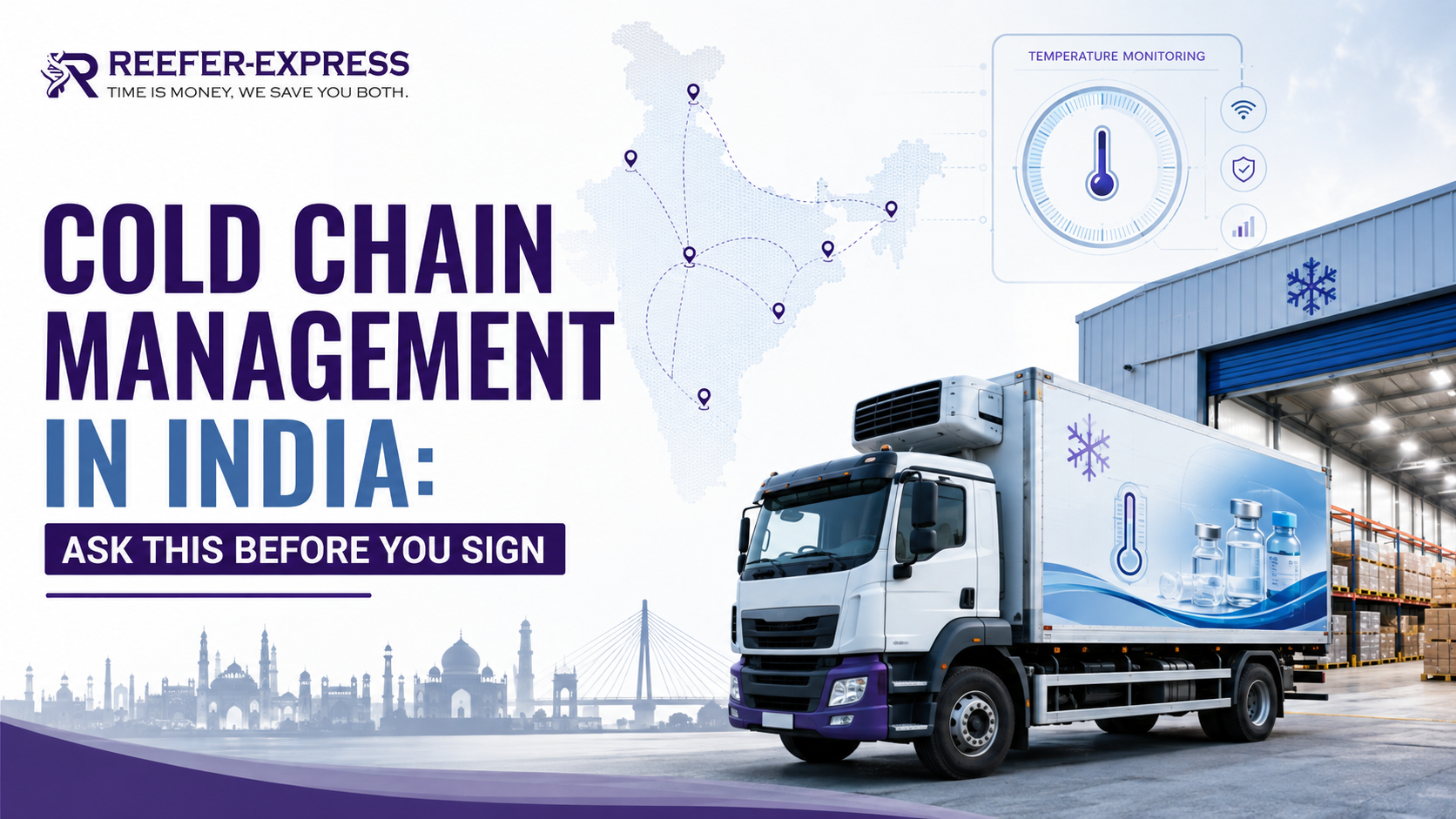
Cold chain management in India is not a single service you buy off a rate card. It is a chain of decisions, from packaging validation to last mile handling, and every weak link in that chain shows up as a compromised shipment, a failed batch release, or a regulatory question you cannot answer. If you are comparing providers right now, you already know the general pitch. Reliable fleet, real time tracking, temperature controlled everything. What you need is a way to tell which of those claims actually hold up once your product is on the road.
This guide walks through what cold chain management in India actually requires, where most providers fall short, and what to ask before you commit your product, your budget, and your compliance record to one company.
What Cold Chain Management Actually Involves in the Indian Context
Cold chain management is the coordinated process of keeping temperature sensitive goods, including pharmaceuticals, vaccines, biologics, and perishables, within a defined temperature range from the point of dispatch to the point of delivery. It covers packaging, refrigerated transport, storage, monitoring, and the documentation that proves the product stayed compliant the entire way.
In India, that coordination has to account for extreme climate variation across regions, road and rail infrastructure that varies widely by state, and a pharmaceutical and food distribution network that often ends with a delivery agent on a two wheeler rather than a climate controlled vehicle. A provider offering cold chain management has to design for all of it, not just the middle leg of the journey where conditions are easiest to control.
There is also a regulatory layer that sits underneath all of this. Drug manufacturers and distributors in India operate under the Drugs and Cosmetics Rules, and the storage and transport conditions they are expected to maintain are increasingly formalized through Good Distribution Practices guidance. That means cold chain management is not only an operational choice, it is a compliance obligation, and a provider who treats it purely as a logistics service without accounting for the regulatory expectations behind it is setting you up for a documentation gap at the worst possible moment, typically during an audit or a batch release review.
Why Cold Chain Management Fails More Often in India Than Providers Admit
India’s cold chain logistics market is projected to be worth roughly USD 24.5 billion in 2026, according to Mordor Intelligence data compiled by Research and Markets, and the sector keeps growing on the back of pharma exports, biologics manufacturing, and organized food retail. Growth in market size has not translated cleanly into growth in reliability. The National Centre for Cold-chain Development has estimated a shortfall of more than 3 million metric tons of cold storage capacity and over 52,000 reefer vehicles against what the country actually needs, which means demand is frequently met by providers stretching capacity rather than building it properly.
The practical result is that a lot of what gets sold as cold chain management is closer to insulated packaging with a delivery van attached. The vehicle might be refrigerated. The packaging might carry a validation certificate. But the certificate is often generic, tested under standard lab conditions rather than on the specific route and climate the shipment will actually travel through. When a shipment fails, the failure rarely shows up as a dramatic breakdown. It shows up as a slow temperature drift that nobody catches until the product arrives outside its compliant window.
What to Evaluate Before You Choose a Provider
Route Specific Validation, Not a Generic Certificate
A packaging or vehicle validation test run in a controlled chamber tells you very little about how that same setup performs on a Chennai to Hyderabad route in May versus a Delhi to Mumbai route in January. Ask any provider whether their validation data is tied to the specific route, duration, and ambient temperature range your shipment will face. If the answer is a single generic test certificate that applies to every route, that is a gap, not a reassurance.
The WHO Model Guidance for the storage and transport of time and temperature sensitive pharmaceutical products sets out exactly this expectation: qualification should reflect the real conditions of the actual distribution route, not a laboratory approximation of it. If a provider cannot produce that data on request, they have not done the qualification work, regardless of what their marketing materials claim.
Packaging and Vehicle Fit for the Product, Not the Provider’s Fleet
Vaccines held at 2 to 8 degrees Celsius, diagnostics at 15 to 25 degrees, and frozen biologics all require different packaging systems and different vehicle configurations. A provider that runs one packaging solution across every product category is optimizing for their own fleet utilization, not for your product’s stability profile. Ask what packaging materials they use for your specific temperature range and why that material was chosen over the alternatives, and check whether their pharma cold chain logistics services actually specify this by product category rather than offering a single default.
Temperature and Location Visibility Together
Tracking that shows only GPS location is not cold chain monitoring, it is fleet monitoring. You need to know where the shipment is and whether the temperature has stayed within range, in the same view, updated in near real time. If a provider can only give you a temperature log after the shipment arrives, you cannot make a release decision with confidence while the product is still in transit, and you lose the ability to intervene before a minor deviation becomes a spoiled batch.
A Documented Excursion Protocol
Ask what happens the moment a temperature excursion is detected. Who gets notified, how fast, and what is the decision tree for quarantine or disposal. India’s drug regulator has published Good Distribution Practices guidance through the Central Drugs Standard Control Organization that expects exactly this kind of documented control over storage and transport conditions. A provider without a written excursion protocol has not thought through what happens when things go wrong, and in cold chain logistics in India, something eventually will.
Last Mile Handling That Is Actually Monitored
Most cold chain failures in India happen after the reefer vehicle has already done its job correctly. The product moves from a compliant, monitored vehicle to a delivery agent’s bike or a handoff point, and that leg often has no temperature monitoring at all. Ask specifically how a provider handles the last mile, what the maximum allowable time is between vehicle and recipient, and whether that window is actually tracked or just assumed.
How India’s Pharma Corridors Shape Cold Chain Requirements
Cold chain management in India cannot be designed around a single national standard because the demand is concentrated in specific corridors, each with its own risk profile. Hyderabad, home to clusters like Genome Valley and Jeedimetla, ships a large share of the country’s vaccines and biologics, and product moving out of that region has to survive peak summer heat before it ever reaches a port or airport. Delhi, Mumbai, and Bangalore add their own variables, from congestion delays that extend transit time to airport handling standards that differ by facility.
Global aviation and logistics bodies have tried to standardize this through certifications like the IATA Center of Excellence for Independent Validators, or CEIV Pharma, which audits facilities, equipment, and personnel against a consistent global standard for pharmaceutical cold chain handling. A provider holding this kind of independent certification, or operating to its standard even without the formal audit, has typically invested in the kind of qualified infrastructure that route specific validation requires. It is a useful signal to ask about, alongside domestic compliance, when you are trying to separate providers who have actually built the capability from providers who are describing intent.
The practical takeaway is that a provider’s claim of pan India coverage means little without knowing whether they have designed specifically for the corridor your shipments actually run. A route from Hyderabad to a metro hospital network requires different handling than a route from a Delhi warehouse to a semi urban distributor, and a provider who treats both the same way is not accounting for the variables that actually cause failures.
Cold Storage Logistics and Cold Chain Management Are Not the Same Thing
Cold storage logistics refers specifically to warehousing temperature sensitive goods, the facilities, racking, and refrigeration systems that keep product compliant while it sits still. Cold chain management is the broader discipline that includes storage as one piece, alongside transport, packaging, monitoring, and documentation across the entire journey. A provider strong in cold storage logistics is not automatically strong in cold chain management. Warehousing a product correctly and moving it correctly through last mile delivery in 42 degree heat are different operational problems that require different capabilities.
This distinction matters when you are comparing quotes, because a provider that leads with warehouse capacity and square footage may be underselling their transport and monitoring capability, or may not have one at all. Ask directly how much of their business is storage versus active transport management, and request references specific to the transport side. If a provider’s cold storage logistics capability reads more like a warehouse listing than a transport operation, treat that as useful information rather than a red flag on its own, since it tells you exactly what to verify separately.
Why Businesses Choose Reefer Express for Cold Chain Management in India
Reefer Express was built around pharma and healthcare cold chain requirements specifically, not adapted from a general freight model. That distinction shows up in three places: the fleet, the documentation, and the last mile.
The reefer fleet maintains temperature continuity for the full route rather than only at pickup and delivery, and packaging is qualified against India’s actual climate zones rather than a single standard test condition. Every shipment ships with temperature logs, chain of custody records, and excursion reporting built in as standard, not something you have to request after the fact. Reefer Express has published more detail on how its fleet and monitoring approach handles India’s cold chain transportation challenges, including how the reefer network is structured across major pharma corridors.
On last mile handling, Reefer Express runs specific protocols to preserve cold chain integrity through the final leg, which is the point where most competitors’ coverage effectively ends. For pharmaceutical shipments where a compliant delivery window determines whether the batch can be released at all, that final leg is often the difference between a shipment that holds up under audit and one that does not.
What Working With Reefer Express Looks Like
The process starts with a route assessment specific to your shipment, covering origin, destination, expected transit time, and the ambient conditions the route will pass through across the season you are shipping in. From there, packaging and vehicle configuration are matched to your product’s actual temperature range rather than assigned from a standard catalog.
During transit, the shipment is monitored for temperature and location together, with alerts triggered the moment a reading moves outside the defined range, so any deviation is caught in minutes rather than discovered on arrival. At delivery, you receive full documentation, including temperature logs and chain of custody records, as a standard part of the shipment rather than a follow up request. If you want to see how this applies to a specific route or product category, Reefer Express’s team can walk through routes, product categories, and turnaround times directly before you commit.
Questions to Ask Before You Sign With Any Provider
Before you commit to a cold chain management provider in India, get direct answers to a short set of questions. Can they produce validation data specific to your route and your product’s temperature range, rather than a generic certificate. What is their written standard operating procedure for a temperature excursion during transit, and who is notified when one occurs. Do temperature logs come standard with every shipment, or only when you ask for them after delivery. How exactly do they manage last mile delivery for temperature sensitive product, and is that leg actually monitored or simply assumed to be fine. Have they shipped your specific product category before, and can they share verifiable case data rather than general claims.
A provider who answers all of these clearly, with documentation to back up each answer, is one worth taking seriously. Vague answers or deflection on any single question usually points to exactly where their operation has a gap.
Frequently Asked Questions
What is cold chain management?
Cold chain management is the coordinated process of keeping temperature sensitive products, such as pharmaceuticals, vaccines, and perishables, within a required temperature range from dispatch to delivery. It includes validated packaging, temperature controlled transport, storage, real time monitoring, and documentation that proves compliance across the full journey.
How is cold chain management different from cold storage logistics?
Cold storage logistics refers specifically to warehousing temperature sensitive goods in refrigerated facilities. Cold chain management is the broader process that includes storage along with transport, packaging validation, monitoring, and documentation across the entire route, including last mile delivery.
What temperature range does pharma cold chain logistics in India typically require?
It depends on the product. Vaccines and many biologics require 2 to 8 degrees Celsius, some diagnostics require 15 to 25 degrees, and certain biologics require frozen conditions below zero. A qualified provider selects packaging and vehicle configuration based on the specific range your product needs, rather than applying one setup to every shipment.
How much does cold chain management cost in India?
Cost depends on route distance, required temperature range, packaging complexity, shipment volume, and whether monitoring and documentation are included as standard or billed separately. Providers that build monitoring and compliance documentation into every shipment, rather than charging extra for it later, tend to offer better long term value even when the base rate looks higher.
What happens if a temperature excursion occurs during transit?
A qualified provider has a written protocol that defines who is notified immediately, how the deviation is assessed, and whether the product is quarantined, escalated for review, or disposed of based on stability data. If a provider cannot describe this process in specific terms before you ship, that protocol likely does not exist in practice.
How do I evaluate a cold chain logistics India provider before signing a contract?
Request route specific validation data, ask for their written excursion protocol, confirm whether temperature and location monitoring are combined in one view, and ask specifically how last mile delivery is handled and monitored. Providers who answer these directly, with documentation, are generally the ones who have actually built the operational capability rather than just marketed it.
Bottom Line
Cold chain management in India determines product integrity, regulatory standing, and your liability if a shipment fails in transit. Price matters, but it should not be the primary filter when the cost of a failed batch is this high. Choose based on route specific validation, monitoring that combines temperature and location, a documented excursion protocol, and last mile handling that is actually tracked rather than assumed.
If you are shipping pharmaceutical or temperature sensitive product in India and want to talk through your specific routes and requirements, Reefer Express is built for exactly this conversation.