

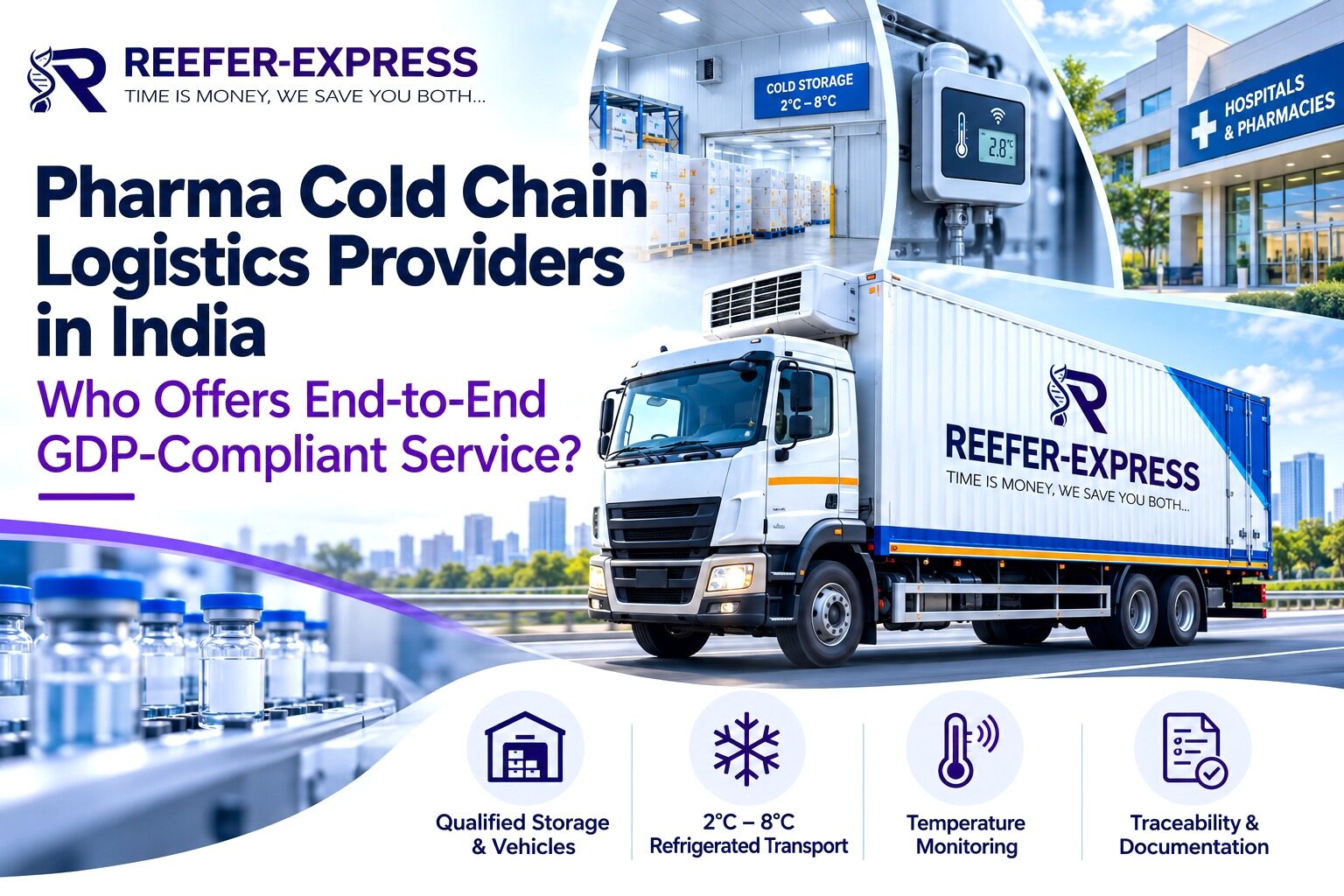
Pharma cold chain logistics providers in India fall into three groups: air-focused forwarders and carriers, domestic road and warehouse specialists, and integrated third-party logistics companies. Very few cover every step from the factory gate to the pharmacy shelf under one quality system. If you are a manufacturer, distributor, hospital group or clinical trial sponsor shortlisting a partner right now, this guide explains what end-to-end GDP-compliant service really means, which provider types deliver it, which documents to demand before you sign, and how to move from enquiry to your first validated shipment in about a month.
What End-to-End GDP-Compliant Service Means in Practice
Good Distribution Practice, usually shortened to GDP, is the quality framework that keeps a medicine within its labelled storage conditions from the moment it leaves the manufacturer until it reaches the patient. End-to-end means one accountable partner, or a tightly controlled chain of partners, covers storage, packing, transport, handover and documentation without gaps in temperature records or responsibility.
Many logistics companies advertise GDP compliance when they only meet part of the requirement. A refrigerated truck with a working compressor is not a GDP service. A GDP service adds qualified vehicles, calibrated monitoring devices, written procedures, trained staff, deviation handling, and records an auditor can read months later. If any link in the chain is missing, your batch is exposed, and so is your marketing authorisation.
Where India’s GDP Rules Stand Today
India’s regulator, the Central Drugs Standard Control Organisation, has been building out distribution guidance. It released a draft guideline on GDP for pharmaceutical products, built on WHO TRS 1025 Annex 7 on good storage and distribution practices. More recently it published a separate draft covering biological products, and RAPS reported that the draft expects written agreements between manufacturers and every party that stores, transports or distributes their products, with each party properly licensed for the work.
The practical meaning for buyers is simple. Even where Indian guidance is still moving through the draft stage, your own quality unit, your export customers and foreign inspectors already audit against WHO and EU style expectations. Choose a provider that works to that higher bar today, because retrofitting a weak supplier later costs far more than selecting a strong one now. Check the current status of the CDSCO documents before you finalise your supplier quality agreement, since regulatory text changes.
The Standards Buyers Actually Use to Judge a Provider
In procurement reviews, four reference points come up repeatedly. WHO TRS 1025 Annex 7 sets the principles. The EU GDP guidelines matter if you export to Europe. IATA CEIV Pharma certification matters for air freight and airport handling. ISO 9001 certification shows a managed quality system, though it is general rather than pharma specific, and buyers should confirm that the certificate refers to the current standard and covers the sites that will handle their product.
No single certificate proves end-to-end capability. What proves it is a combination of a documented quality system, qualified equipment, trained people and a clean audit of the exact sites and lanes you plan to use.
Types of Pharma Cold Chain Logistics Providers in India
Before comparing names, match the provider type to your shipment profile. A mismatch here causes more failures than a weak vendor within the right category.
Air-Focused Forwarders and Carriers for Export Lanes
If your volume is mostly exports of vaccines, biologics and finished formulations by air, look at forwarders and carriers with airport-level pharma certification. DACHSER India received IATA CEIV Pharma certification for its Mumbai and Hyderabad branches, and Agility India earned the same certification for its Mumbai operations, with life sciences facilities at Nhava Sheva seaport and Hyderabad airport. On the carrier side, Air India Cargo has received GDP certification covering domestic stations that include Delhi, Mumbai, Hyderabad, Bangalore, Chennai, Ahmedabad, Indore and Goa.
These providers are strong where the main risk sits at airports and on aircraft. They are usually not the right primary partner for daily domestic distribution to stockists and hospitals in tier two and tier three cities, because their strength lies in gateway handling rather than last-mile road networks.
Domestic Road and Warehouse Specialists
Most Indian pharma volume moves domestically: plant to depot, depot to distributor, distributor to chemist or hospital. This segment needs qualified refrigerated vehicles, multi-temperature warehouses, route discipline and local delivery coverage. Specialists in this group tend to be faster to onboard, closer to your plants, and more flexible on pallet volumes and delivery windows than global integrators.
Reefer Express operates in this category. It is headquartered in Hyderabad, which sits at the centre of India’s pharma manufacturing cluster, and reports 12 warehouses, more than 130,000 pallet positions, a fleet of over 50 vehicles and coverage of more than 100 cities. Its pharma supply chain solutions combine cold storage, transport and distribution under one operating team.
Integrated Third-Party Logistics Companies
A third group offers storage, domestic transport, air and ocean forwarding and value-added services across a single contract. These suit large manufacturers that want one commercial relationship and one quality agreement. The trade-off is that you often pay a premium, and the service level for smaller shipments can depend on how much volume you bring.
Most mid-sized companies end up with a hybrid model: a domestic specialist for storage and road distribution, and a certified air partner for export. The important point is that the handover between the two is written into a quality agreement, with defined responsibility for temperature records at every transfer.
Seven Checks Before You Appoint a Provider
The following checks apply whichever provider type you choose. Treat each one as a gate. If a provider cannot document it, either treat the gap as a risk you will manage or move on.
Check 1: Licences, Registrations and Audit History
Ask for the current warehouse and storage licences applicable to the sites that will hold your product, the registration details of the legal entity, and a summary of the last two external audits. Ask which customers audited them and when. A provider that has hosted pharmaceutical customer audits will hand these over without delay. Hesitation is informative.
Check 2: Qualified and Mapped Storage
Cold rooms and cold stores should have temperature mapping reports that show where the hot and cold spots are, the sensor positions chosen as a result, alarm limits, and a record of calibration for each probe. Ask how often mapping is repeated and what triggers a re-mapping. Seasonal extremes in India, particularly the pre-monsoon months, are the test that matters, so request mapping data from the hottest part of the year.
A feature worth looking for is a data logger assigned to each storage unit with real-time temperature and humidity access for you, not just a log retrieved after a complaint. Reefer Express states that it provides a data logger for each storage unit and monitors facilities around the clock, which is the kind of claim you should confirm during a site visit.
Check 3: Qualified Vehicles and Equipment
Vehicle qualification covers more than a working refrigeration unit. It should include temperature mapping of the loaded cargo space, pre-cooling procedures, door-open time rules, calibrated monitoring devices and a maintenance schedule. Ask for sample qualification reports across the vehicle types you will use. Our guide to temperature-controlled transportation services lists the vehicle questions worth asking before you commit.
Check 4: Packaging Validation
For shipments that leave controlled vehicles, such as courier delivery, trial kit dispatch or last-mile handover, packaging is the cold chain. Validated shippers should have documented performance across summer and winter profiles with defined hold times. Confirm that the provider can supply, validate and, where needed, collect and recycle packaging. See how packaging and distribution services can be matched to your product’s temperature range and transit duration.
Check 5: Real-Time Monitoring and Excursion Handling
GPS tracking and temperature telemetry are standard in this market. What differs is what happens after an alert. Ask for the written excursion procedure: who is notified, within what time, who decides on product disposition, and how the event is documented. The provider should not decide product fate. Your quality unit should, with the provider supplying full data. Request anonymised examples of past excursion reports to see how clearly they are written.
Check 6: Documentation, Traceability and Recall Support
Every movement should leave a trail that includes dispatch date, consignee, product details, quantities and condition at receipt. Ask how long records are retained, how quickly they can be retrieved, and whether the provider can support a mock recall. A provider that can trace a batch to every consignee within a few hours is operating at a different level from one that needs days to compile the same information.
Check 7: People, Training and Quality Ownership
GDP works only when drivers, warehouse staff and supervisors understand why the rules exist. Ask for training records, the name of the person responsible for quality at each site, and how that person escalates problems. A named, empowered quality owner is a stronger signal than a long list of certificates.
For a wider procurement framework you can adapt for tenders, use our RFP checklist for evaluating cold chain logistics vendors.
Reefer Express: What It Offers and What You Should Verify
Because this guide is published by Reefer Express, the same standard of scrutiny applies to us. Here is what the company offers, and where you should ask for evidence during your audit.
Services Relevant to Pharma Buyers
Reefer Express provides cold chain logistics solutions across India covering storage, transport and delivery, temperature-controlled logistics with refrigerated trailers and containers, and healthcare logistics for hospitals, diagnostics and medical products. Specialised programmes include the cell and gene supply chain for therapies with very narrow handling windows. Door-to-door transport uses single-use packaging and a data logger for each shipment, according to the company.
Where the Fit Is Strongest
The strongest fit is a manufacturer or distributor based in or around Hyderabad that needs domestic cold storage and road distribution across many cities, with flexible pallet volumes and no minimum fleet commitment. It also suits hospital networks and diagnostic companies that need predictable delivery windows for temperature-sensitive supplies, and companies that want a regional partner to complement a certified air forwarder on export lanes.
What to Ask for During Your Audit
Request the certificate scope for each quality standard the company cites, with the standard version and the sites covered, along with current licences for the warehouses you would use. Ask for mapping reports, vehicle qualification files, the excursion procedure and the training matrix. Ask for a reference from a pharmaceutical customer with a similar product profile. A provider confident in its system will welcome this process, and so will we.
What Drives Pharma Cold Chain Pricing in India
Price comparisons fail when buyers compare per-kilometre or per-pallet numbers without checking what sits inside them. Four variables explain most of the difference between quotes.
The first is temperature range. Controlled room temperature at 15 to 25 degrees Celsius costs less than refrigerated 2 to 8 degrees Celsius, and frozen or deep-frozen ranges cost significantly more. The second is monitoring depth. A single logger per consignment is cheaper than continuous telemetry with live alerts. The third is shipment profile, because full truckloads, part truckloads and small parcels carry very different cost structures. The fourth is packaging, since validated passive shippers add cost that often replaces a more expensive active vehicle on difficult lanes.
Ask every bidder to price the same scenario, with the same temperature range, lane, volume, monitoring level and documentation, and require a line-by-line breakdown. Storage agreements usually become cheaper for longer commitments, so ask about term discounts, but do not lock in a long contract before a pilot has proved the service.
How to Onboard a GDP-Compliant Provider in About 30 Days
A structured start prevents the most common failure, which is a signed contract followed by weeks of unclear responsibilities.
In the first week, share your product temperature requirements, stability data summary, lane list and volume forecast, and request the provider’s quality documentation. In the second week, run a desk review followed by a site audit of the warehouse and a vehicle inspection. In the third week, finalise the quality agreement that defines responsibilities at each handover, excursion handling, change control, record retention and recall support, and agree the commercial terms. In the fourth week, run a pilot on your busiest lane with data loggers in every shipment, then review the temperature records together before releasing commercial volume.
Keep the pilot honest by running it in conditions that reflect real operations, including a loaded vehicle waiting at a dock and a delivery at a busy hospital. A pilot staged in perfect conditions teaches you nothing.
Choosing the Right Provider for Your Situation
For an exporter moving high-value biologics by air to regulated markets, start with certified air forwarders and carriers, then add a domestic partner for pre-carriage to the airport. For a domestic manufacturer supplying chemists and hospitals across several states, a road and warehouse specialist with multi-city reach is the more practical primary partner. For a clinical trial sponsor handling cell and gene therapies, prioritise a provider with proven experience in narrow time windows and chain-of-custody documentation. For a distributor with seasonal volume swings, favour a provider with flexible pallet capacity over a fixed fleet commitment.
If your needs span more than one of these, expect to run a hybrid model and invest time in the quality agreement that joins the parts together.
Request a Quote and Audit Visit
If you want a domestic cold chain partner with storage, transport and distribution under one team, contact Reefer Express with your product temperature range, lanes, monthly volume and any compliance documents you need to see. Share the scope and we will respond with a lane-level quote and an audit date, so your quality team can verify our systems before any product moves.
Frequently Asked Questions
Which pharma cold chain logistics providers in India offer end-to-end GDP-compliant services?
No single provider fits every shipment. Certified air forwarders and carriers such as DACHSER India, Agility India and Air India Cargo are strong on export lanes. Domestic specialists such as Reefer Express cover storage and road distribution across Indian cities. Large integrated 3PLs combine several modes. Verify each provider through an audit, because the certificate alone does not prove coverage of your lanes.
Is GDP certification mandatory for pharma logistics providers in India?
India has published draft GDP guidelines through CDSCO for pharmaceutical products and for biological products, and a final binding position should be checked directly with the regulator at the time you contract. In practice, your own quality system, export customers and foreign inspectors expect GDP-aligned controls, so most manufacturers require them in the supplier agreement regardless of the Indian legal position.
What temperature ranges do pharma cold chain providers handle?
Common ranges are controlled room temperature at 15 to 25 degrees Celsius, refrigerated at 2 to 8 degrees Celsius, frozen at minus 20 degrees Celsius, and ultra-low or cryogenic ranges for cell and gene therapies. Confirm that the provider has qualified equipment for your exact range, not an adjacent one.
How do I verify that a provider is genuinely GDP-compliant?
Audit the sites and vehicles you will use. Review mapping reports, calibration records, vehicle qualification files, training records, the excursion procedure and a sample of past temperature data. Speak to a pharmaceutical reference customer. A certificate supports your decision but does not replace the audit.
What is the difference between GDP and CEIV Pharma?
GDP is a set of quality principles for storage and distribution of medicines. CEIV Pharma is an IATA certification programme focused on air cargo handling of pharmaceutical products at airports and by forwarders and carriers. A provider can hold one, both or neither, and each covers a different part of the chain.
How much does pharma cold chain logistics cost in India?
Cost depends on temperature range, monitoring depth, shipment size, lane distance and packaging. Refrigerated and frozen ranges cost more than controlled room temperature. Ask each bidder to price an identical scenario so the quotes compare fairly.
Can a provider handle both storage and transport under one contract?
Yes. Several Indian providers combine cold storage, transport and distribution, which simplifies the quality agreement and reduces handover risk. Confirm that the same quality system covers both the warehouse and the vehicles.
How long does it take to start working with a new cold chain provider?
A realistic timeline is three to five weeks, covering documentation review, site audit, quality agreement, commercial terms and a pilot shipment with data loggers. Rushing the audit or the pilot is the most common cause of later problems.