

Choosing a cold chain logistics vendor requires more than comparing transportation rates or warehouse capacity. Businesses handling pharmaceuticals, vaccines, biologics, food products and other temperature-sensitive goods need a logistics partner that can maintain the required conditions throughout storage, transportation and delivery.
A vendor may offer refrigerated vehicles and temperature-controlled warehouses, but procurement teams must also evaluate temperature monitoring, shipment documentation, contingency planning, distribution coverage and service reliability. A gap in any of these areas can affect product quality, delivery schedules and operating costs.
A Request for Proposal (RFP) helps businesses evaluate potential vendors against the same requirements. Instead of relying on sales presentations or price quotations alone, procurement teams can use a structured process to compare capabilities, identify risks and select a partner that meets their operational needs.
This guide explains how to evaluate cold chain logistics vendors, what to include in an RFP and which questions to ask before signing a contract.
1. Define Your Cold Chain Logistics Requirements
Before contacting vendors, establish what your business needs from a cold chain logistics provider. Requirements vary depending on the product, storage conditions, shipment volume and delivery locations.
For example, a pharmaceutical manufacturer distributing temperature-sensitive medicines may need controlled storage, validated packaging, shipment monitoring and documented handling procedures. A food distributor may focus more on refrigerated transportation, delivery frequency, warehouse capacity and product freshness.
Your RFP should clearly state the following requirements:
- Product type: Pharmaceuticals, vaccines, biologics, food products or other temperature-sensitive goods.
- Temperature range: The required storage and transportation conditions for each product.
- Storage requirements: Ambient-controlled, chilled, frozen or other specified conditions.
- Shipment volume: Average shipment size, monthly volume and expected seasonal variations.
- Distribution coverage: Origin and destination locations, including regional and pan-India requirements.
- Delivery schedules: Standard transit times, delivery windows and urgent shipment requirements.
- Additional services: Packaging, order fulfilment, inventory management, documentation and last-mile delivery.
Providing this information allows vendors to submit proposals based on your actual requirements rather than general service descriptions.
2. Check the Vendor’s Experience and Industry Expertise
Cold chain logistics requires specialised operating procedures. A vendor experienced in transporting general cargo may not have the infrastructure or expertise needed to handle sensitive pharmaceutical products or biologics.
Ask vendors about their experience with products similar to yours. Their response should demonstrate practical knowledge of the storage conditions, transportation requirements and handling procedures involved.
During the evaluation, consider:
- Experience handling your product category.
- Experience managing similar shipment volumes.
- Knowledge of applicable industry regulations and handling requirements.
- Availability of trained warehouse, transportation and quality personnel.
- Experience serving businesses across your required locations.
- References from clients with comparable logistics requirements.
Request relevant case studies or client references where available. Ask how the vendor manages temperature excursions, delayed deliveries, equipment failures and other operational issues.
For pharmaceutical shipments, experience with similar products and quality requirements is particularly important. The vendor should be able to explain how it maintains shipment integrity and provides the documentation needed by your quality team.
3. Evaluate Temperature-Controlled Storage Facilities
Warehouse conditions directly affect the quality of temperature-sensitive products. Procurement teams should assess whether a vendor’s facilities can maintain the required conditions consistently.
Do not evaluate a warehouse solely on its total storage capacity. Check whether the available storage areas, equipment and operating procedures match your product requirements.
Your RFP should request details about:
- Available temperature zones and their operating ranges.
- Total storage capacity and currently available capacity.
- Temperature mapping and qualification procedures, where applicable.
- Temperature monitoring equipment and calibration records.
- Alarm systems for temperature deviations and equipment failures.
- Backup power and refrigeration arrangements.
- Cleaning, pest control and access control procedures.
- Inventory management and stock rotation processes.
- Procedures for handling damaged, expired or quarantined products.
For pharmaceutical and biologic products, ask whether the vendor can provide documented evidence of temperature control and relevant facility qualification. Requirements should be assessed according to the product, applicable regulations and the responsibilities assigned to each party.
A site visit can help verify whether the facilities match the proposal. During the visit, review the warehouse layout, loading areas, monitoring systems and procedures for receiving and dispatching shipments.
4. Assess the Refrigerated Transportation Fleet
A reliable cold chain operation depends on the condition and suitability of its transportation equipment. The vendor must be able to maintain the required temperature throughout the journey, including loading, unloading and temporary delays.
Ask for a breakdown of the available fleet, including vehicle types, capacities, temperature ranges and geographic availability.
The RFP should cover:
- Number and types of refrigerated vehicles available.
- Availability of dedicated or shared transportation.
- Temperature ranges supported by the fleet.
- Refrigeration unit maintenance schedules.
- Temperature monitoring during transit.
- Driver training for temperature-sensitive shipments.
- Vehicle cleaning and hygiene procedures.
- Backup vehicles and arrangements for breakdowns.
- Availability of GPS tracking and shipment status updates.
- Procedures for managing route changes and delivery delays.
If your shipments require specific temperature conditions, confirm that the proposed vehicle can maintain them under expected operating conditions.
Ask the vendor to explain what happens if a refrigeration unit fails during transit. The response should identify who receives the alert, how the shipment is protected, when a replacement vehicle is arranged and how the incident is documented.
These details help procurement teams distinguish between vendors that simply operate refrigerated vehicles and those with defined procedures for protecting cargo during unexpected events.
5. Review Temperature Monitoring and Shipment Visibility
Temperature monitoring provides evidence of the conditions under which products have been stored and transported. It also helps identify potential problems before they affect a shipment.
During the RFP process, ask vendors to explain their monitoring systems and the information they provide to customers.
Important evaluation criteria include:
Real-time temperature monitoring: Can the vendor monitor temperatures continuously or at defined intervals, depending on the shipment requirements?
Data loggers: Are temperature data loggers available for individual shipments? Can customers access the recorded data?
GPS tracking: Can customers view vehicle location, shipment progress and estimated delivery times?
Automated alerts: Does the system notify designated personnel when temperature or other predefined limits are exceeded?
Reporting: Can the vendor provide temperature records, delivery confirmation and exception reports?
Data retention: How long are shipment records retained, and can they be retrieved when required?
System access: Can the customer’s procurement, operations and quality teams access the relevant information?
For pharmaceutical shipments, temperature records may be required for quality reviews, investigations and audits. Confirm that the vendor can provide complete, traceable records in an agreed format and within the required timeframe.
Do not assume that GPS tracking alone provides temperature visibility. These are separate capabilities, and both may be necessary depending on the shipment.
6. Verify Quality Management and Regulatory Compliance
Regulatory and quality requirements should be defined before selecting a cold chain logistics vendor, particularly when transporting pharmaceuticals, vaccines, biologics or clinical trial materials.
The vendor should explain which standards, licences, certifications and documented procedures apply to its facilities and services.
Ask for evidence relevant to your product category, including:
- Applicable licences and registrations.
- Relevant quality certifications, where held.
- Good Distribution Practice (GDP) procedures, where applicable.
- Standard operating procedures for receiving, storage, handling and dispatch.
- Temperature excursion investigation and reporting procedures.
- Equipment calibration and maintenance records.
- Staff training records.
- Internal audit procedures and corrective action records.
- Product traceability and shipment documentation.
- Procedures for handling rejected, damaged or potentially compromised products.
For pharmaceutical logistics, clarify how the vendor supports the customer’s quality management system and any applicable regulatory obligations.
Certifications should be verified for their scope, validity and relevance to the proposed service. A certification held by a company does not automatically establish that every facility, vehicle or operation is covered by it.
The RFP should also establish who is responsible for investigating temperature excursions, reviewing product impact and authorising the release or rejection of affected goods. These responsibilities should be documented in the final agreement.
7. Examine Packaging and Distribution Capabilities
Temperature-controlled transportation is only one part of a cold chain operation. Packaging, handling and distribution arrangements can also affect product integrity.
This is particularly important for pharmaceutical products, biologics and other goods that require specific temperature protection during transit.
Ask the vendor whether it provides:
- Insulated shipping containers and temperature-controlled packaging.
- Packaging suitable for the required temperature range and shipment duration.
- Qualified or validated packaging solutions, where required.
- Appropriate coolant materials and packing procedures.
- Single-use or reusable packaging options.
- Packaging assembly and dispatch services.
- Last-mile delivery for temperature-sensitive shipments.
- Return handling for reusable packaging, where applicable.
- Documentation for packaging configuration and shipment monitoring.
The appropriate packaging depends on the product, route, expected transit time and environmental conditions. A solution suitable for a short domestic shipment may not be suitable for a longer journey with multiple handling points.
Ask vendors to explain how they select packaging for different routes and what evidence supports its suitability for your products.
8. Evaluate Geographic Coverage and Delivery Performance
A vendor may have suitable facilities but limited coverage in the regions where your business operates. Procurement teams should confirm that the proposed network can support current distribution requirements and future expansion.
Provide vendors with your expected origin and destination locations. Request details about service availability, transit times and delivery arrangements for each location.
Evaluate:
- Warehouse locations and distribution hubs.
- Cities and regions served directly.
- Areas covered through subcontractors.
- Standard transit times for major routes.
- Delivery performance against agreed schedules.
- Availability of urgent or time-critical deliveries.
- Handling arrangements at transfer points.
- Seasonal capacity and peak-period planning.
- Procedures for delays caused by traffic, weather or other disruptions.
Ask for historical delivery performance data where available. Review the reporting period, number of shipments and definition of on-time delivery to ensure that comparisons are meaningful.
For businesses operating across multiple cities, also assess whether the vendor can coordinate warehousing, transportation and final delivery under a single operating arrangement.
9. Review Contingency Planning and Risk Management
Cold chain operations can face refrigeration failures, power interruptions, vehicle breakdowns, route disruptions and unexpected delays. The vendor’s ability to respond to these events should form a major part of the evaluation.
An RFP should require vendors to explain their contingency plans and demonstrate how these plans work in practice.
Questions to include are:
- What happens if a warehouse loses power?
- How are refrigeration failures detected and escalated?
- Is backup storage available during equipment failure?
- How quickly can a replacement vehicle be arranged?
- How are temperature excursions reported to customers?
- What procedures apply when a shipment is delayed?
- How are affected products identified and segregated?
- How are incidents investigated and documented?
- Does the vendor maintain a business continuity plan?
- How frequently are emergency procedures reviewed or tested?
For sensitive products, the vendor should have a defined process for protecting the shipment while the incident is investigated.
The contract should also clarify escalation contacts, response times, reporting requirements and responsibilities for decisions involving potentially compromised products.
A documented contingency plan is useful only if staff understand it and the necessary equipment, contacts and resources are available when needed.
10. Compare Pricing and the Total Cost of Service
Transportation rates are important, but the lowest quotation may not represent the lowest overall cost.
Cold chain logistics pricing can include transportation, storage, handling, packaging, monitoring and additional charges for special requirements. If vendors use different pricing structures, comparing quotations becomes difficult.
Ask every vendor to provide an itemised commercial proposal covering:
| Cost component | What to clarify |
| Transportation | Rates by route, vehicle type, shipment size or weight |
| Storage | Charges by pallet, unit, volume or storage duration |
| Handling | Inbound, outbound, loading and unloading fees |
| Packaging | Packaging materials, assembly and reusable packaging charges |
| Monitoring | Data loggers, monitoring devices and reporting fees |
| Additional services | Urgent deliveries, special handling and other agreed services |
| Waiting time | Charges for vehicle detention or delayed loading |
| Failed delivery | Redelivery, return transportation and related charges |
| Fuel and surcharges | Applicable adjustments and calculation methods |
| Taxes and payment terms | Taxes, credit period, billing frequency and payment conditions |
Request pricing for your expected shipment volumes and typical routes. This will help you compare proposals using the same assumptions.
Also review minimum billing quantities, contract duration, annual price revisions and volume commitments.
Where appropriate, compare the quoted price with the vendor’s ability to meet your service requirements. A lower rate may not be suitable if it excludes essential monitoring, backup arrangements or documentation.
11. Assess Customer Support and Account Management
Cold chain logistics often requires coordination between procurement, warehouse operations, transportation teams and quality personnel. Clear communication is essential when shipments are delayed or operating conditions change.
Ask vendors to explain their customer support structure and how day-to-day operations will be managed.
Your evaluation should cover:
- Availability of a dedicated account manager.
- Access to an operations contact during business hours and emergencies.
- Escalation procedures for delayed or temperature-sensitive shipments.
- Response times for customer queries.
- Frequency of operational and performance reviews.
- Availability of shipment status reports.
- Procedures for resolving billing and service disputes.
- Coordination between the vendor’s operations and quality teams.
If your business operates continuously or handles critical healthcare products, confirm whether support is available outside standard business hours.
The vendor should also identify who will manage service issues and communicate with your team until the issue is resolved.
12. Check the Vendor’s Subcontracting Policy
Some logistics providers use third-party transport operators, warehouse partners or local distribution agents to extend their network.
Subcontracting is not necessarily a problem, but procurement teams need to understand how the arrangement affects service quality, visibility and accountability.
Include the following questions in your RFP:
- Which parts of the service will be subcontracted?
- Will the customer be informed before subcontractors are used?
- How are subcontractors evaluated and approved?
- Are subcontracted vehicles and facilities subject to the same temperature-control requirements?
- Who is responsible for monitoring and documenting subcontracted shipments?
- How are incidents involving subcontractors reported?
- Who remains accountable for service performance?
The contract should clearly define the primary vendor’s responsibilities, including any obligations relating to subcontracted services.
This is particularly important when a shipment passes through multiple facilities or transportation providers.
13. Use a Standardised Vendor Evaluation Scorecard
Once the proposals are received, evaluate each vendor against the same criteria. This reduces the risk of selecting a provider based only on price, presentation quality or an individual evaluator’s preference.
The following example can be adapted to your business requirements.
| Evaluation criterion | Suggested weight |
| Temperature control and monitoring | 20% |
| Quality management and compliance | 20% |
| Transportation and storage capabilities | 15% |
| Geographic coverage and delivery performance | 15% |
| Contingency planning and risk management | 10% |
| Pricing and commercial terms | 10% |
| Customer support and reporting | 5% |
| Relevant experience and references | 5% |
| Total | 100% |
These weights are illustrative. A pharmaceutical manufacturer may place greater emphasis on quality management and temperature monitoring, while a food distributor may prioritise delivery frequency, network coverage and operating costs.
Score each criterion on a consistent scale, such as 1 to 5:
- 1 – Poor: The vendor does not meet the requirement.
- 2 – Limited: The vendor meets only part of the requirement.
- 3 – Acceptable: The vendor meets the basic requirement.
- 4 – Strong: The vendor meets the requirement with supporting evidence.
- 5 – Excellent: The vendor demonstrates strong capability, documented processes and relevant evidence.
Calculate the weighted score by multiplying each criterion’s weight by the vendor’s score divided by 5.
For example, if a vendor scores 4 out of 5 on a criterion weighted at 20%, its weighted contribution is 16 percentage points.
Use the scorecard to support the decision, not replace technical and quality reviews. A vendor that fails a mandatory temperature-control or regulatory requirement should not be selected simply because it achieves a high overall score.
14. Conduct a Site Visit and Operational Assessment
Documentation helps procurement teams shortlist vendors, but a site visit can reveal operational gaps that may not be obvious in a proposal.
Where practical, inspect the proposed warehouse, transportation facilities or relevant operating locations before making the final decision.
During the assessment, verify:
- Whether the proposed facilities are available for your business.
- Whether temperature monitoring equipment is installed and operational.
- Whether temperature records and alarm logs can be retrieved.
- Whether equipment maintenance and calibration records are available.
- Whether warehouse procedures match the documented SOPs.
- Whether staff understand the required handling procedures.
- Whether backup power and emergency arrangements are in place.
- Whether loading and unloading areas support the required conditions.
- Whether inventory and shipment records are traceable.
- Whether corrective actions from previous audits have been addressed.
For pharmaceutical logistics, involve the quality assurance team in the assessment. Procurement, operations and quality teams may identify different risks, and all three perspectives are useful before final approval.
Record the findings and ask the vendor to address any gaps before the contract is awarded.
15. Run a Pilot Shipment Before Full Implementation
A pilot shipment can help verify whether the vendor’s proposed processes work under actual operating conditions.
This is especially useful when introducing a new logistics provider, changing transportation routes or outsourcing a significant part of your cold chain operation.
Agree on the pilot’s scope before dispatch. Define the product requirements, route, temperature range, shipment duration, packaging configuration and delivery expectations.
During the pilot, evaluate:
- Temperature stability throughout the shipment.
- Availability and accuracy of monitoring records.
- GPS visibility and shipment status updates.
- Delivery performance against the agreed schedule.
- Packaging condition at delivery.
- Communication during routine operations and exceptions.
- Completeness of delivery and quality documentation.
- Resolution of any issues encountered.
Review the results with the vendor and relevant internal teams. Document corrective actions and confirm whether the provider meets the agreed acceptance criteria.
For regulated or highly sensitive products, the pilot must follow applicable quality procedures and receive the required internal approvals. A successful test shipment should not be treated as a substitute for formal qualification or validation where those activities are required.
16. Finalise the Contract and Service-Level Agreement
After completing the evaluation, document the agreed service requirements in a contract and Service-Level Agreement (SLA).
The agreement should establish measurable expectations and clarify responsibilities when performance falls short.
Include provisions covering:
Temperature requirements: Specify the required conditions for storage and transportation, along with monitoring and reporting obligations.
Delivery performance: Define the on-time delivery target, measurement method and reporting frequency.
Incident reporting: Establish how quickly the vendor must report temperature excursions, equipment failures and other significant incidents.
Documentation: Specify the records the vendor must provide, their format and the time allowed for delivery.
Escalation: Identify operational and quality contacts, escalation levels and emergency communication procedures.
Product liability and insurance: Clarify responsibility for loss, damage, temperature excursions and other incidents, together with applicable insurance coverage and contractual limits.
Audit rights: Define the customer’s right to review relevant facilities, records and processes, subject to applicable confidentiality and contractual requirements.
Subcontracting: Set conditions for subcontractor approval, monitoring and accountability.
Pricing and termination: Document rates, price revisions, contract duration, renewal terms and termination conditions.
Performance reviews: Establish periodic reviews of service levels, incidents, corrective actions and opportunities for improvement.
Avoid vague commitments such as “timely delivery” or “proper temperature maintenance.” Use measurable requirements wherever possible and ensure that the agreement reflects the actual needs of your products and operations.
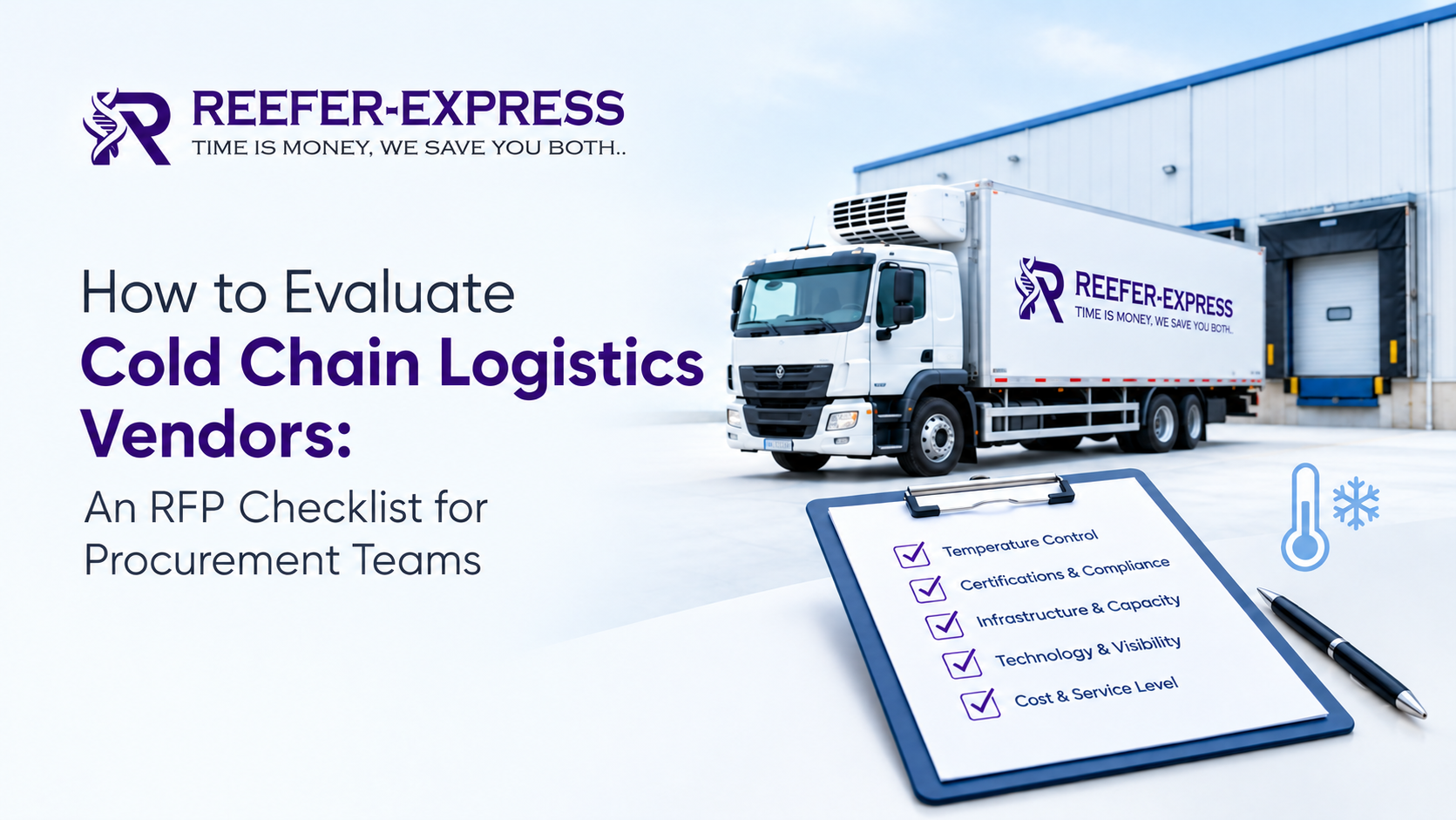
Cold Chain Logistics Vendor RFP Checklist
Use the following checklist before approving a vendor.
- Product types, temperature ranges and shipment volumes are clearly defined.
- Relevant industry experience and client references have been reviewed.
- Warehouse capacity and temperature-controlled facilities have been assessed.
- Refrigerated fleet availability and maintenance procedures have been verified.
- Temperature monitoring, data loggers and shipment visibility have been evaluated.
- Applicable licences, certifications and quality procedures have been checked.
- Packaging and distribution capabilities meet shipment requirements.
- Geographic coverage and delivery performance have been reviewed.
- Contingency plans and temperature excursion procedures have been assessed.
- Itemised pricing and commercial terms have been compared.
- Customer support and escalation procedures have been confirmed.
- Subcontracting arrangements and responsibilities are documented.
- Vendor proposals have been scored against common criteria.
- Site assessments and pilot shipments have been completed where appropriate.
- Contract terms and service-level commitments have been agreed.
Conclusion
Evaluating cold chain logistics vendors requires a structured review of temperature control, infrastructure, quality management, delivery capabilities, risk management and commercial terms. Procurement teams should assess these factors against the actual requirements of their products rather than selecting a provider based on price alone.
A well-prepared RFP makes the selection process more transparent. It helps businesses compare vendors using consistent criteria, identify operational risks before signing a contract and establish clear service expectations from the beginning.
For businesses handling pharmaceuticals, biologics, healthcare products or other temperature-sensitive goods, the right logistics partner should be able to demonstrate how it maintains shipment integrity, provides reliable monitoring and manages unexpected disruptions.
Reefer Express provides cold chain logistics, temperature-controlled transportation, storage, pharmaceutical supply chain solutions, healthcare logistics and packaging and distribution services. Businesses evaluating logistics partners can discuss their storage requirements, shipment volumes, temperature specifications and distribution needs with the Reefer Express team to determine whether its services are suitable for their operations.
Need a cold chain logistics partner for your business? Contact Reefer Express to discuss your temperature-controlled storage and transportation requirements and request further information about available solutions.
“`html “`