

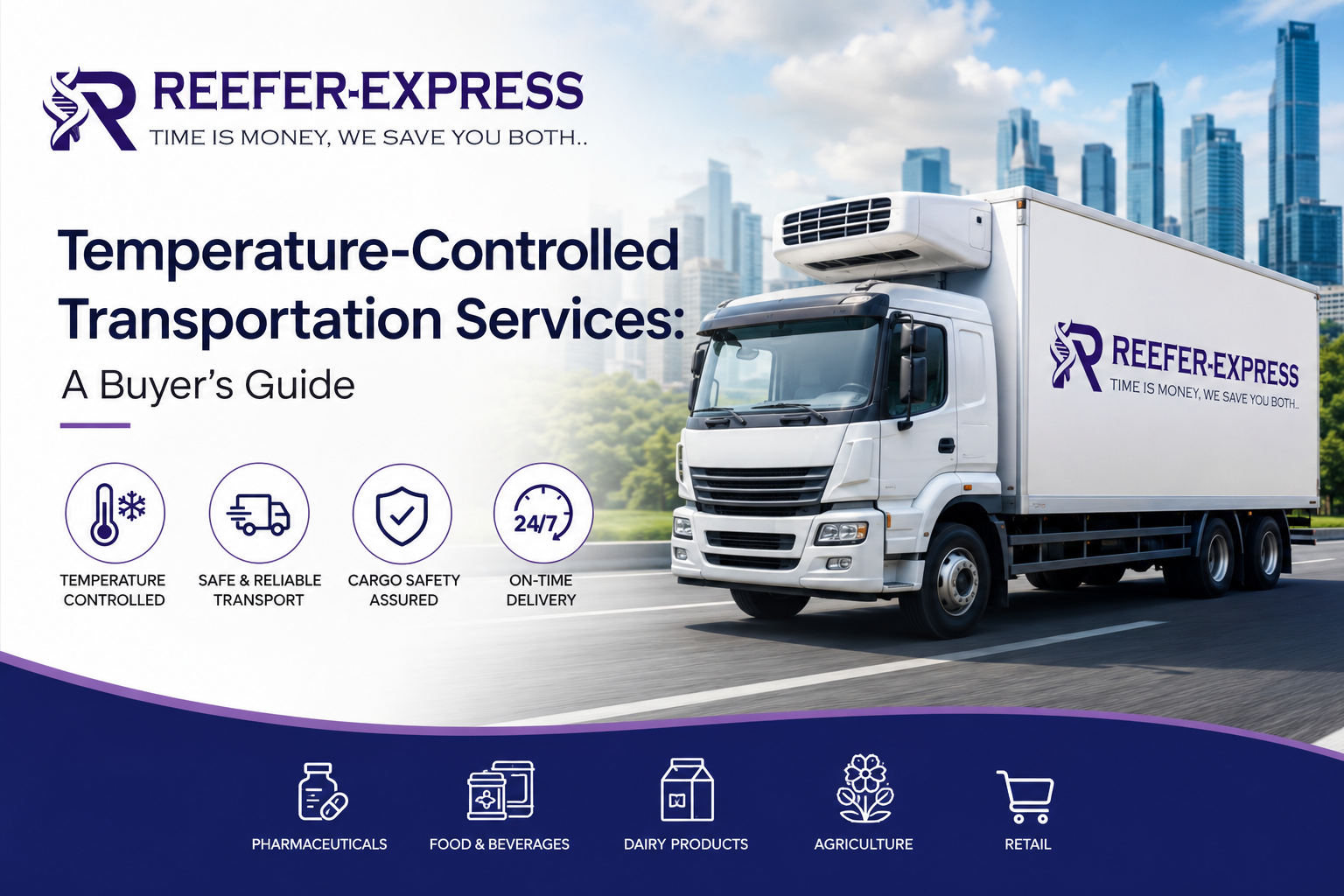
Choosing a temperature-controlled transportation provider is an important decision for businesses that move pharmaceutical products, healthcare supplies, food products or other temperature-sensitive goods. The right provider helps maintain the required conditions during transit, reduces the risk of product damage and supports reliable deliveries.
However, not every transport provider offers the same level of temperature control, monitoring, documentation or shipment visibility. Before selecting a logistics partner, businesses need to understand their transportation requirements and evaluate providers against clear operational criteria.
This guide explains what temperature-controlled transportation services include, what to check before hiring a provider and how to compare transport partners for your business.
What Are Temperature-Controlled Transportation Services?
Temperature-controlled transportation services involve moving goods in vehicles or containers designed to maintain specified temperature conditions throughout transit.
These services are used when changes in temperature can affect a product’s quality, safety, stability or usability. Depending on the shipment, transportation may require refrigerated vehicles, insulated packaging, temperature-monitoring devices or a combination of these solutions.
Temperature-controlled transport is commonly used for:
- Pharmaceutical products: Medicines and other temperature-sensitive pharmaceutical supplies.
- Vaccines and biological products: Shipments that require specific handling and temperature conditions.
- Biotechnology products: Sensitive materials that may need carefully controlled transportation.
- Food and perishable goods: Products that require refrigeration or frozen transport.
- Healthcare supplies: Medical products that must be protected from unsuitable environmental conditions.
The required conditions depend on the product. A suitable transportation solution should be selected according to the product’s documented storage and transport requirements rather than a general assumption about temperature.
How Do Temperature-Controlled Transportation Services Work?
A temperature-controlled shipment involves more than placing goods inside a refrigerated vehicle. The process starts with understanding the shipment requirements and continues through delivery and the review of relevant records.
1. Shipment assessment
The logistics provider reviews the product type, required temperature range, shipment volume, packaging, collection location, delivery destination and expected transit time.
For pharmaceutical and healthcare shipments, the provider may also need to understand product-specific handling instructions and documentation requirements.
2. Vehicle and equipment selection
The provider selects a suitable vehicle, container or transport configuration based on the shipment requirements. This may include refrigerated vehicles, insulated transport equipment and temperature-monitoring devices.
The equipment should be appropriate for the expected journey, including the shipment size, duration and external conditions.
3. Pre-dispatch checks
Before collection, the transport team should confirm that the vehicle is suitable for the shipment and that the required temperature conditions have been established.
Businesses should ask what checks are completed before loading and how the provider handles equipment faults or temperature deviations.
4. Temperature monitoring during transit
Temperature monitoring helps establish whether shipment conditions remained within the required limits during transportation.
Depending on the service, monitoring may involve data loggers, electronic sensors or other tracking systems. Businesses should confirm what information is recorded, whether it can be accessed during transit and how monitoring records are provided after delivery.
5. Delivery and documentation
At the destination, the shipment is handed over according to the agreed delivery procedure. Relevant records may include delivery confirmation, temperature logs, shipment documentation and details of any reported deviations.
For sensitive products, these records help the business assess whether the shipment was handled according to its requirements.
What to Check When Evaluating Temperature-Controlled Transport Providers
Evaluating transport providers requires more than comparing prices. A suitable partner should have the equipment, processes, trained personnel and communication systems needed for the specific shipment.
1. Experience with your product category
Start by checking whether the provider has experience transporting products similar to yours.
A company that handles general refrigerated goods may not have the same procedures or documentation practices required for pharmaceutical or biotechnology shipments.
Ask the provider:
- What types of temperature-sensitive products do you transport?
- Do you handle pharmaceutical and healthcare shipments?
- Can you support our shipment size, route and delivery schedule?
- Can you share relevant examples of your operational experience?
The objective is to establish whether the provider understands the handling requirements of your products, not simply whether it owns refrigerated vehicles.
2. Temperature range and control capabilities
Confirm that the provider can maintain the temperature conditions required for your shipment throughout the journey.
Do not assume that every refrigerated vehicle can support every temperature requirement. Ask about the equipment available, its operating capabilities and how the provider verifies conditions before dispatch.
You should also establish what happens if the required conditions cannot be maintained.
For pharmaceutical shipments, the transport arrangements should be consistent with the product’s specified storage and transportation requirements and the applicable procedures of your business.
3. Vehicle condition and maintenance
Vehicle condition can directly affect the reliability of temperature-controlled transportation.
Ask how vehicles and refrigeration equipment are inspected and maintained. Find out whether preventive maintenance is scheduled and how equipment failures are managed.
Important checks include:
- Condition of the refrigeration unit.
- Suitability of the vehicle for the shipment.
- Maintenance and inspection procedures.
- Availability of backup arrangements.
- Procedures for handling vehicle breakdowns or equipment failure.
A provider should be able to explain how it reduces the risk of a temperature-control failure during transit.
4. Temperature monitoring and shipment visibility
Temperature monitoring helps businesses identify whether the required conditions are being maintained. Shipment tracking provides visibility into the location and progress of the vehicle.
These are related but different functions. GPS tracking shows where a vehicle is, while temperature monitoring records the conditions inside the shipment environment or monitoring location.
When evaluating providers, ask:
- Is temperature data recorded throughout the journey?
- Are monitoring devices suitable for the shipment?
- Can the customer access temperature information during transit?
- Are temperature records available after delivery?
- How are temperature deviations communicated?
- Is GPS tracking available for shipment visibility?
For sensitive shipments, clarify how quickly the provider notifies the customer of an issue and who is responsible for deciding the next steps.
5. Temperature deviation management
A temperature deviation occurs when monitored conditions move outside the agreed limits. It can happen because of equipment failure, delays, incorrect handling or other operational problems.
The provider should have a defined process for identifying, reporting and managing deviations.
Ask how the company records the incident, notifies the customer, protects the shipment where possible and supplies supporting information for assessment.
It is also important to establish who makes decisions about the affected goods. A transport provider should not independently determine whether a pharmaceutical product remains suitable for use unless that responsibility has been formally assigned and is supported by the appropriate process.
6. Route planning and delivery reliability
Temperature-controlled shipments can be affected by long transit times, traffic, loading delays and unexpected route changes.
A reliable provider should assess the proposed route and estimated journey time before accepting the shipment. For regular movements, ask whether the provider can support a consistent schedule.
Evaluate the following:
- Expected transit time.
- Collection and delivery windows.
- Route planning procedures.
- Communication during delays.
- Contingency arrangements.
- Ability to support recurring shipments.
For urgent healthcare and pharmaceutical movements, confirm whether the provider can meet the required delivery schedule before booking.
7. Packaging and loading procedures
Temperature control depends on the complete transport arrangement, not only the vehicle.
Depending on the product, shipment duration and transport conditions, suitable packaging may be necessary to protect the goods from temperature fluctuations. Loading procedures also matter because poor handling can compromise the shipment.
Ask whether the provider can support the packaging specified for your products and whether its team follows defined loading and unloading procedures.
You should also clarify which party is responsible for packaging, pre-conditioning, loading, unloading and checking the shipment at handover.
8. Documentation and reporting
Documentation helps businesses verify how a shipment was transported and investigate problems when they occur.
Before appointing a provider, confirm which records are included in the service and how long they remain available.
Depending on the shipment and agreed requirements, documentation may include:
- Shipment and delivery records.
- Temperature-monitoring reports.
- Vehicle or equipment check records.
- Details of delays or temperature deviations.
- Incident reports and corrective actions.
- Relevant handling and handover records.
Pharmaceutical and healthcare businesses should assess documentation against their own quality procedures and applicable requirements. Do not assume that a provider meets a particular regulatory or quality standard without checking the relevant evidence.
9. Geographic coverage and transport capacity
The provider must be able to support your collection and delivery locations without compromising the required handling conditions.
Ask whether the company operates directly on your route or uses subcontractors. If subcontractors are involved, clarify how transport conditions, monitoring, communication and documentation are managed across the journey.
For businesses with frequent shipments, evaluate the provider’s capacity to handle normal demand as well as periods of increased volume.
Check its ability to support your required vehicle type, shipment size, delivery frequency and service area.
10. Customer support and accountability
Clear communication is important when goods are time-sensitive.
Before signing an agreement, establish who will manage your shipments, how operational updates are shared and whom you should contact if a delay or equipment problem occurs.
You should also clarify responsibilities for shipment acceptance, monitoring, deviation reporting, incident investigation and delivery confirmation.
A provider with clear communication and defined responsibilities is easier to evaluate and manage over time.
Temperature-Controlled Transportation Services: Questions to Ask Before Hiring
Use the following questions when comparing shortlisted providers.
| Evaluation area | Questions to ask |
| Product experience | Do you have experience transporting our product category? |
| Temperature requirements | Can you maintain the specific conditions our shipment requires? |
| Vehicles and equipment | What vehicles and refrigeration equipment are available? |
| Maintenance | How are vehicles and refrigeration units inspected and maintained? |
| Temperature monitoring | How is temperature recorded during transit? |
| Shipment tracking | Can we access shipment location and status updates? |
| Deviations | How are temperature excursions identified and reported? |
| Route planning | What transit time and delivery schedule can you support? |
| Packaging | Can you support our packaging and handling requirements? |
| Documentation | Which temperature and delivery records will we receive? |
| Subcontracting | Will any part of the shipment be handled by another provider? |
| Contingency planning | What happens if a vehicle breaks down or a shipment is delayed? |
| Commercial terms | What is included in the quotation, and what may incur extra charges? |
| Customer support | Who is responsible for updates and incident escalation? |
Ask shortlisted providers to answer these questions in writing. This makes it easier to compare their capabilities and identify gaps before entering into a contract.
How to Compare Temperature-Controlled Transport Providers
A structured evaluation helps businesses avoid choosing a provider based on price alone.
Consider assessing each provider against the same criteria. Assign importance to each area according to your shipment’s risk and operational requirements.
For example, a pharmaceutical shipment may place greater importance on temperature monitoring, deviation management and documentation than a shipment with less restrictive handling requirements.
| Evaluation criterion | What to assess |
| Product suitability | Experience with your type of goods |
| Temperature control | Ability to maintain the required conditions |
| Monitoring | Availability and quality of temperature records |
| Operational reliability | Vehicle maintenance, route planning and contingency procedures |
| Documentation | Completeness and availability of shipment records |
| Service coverage | Ability to meet your origin, destination and frequency requirements |
| Communication | Timely updates and clear escalation procedures |
| Total cost | Transport charges, additional services and potential extra fees |
Once the initial evaluation is complete, request supporting evidence for important claims. This may include sample reports, equipment details, maintenance procedures, service terms or references relevant to your requirements.
Where possible, review the provider’s performance during a trial shipment before moving all your shipments to the new partner.
What Affects the Cost of Temperature-Controlled Transportation?
The cost of temperature-controlled transportation services depends on the shipment and the level of control required. Two shipments travelling a similar distance may have different costs because of differences in equipment, handling, packaging and delivery requirements.
The main factors include:
Distance and route: Longer journeys generally involve higher transport costs. Difficult routes, restricted access and delivery time requirements may also affect pricing.
Temperature requirements: The required operating conditions and the equipment needed to maintain them can influence the cost.
Shipment size and weight: The amount of space occupied by the shipment, its weight and the vehicle capacity required affect the quotation.
Transport frequency: Regular shipments may allow for planned schedules and more predictable capacity requirements.
Monitoring and reporting: Temperature-monitoring devices, data reporting and additional documentation may be included in the quoted service or charged separately.
Packaging requirements: Specialised packaging or other protective measures can increase the total cost.
Delivery urgency: Time-sensitive collections, dedicated vehicles and restricted delivery windows may affect pricing.
Additional services: Warehousing, handling, packaging support or other logistics services can change the overall cost.
When comparing quotations, confirm exactly what each provider includes. A lower transport rate may not represent better value if monitoring, reporting or essential handling services are charged separately.
Common Mistakes to Avoid When Selecting a Provider
Choosing on price alone
The lowest quotation may not include the monitoring, documentation or contingency arrangements your shipment requires. Compare the complete service before making a decision.
Assuming refrigerated transport is sufficient
Refrigerated vehicles are not automatically suitable for every temperature-sensitive product. Confirm the equipment’s capabilities against the actual shipment requirements.
Overlooking temperature records
A provider may offer temperature control but have limited arrangements for sharing records. Confirm what evidence you will receive and how it can be accessed.
Failing to discuss temperature deviations
Do not wait for an incident to find out how the provider handles it. Agree on reporting, escalation and responsibilities before the first shipment.
Ignoring subcontractors
If multiple companies handle a shipment, responsibilities can become unclear. Understand who manages each stage and how consistent handling and monitoring are maintained.
Accepting unsupported compliance claims
Ask for evidence of any certification, qualification or compliance claim relevant to your shipment. A general statement about quality or experience is not a substitute for verification.
When Should You Consider an Integrated Cold Chain Logistics Partner?
Some businesses need more than transportation. They may require temperature-controlled storage, packaging, distribution and coordinated handling across several stages of the supply chain.
In these cases, an integrated cold chain logistics partner may help simplify coordination by managing multiple services through one provider.
This option may be worth evaluating if your business:
- Moves pharmaceutical products between warehouses and distribution points.
- Requires both storage and temperature-controlled transportation.
- Manages recurring shipments across multiple locations.
- Needs coordinated packaging, transport and delivery documentation.
- Wants clearer communication across different logistics activities.
Before choosing an integrated provider, confirm that it can meet the requirements of every service involved. A company offering several logistics services should still be evaluated on the actual equipment, processes, monitoring arrangements and operational capabilities required for your shipments.
Why Choose Reefer Express for Temperature-Controlled Transportation?
Reefer Express provides cold chain logistics solutions for businesses that need support with temperature-sensitive products. Its service offering includes temperature-controlled logistics, pharmaceutical supply chain solutions, healthcare logistics, packaging and distribution, and cell and gene supply chain services.
For businesses evaluating a transport partner, the key consideration is whether the available services match their product requirements, routes, shipment frequency and documentation needs.
When discussing your requirements with Reefer Express, provide details about the products being transported, the required temperature conditions, collection and delivery locations, shipment volume and expected frequency. This information helps establish the type of transport arrangement your business needs.
You can also discuss whether your requirements involve transportation alone or additional services such as temperature-controlled storage, packaging and distribution.
Before confirming a shipment, clarify the available vehicle and equipment options, temperature-monitoring arrangements, reporting procedures, delivery timelines and commercial terms.
Looking for temperature-controlled transportation services for your business?
Contact Reefer Express to discuss your shipment requirements and explore a suitable cold chain logistics solution.
Website: https://reefer-ex.com/
Frequently Asked Questions
What are temperature-controlled transportation services?
Temperature-controlled transportation services move goods under specified temperature conditions using suitable vehicles, containers, monitoring equipment or protective packaging. They are used for products such as pharmaceuticals, vaccines, biological materials, healthcare supplies and perishable goods.
How do I choose a temperature-controlled transportation provider?
Evaluate the provider’s experience with your product category, temperature-control capabilities, vehicle maintenance, monitoring systems, route coverage, documentation, deviation procedures and customer support. Compare the complete service rather than choosing on price alone.
Why is temperature monitoring important during transportation?
Temperature monitoring provides records of conditions during transit. It can help identify deviations from the required limits and provide information for investigating incidents. The appropriate monitoring method depends on the product, shipment and applicable requirements.
What is the difference between refrigerated transport and temperature-controlled transport?
Refrigerated transport generally refers to transport using cooling equipment. Temperature-controlled transport is a broader term that describes arrangements intended to maintain specified conditions. The suitable solution depends on the product’s requirements and may involve refrigerated vehicles, insulated packaging, monitoring and defined handling procedures.
What information should I provide when requesting a quotation?
Provide the product category, required temperature range, shipment quantity and dimensions, collection and delivery locations, expected frequency, delivery timeline and any packaging, monitoring or documentation requirements. Also mention whether you need storage or other logistics services.
Can temperature-controlled transportation providers handle pharmaceutical shipments?
Some providers specialise in pharmaceutical transportation, while others focus on different types of temperature-sensitive goods. Confirm the provider’s relevant experience, equipment, monitoring arrangements, documentation and ability to meet the specific requirements of your products before booking.
What should happen if a shipment experiences a temperature deviation?
The provider should follow an agreed procedure for identifying, recording and reporting the deviation. The shipment should be managed according to the relevant handling procedures, with appropriate information supplied to the responsible customer or quality team for assessment.
Is temperature-controlled transportation more expensive than standard transport?
It can cost more because it may require specialised vehicles, refrigeration equipment, temperature monitoring, additional packaging and specific handling procedures. The actual price depends on the route, shipment size, required conditions, urgency and services included.
Conclusion
Selecting temperature-controlled transportation services requires a clear understanding of your products, transport conditions and operational needs. The right provider should be able to explain how it maintains the required conditions, monitors shipments, manages deviations and supplies relevant documentation.
Before making a decision, compare providers using consistent criteria, verify important claims and clarify responsibilities in writing. For businesses transporting pharmaceuticals and other sensitive products, these checks help establish whether a logistics partner is suitable for the shipment.
Reefer Express offers cold chain logistics services that businesses can evaluate against their transportation and supply chain requirements. Discuss your shipment details with the team to determine which services may be appropriate for your operations.