



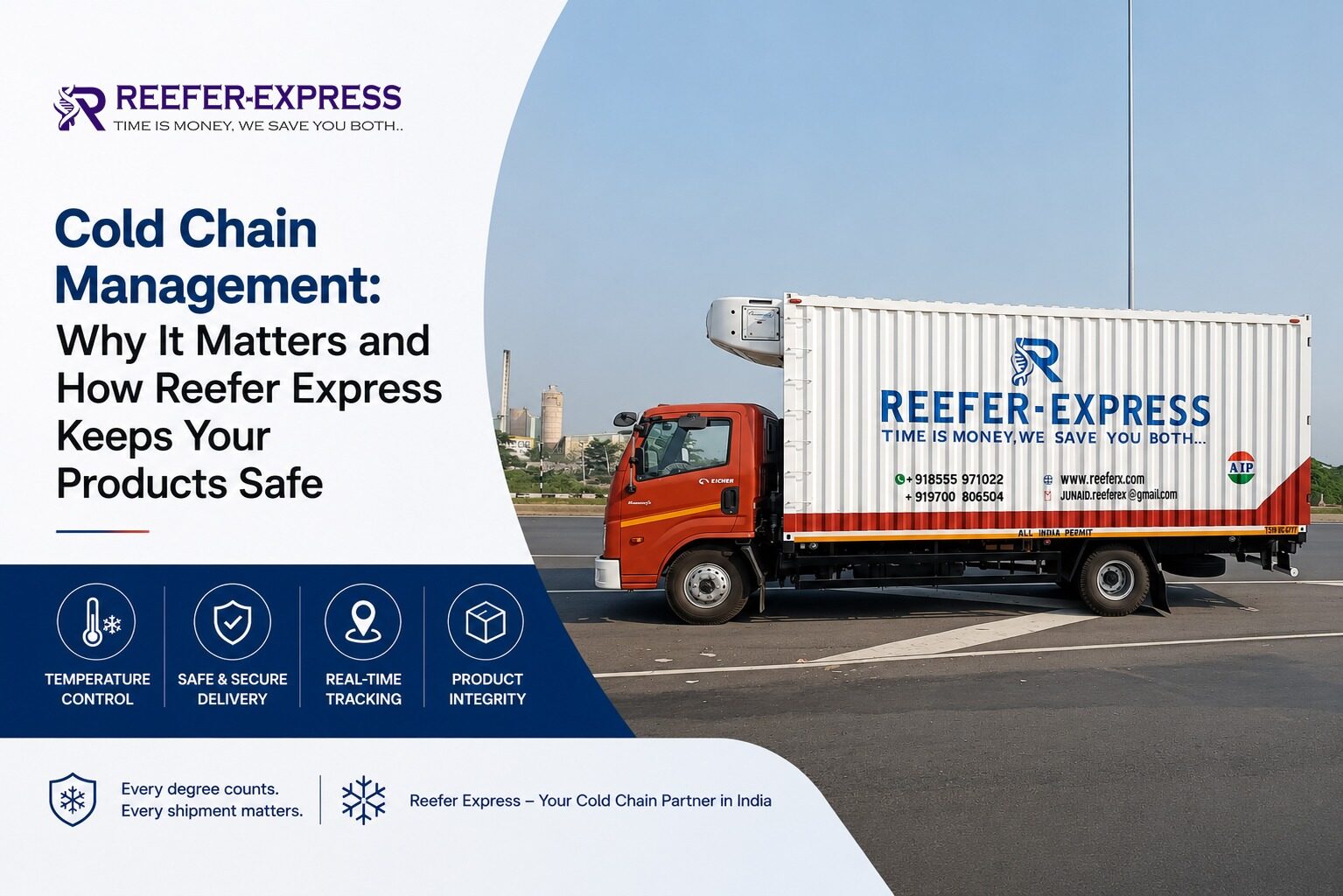
Every single day, millions of temperature-sensitive shipments move quietly across the country vaccines that prevent disease, medicines that keep patients stable, fresh produce, seafood, and dairy that families rely on for dinner. Behind every one of these safe deliveries sits an invisible system called cold chain management, and most people never think about it until something goes wrong. In simple terms, it is the set of steps, equipment, and checks that keep a product at the right temperature from the moment it leaves the factory or farm until it reaches your hands. If that chain of controlled temperature breaks at any single point along the way even for twenty or thirty minutes the product inside can spoil, lose its effectiveness, or become unsafe to use. This article walks through, in plain language, what cold chain management actually involves, why each part of it matters to real people and real businesses, and exactly how Reefer Express builds reliability into every mile of the journey.
Key Takeaways
Cold chain management is not just about a refrigerated truck it covers storage, packaging, loading, the drive itself, and the final handoff to the customer, and every one of those steps has to stay within the right temperature range.
A single temperature excursion, meaning even a short period where the temperature slips outside the safe range, can quietly ruin a shipment by causing spoilage, bacterial growth, or a loss of medical potency that cannot be reversed later.
Reefer Express combines temperature-controlled vehicles, continuous real-time tracking, and specially trained handling staff so that the weak points where most failures happen loading docks and last-mile handoffs are covered, not ignored.
Rules from the FDA, the CDC, and the DOT exist specifically because temperature failures in food and medicine can hurt people, which means documented, continuous monitoring is a genuine legal requirement and not just good practice.
What Is Cold Chain Management?
Cold chain management is the ongoing process of controlling and closely monitoring the temperature of sensitive goods at every single stage of their journey, including storage in a warehouse, the way they are packaged, the vehicle that transports them, and the final delivery to the customer’s door. The whole point is simple to state but hard to execute well: keep the product inside its required temperature range from the moment it leaves the manufacturer all the way through to the moment it lands in the customer’s hands, without a single gap. This matters for a wide range of everyday products, including vaccines and other pharmaceuticals, fresh produce like fruit and leafy greens, seafood and meat, dairy items such as milk and cheese, and even certain beverages like wine, because all of these lose their safety, their effectiveness, or their quality once they sit outside their specific safe temperature window for too long.
At Reefer Express, cold chain management is not an add-on service bolted onto a general trucking business it is the foundation the whole company is built around, using refrigerated freight solutions engineered specifically for this kind of precision work. Even a brief break in the chain, lasting just minutes, can quietly compromise product safety, shorten shelf life, or make an entire shipment unusable and unsellable, which is exactly why constant monitoring, well-maintained equipment, and dependable partners at every single handoff point are treated as absolutely non-negotiable. To make this transparent for customers rather than something they have to simply trust, every shipment we move is visible from start to finish through our live shipment tracking system, so you can see exactly what is happening to your product at any given moment.
Why Cold Chain Management Matters
1. Protecting Product Integrity
Product integrity depends entirely on maintaining the correct temperature range from the moment of pickup all the way through to final delivery, without exception. Whether the shipment is frozen seafood headed to a restaurant, fresh dairy headed to a grocery store, or a life-saving medication headed to a hospital, any fluctuation outside the required temperature range can lead to spoilage, the growth of harmful bacteria, or a loss of potency in medicine that makes it less effective or even unsafe. These outcomes are typically irreversible once they happen, meaning the product usually cannot be saved, sold, or safely used again — it simply has to be thrown away, which is both a financial loss and, in the case of medicine, a real risk to patient health.
2. Reducing Waste and Financial Loss
Temperature excursions, which is the technical term for moments when a shipment’s temperature slips outside its safe range, are among the single leading causes of product loss across the entire cold chain industry. When businesses use real-time monitoring paired with proper handling protocols, they are able to catch these deviations early, often within minutes, which significantly cuts down on waste, damaged goods, and the direct financial costs that follow, including full write-offs of ruined product, the expense of arranging replacement shipments, and the reputational cost of frustrated customers who received a compromised delivery. In an industry where margins are often tight, avoiding even a handful of these losses each year can make a meaningful difference to a company’s bottom line.
3. Meeting Regulatory Requirements
Regulatory compliance in cold chain logistics is governed by specific, legally enforceable rules such as the FDA’s Food Safety Modernization Act, which sets national standards for how food must be handled and transported safely, and the CDC vaccine storage and handling guidelines, which lay out exactly how vaccines must be kept cold to remain effective. Both of these require detailed, documented, and consistent temperature control, meaning a business cannot simply claim it kept things cold — it has to prove it with logs and records. Proper cold chain management keeps a business safely inside these requirements and protected from steep financial penalties, failed inspections, and the kind of reputational damage that is very hard to recover from once trust is lost.
4. Building Customer Trust
Customer trust in temperature-sensitive shipping is built, slowly and consistently, on shipments arriving fresh, safe, and exactly as promised every single time, with no surprises and no excuses. Reliable cold chain logistics is what makes that kind of consistency actually possible in the real world, rather than just something a company promises in a sales pitch, and it is also what quietly turns a one-time, cautious customer into a long-term, repeat relationship built on proven reliability. You can see how this plays out in practice, in the words of real customers, on our customer success stories page, where clients describe exactly what dependable cold chain service has meant for their own business.
5. Improving Supply Chain Efficiency
Cold chain efficiency comes from thoughtfully combining smart tracking and monitoring technology with the physical transport network itself, so that data and vehicles work together instead of operating as two separate, disconnected systems. When this is done well, it streamlines handling at every stage and reduces unnecessary delays that would otherwise add cost and risk to a shipment. Businesses using this integrated approach typically see noticeably improved delivery accuracy and speed, alongside lower overall operating costs, because problems can be spotted and corrected early rather than discovered only after a shipment has already failed.
The Numbers Behind Cold Chain Failure
According to Reefer Express’s own internal shipment data, the majority of temperature excursions do not happen during the long highway stretch of a journey, where you might expect the most risk they happen at handoff points, meaning the moments of loading a vehicle, unloading it, and transferring a package during the last mile to its final destination. This is an important and somewhat counterintuitive finding, and it is exactly why trained handling teams and continuous, minute-by-minute temperature tracking matter just as much as having a reliable, well-insulated reefer vehicle itself; a great truck cannot protect a shipment during the fifteen minutes it sits unmonitored on a loading dock or a delivery bike.
Cold Chain Temperature Requirements by Product Type
Different categories of products each require their own specific temperature band to stay safe and effective, and correctly matching a shipment to its proper range is the very first control point in any well-run cold chain — get this step wrong, and everything downstream is compromised from the start.
| Product Category | Required Range | Typical Format | Primary Risk if Broken |
| Frozen goods (seafood, meat, ice cream) | 0°F or below | Deep-freeze reefer | Bacterial growth, spoilage |
| Chilled dairy & produce | 33°F – 40°F | Standard reefer | Spoilage, shortened shelf life |
| Vaccines & biologics | 2°C – 8°C (35.6°F – 46.4°F) | Validated reefer + data logger | Loss of potency, non-compliance |
| Ambient-sensitive pharma/diagnostics | 15°C – 25°C (59°F – 77°F) | Climate-controlled transport | Degradation, failed release testing |
Reefer Express customizes temperature settings for each individual shipment based on that specific product’s actual requirements, rather than applying one generic default setting to every load regardless of what it is carrying.
How Reefer Express Delivers Reliable Cold Chain Solutions
No two shipments are exactly the same, which is precisely why the Reefer Express process is deliberately built around five clear steps that keep precision, transparency, and reliability consistent from the very first pickup all the way through to final delivery, no matter what the product is or how far it has to travel.
Step 1 Specialized Refrigerated Transport
Every shipment moves inside a reefer vehicle that is specifically equipped to maintain precise, steady temperature control across every single mile of the route, regardless of how far the distance is or how extreme the outside weather conditions might be, whether that means summer heat or winter cold.
Step 2 Real-Time Temperature Monitoring
Each shipment is tracked continuously, not just checked occasionally, through our live shipment tracking system, which gives full visibility into temperature, exact location, and delivery status from the moment of pickup all the way to drop-off this means customers get real information as it happens, not just a summary report requested and pieced together after the fact.
Step 3 Trained Handling Teams
Staff are required to follow strict, well-documented protocols for loading, unloading, and storage that are specifically designed to eliminate temperature breaks and careless product mishandling at transfer points, since this is where the data shows most excursions actually occur — meaning trained people are just as important to cold chain safety as good equipment.
Step 4 Regulatory Compliance
Reefer Express stays current with FDA, DOT, and other industry-specific cold chain regulations on an ongoing basis, so that shipments consistently meet the documentation and handling standards that regulators actually require, rather than falling behind as rules are updated over time.
Step 5 Fast, Efficient Delivery
Our nationwide logistics network is carefully designed to minimize transit time without ever compromising temperature control along the way, so that speed and safety are never quietly traded off against each other — customers get both a fast delivery and a safe one, not a compromise between the two.
Frequently Asked Questions
What is cold chain management in logistics?
Cold chain management is the process of maintaining a consistent, carefully controlled temperature for sensitive products such as food, pharmaceuticals, and vaccines — all the way through storage, packaging, and transportation, from the very start of the journey to the very end. In practical terms, it means that at no point does the product sit somewhere too warm or too cold for its specific needs, which ensures it stays safe, effective, and exactly as intended from origin all the way to final delivery, protecting both the business shipping it and the person who ultimately receives it.
What products require cold chain management?
Common examples that require careful cold chain management include vaccines and other medical products, fresh and frozen produce like fruits and vegetables, meat and seafood, dairy items such as milk and cheese, and certain beverages like wine, all of which are sensitive to temperature in different ways. In general, any product that degrades in quality, loses its effectiveness, or becomes genuinely unsafe to use outside a specific temperature range needs proper cold chain handling if a product would be ruined by sitting in a hot delivery van for an hour, it belongs in this category.
What temperature should a reefer truck maintain?
The correct temperature genuinely depends on exactly what is being shipped, since different products have very different tolerances. Frozen goods are typically kept at 0°F or below to stay solid and safe, while chilled products like dairy and fresh produce are usually maintained in a narrower range between 33°F and 40°F, cold enough to slow spoilage but not so cold that the product freezes and is damaged. Reefer Express customizes the exact temperature setting for each individual shipment based on that specific product’s real requirements, rather than using one generic setting for every load.
How is temperature monitored during transport?
Modern cold chain shipments rely on real-time data loggers and GPS-enabled sensors that continuously track temperature, humidity, and precise location throughout the entire journey, recording readings at frequent, regular intervals rather than only at the start and end. This continuous stream of data gives both the shipping company and the customer full visibility into exactly what is happening at any given moment, and just as importantly, it helps quickly flag any deviation from the safe range so that corrective action, such as rerouting or emergency repacking, can be taken before the product is genuinely harmed.
What happens if the cold chain is broken during shipping?
A break in the cold chain, even a short one, can lead to spoilage, a noticeably reduced shelf life, harmful bacterial growth, or a loss of potency in medical products that makes them less effective or even unsafe for patients to use. Beyond the immediate product damage, it may also result in serious regulatory non-compliance, since agencies expect documented proof that temperature was maintained throughout — which is exactly why continuous, real-time monitoring paired with a quick, well-rehearsed corrective response plan is treated as absolutely essential rather than optional.
How does Reefer Express ensure cold chain compliance?
Reefer Express relies on temperature-controlled fleets, continuous real-time tracking, and specifically trained handling teams working together to meet FDA, DOT, and other industry-specific standards, so that every shipment stays fully compliant and genuinely protected at each stage of its journey rather than being left vulnerable at any single weak point.
How do I get started with Reefer Express for cold chain shipping?
Getting started is straightforward: simply contact our team or request a quote to discuss the specifics of your shipment needs including product type, volume, and timeline and we will work with you to build a cold chain solution that is genuinely tailored to what you are shipping, rather than a generic, one-size-fits-all package.
The Bottom Line
Cold chain management is more than just refrigeration it is a coordinated, carefully documented system covering storage, transport, tracking, and regulatory compliance that protects a product at every single step of its journey, from the first warehouse shelf to the final doorstep. The businesses that get this right treat temperature control as an ongoing, monitored process rather than a single truck ride they assume will go fine, and they deliberately choose partners who can actually document that entire process from end to end, with real records rather than vague reassurances.
When you partner with Reefer Express, you are choosing a team that combines specialized reefer transport, real-time monitoring, carefully trained handling staff, and strict regulatory compliance into one single, accountable process, rather than juggling several disconnected vendors yourself. You can explore our live shipment tracking system to see exactly how visibility works in practice, or read our detailed guide to cold chain packaging in India to understand how validated, route-specific packaging fits into this same overall chain of protection.
Ready to move your temperature-sensitive shipments with real confidence instead of crossed fingers? Contact Reefer Express today or request a quote and experience cold chain logistics that is genuinely done right, from the first pickup to the final delivery.
About the Author
The Reefer Express Editorial Team writes on cold chain logistics, regulatory compliance, and temperature-controlled transport, drawing directly on Reefer Express’s own operational experience moving pharmaceutical, food, and other perishable shipments across the country every day. Connect with our team if you have questions, or read more practical guides on the Reefer Express blog.
Comments2
The bonuses here are actually worth it. I managed to hit a decent win last night using the welcome credit. 90jiliclublogin
Finally found a site that actually feels localized for us. The game selection is huge and the loading times are impressive. Keep it up sz777asiaphilippines.