

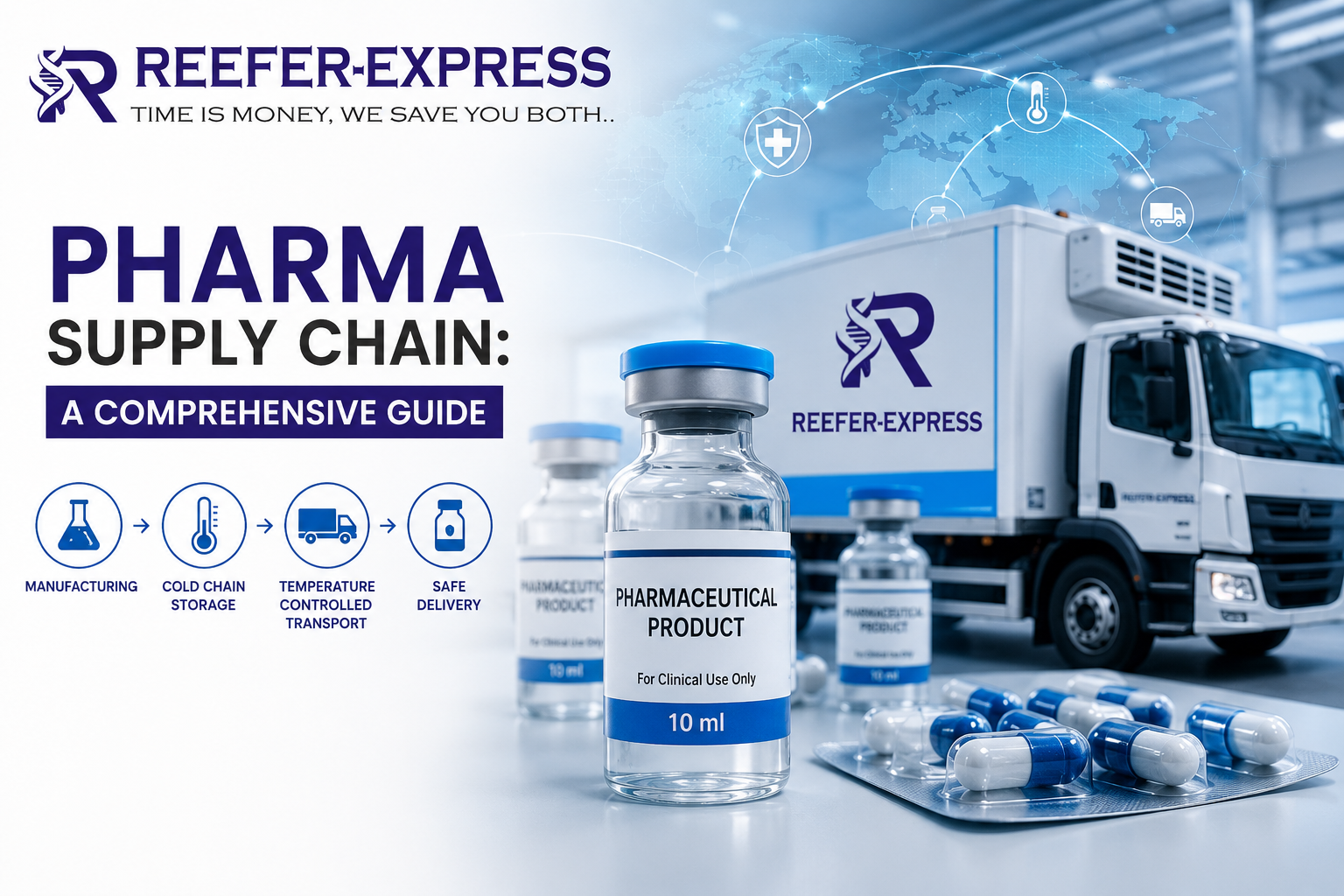
The pharma supply chain is the network of manufacturing, storage, transportation, and monitoring systems that move medicines, vaccines, and biologics from production facilities to hospitals, pharmacies, and patients without a single break in temperature or quality control. Every stage carries regulatory weight, and a single lapse in handling can turn a life saving shipment into a financial loss and, worse, a patient safety risk. If you manufacture, distribute, or import pharmaceutical products, understanding how this chain works, and choosing the right logistics partner to run it, is not optional. It decides whether your product reaches the market intact or gets flagged, rejected, or destroyed at a checkpoint.
This guide walks through how the pharma supply chain is structured, why cold chain logistics sits at its center, the regulations that govern it, the mistakes that cost companies the most, and what to look for in a logistics partner before you sign a contract.
What Is a Pharma Supply Chain
A pharma supply chain covers every step a pharmaceutical product takes after it leaves the manufacturing line: quality testing, packaging, warehousing, customs clearance, transportation across multiple modes, and final delivery to the point of care. Unlike a typical retail supply chain, pharma shipments are treated as regulated cargo. That means documentation, chain of custody records, and environmental data have to travel with the product at every handoff.
Three things separate this supply chain from any other:
Temperature control is not a preference, it is a legal requirement tied to the drug’s stability data. Traceability has to be complete, since regulators and manufacturers need to know exactly who touched a shipment and when. And timing is unforgiving, because biologics, vaccines, and specialty drugs often have narrow windows before potency drops.
Get any one of these wrong and the consequences show up fast: rejected shipments, recalled batches, and regulatory penalties that can shut down a distribution license.
Why Pharma Supply Chain Management Is Different From Regular Logistics
Moving a pallet of pharmaceuticals is not the same job as moving a pallet of consumer goods, even though both might travel in the same truck fleet on paper. The difference comes down to risk tolerance. A retail shipment that arrives a few degrees warmer than ideal is an inconvenience. A vaccine shipment that experiences the same excursion can lose efficacy permanently, and there is no way to visually detect that failure once it happens.
This is why pharmaceutical companies increasingly refuse to work with general freight carriers for anything temperature sensitive. According to a recent pharmaceutical logistics market forecast, providers across the industry are expanding dedicated cold chain fleets and building cryogenic hubs specifically because standard freight infrastructure cannot meet the compliance bar pharma shipments demand. The specialization is not a marketing angle, it is a response to what regulators and manufacturers now expect as the baseline.
If you are still routing temperature sensitive shipments through a generalist carrier, you are carrying risk that a dedicated pharma cold chain shipping partner is built to remove.
Core Stages of the Pharma Supply Chain
Manufacturing and Raw Material Sourcing
The chain starts before a single unit ships. Active pharmaceutical ingredients (APIs) often travel internationally before final formulation, and many of these raw materials are themselves temperature sensitive. Sourcing decisions at this stage set the tone for everything downstream, since a break in cold chain integrity at the ingredient level cannot be corrected later in the process.
Storage and Warehousing
Once a product is manufactured, it needs GDP compliant warehousing that can hold multiple temperature zones at once, typically frozen below -20°C, refrigerated between 2°C and 8°C, and controlled ambient between 15°C and 25°C. Facilities need validated mapping, redundant refrigeration, and continuous monitoring with alarm systems that alert staff the moment a zone drifts outside its range.
Transportation and Distribution
This is where most temperature excursions actually happen, since transportation involves the most handoffs and the least environmental control compared to a fixed warehouse. Reliable temperature controlled trucking closes this gap by keeping the product inside a validated envelope through loading docks, highway transit, and cross-border checkpoints, where delays are common and unpredictable.
Last Mile Delivery
The final leg is often the riskiest because it involves the smallest, least controlled vehicles and the most time pressure. Hospitals and pharmacies need product on tight schedules, and any delay at this stage can push a shipment past its usable window. Providers with real time GPS and temperature tracking give receiving teams visibility into exactly where a shipment is and what condition it is in before it arrives at the loading dock.
Cold Chain Logistics: The Backbone of Pharma Supply Chain
Cold chain logistics is not a supporting function inside the pharma supply chain, it is the function the entire chain is built around. Roughly half of new drugs currently in development pipelines require temperature controlled storage and transport, according to estimates cited in a global pharmaceutical logistics market report, which means cold chain capability is quickly becoming the deciding factor in which logistics providers pharma companies choose to work with.
Temperature Ranges You Need to Know
Pharmaceutical products generally fall into four handling categories. Frozen products stay below -20°C, and some cell and gene therapies require cryogenic conditions near -150°C. Refrigerated products sit between 2°C and 8°C, which covers the majority of vaccines and biologics. Controlled ambient products need 15°C to 25°C, protecting them from both heat and unexpected cold. Each category demands its own packaging, monitoring calibration, and staff training, and mixing these categories in a single shipment without proper zoning is one of the fastest ways to trigger a quality failure.
Packaging and Monitoring Technology
Passive packaging using phase change materials and insulated containers still handles a large share of pharma shipments, but active monitoring has become the standard for anything high value or long haul. IoT enabled loggers now track location and temperature simultaneously and send automated alerts the moment a reading drifts out of range, giving logistics teams the chance to intervene before a full excursion occurs rather than discovering the problem after delivery.
Sustainable, reusable packaging is also gaining ground as pharma companies look to cut both cost and environmental impact without compromising on protection, a trend reflected across current cold chain packaging market analysis.
Regulatory Framework Governing Pharma Supply Chain
Compliance is not a checkbox exercise in this industry. It is the mechanism that keeps counterfeit and degraded products out of the supply chain, and regulators enforce it accordingly.
WHO Good Distribution Practices
The World Health Organization’s Good Distribution Practices guidelines set the international benchmark for storing and distributing pharmaceutical products safely. These standards cover documentation, staff qualification, storage conditions, and transport validation, and most national regulators build their own requirements on top of this framework.
FDA DSCSA Requirements
In the United States, the Drug Supply Chain Security Act governs how prescription drugs are traced at the package level as they move through manufacturers, wholesalers, and dispensers. The FDA’s DSCSA guidance requires interoperable, electronic tracing so that suspect or illegitimate product can be identified and removed quickly. Any distribution partner operating in the US market needs systems that can produce this data on request, not just promise compliance on paper.
EU and International Distribution Standards
Within the European Union, Article 84 of Directive 2001/83/EC requires published guidelines on good distribution practice, and member states enforce these through national medicines agencies. Companies shipping across borders need a partner who understands how these regional frameworks interact, since a shipment that clears one jurisdiction cleanly can still get held up if documentation does not match the requirements of the next.
Common Challenges in Pharma Supply Chain Management
Temperature excursions remain the single most expensive failure point, and most of them happen during handoffs rather than during transit itself, at the moment a pallet moves from a warehouse dock to a truck or from a truck to an airport tarmac. Documentation gaps come next. A shipment can be handled perfectly and still get rejected at a border or a receiving dock if the paperwork does not match the physical product or the temperature log has missing intervals.
Capacity constraints during peak vaccine or seasonal demand periods push companies toward carriers that cannot actually meet cold chain specifications, which is exactly when the cheapest option becomes the most expensive mistake. And visibility gaps, where a shipper cannot see real time conditions inside a container until it has already arrived, remove the ability to intervene before a problem becomes a total loss.
None of these challenges are new, but they get harder to manage every year as product portfolios shift further toward biologics and cell and gene therapies that carry tighter tolerances than traditional small molecule drugs. Staffing gaps compound all of this, since a warehouse or transport team without proper pharma handling training will treat a temperature alert as a minor inconvenience rather than the time sensitive event it actually is, and by the time the right person reviews the log, the window to save the shipment has often already closed.
What Pharma Supply Chain Logistics Actually Costs
Pricing conversations around pharma logistics tend to focus on freight rates alone, which misses most of the real cost. A shipment that looks cheap on a quote sheet can end up far more expensive if it triggers a temperature excursion, since the loss is not just the freight charge but the full value of the batch, the cost of the recall or disposal process, and the regulatory scrutiny that follows a repeated failure.
Dedicated cold chain capacity, validated packaging, and continuous monitoring all carry a real cost, and that cost is the price of predictability. A logistics partner who cuts corners on any of these to offer a lower rate is shifting risk onto your company, not removing cost from the process. When you compare quotes, ask what is actually included: monitoring hardware, alert response staffing, validated packaging, and documentation support should all be itemized rather than assumed. A quote that looks unusually low compared to competitors in the same lane is worth a direct question about what has been left out.
The market itself reflects how much weight buyers now put on reliability over price alone. Growth in the pharmaceutical cold chain packaging market, projected to more than double by the mid-2030s according to recent packaging market analysis, is being driven largely by demand for sustainable, reusable, and better monitored packaging rather than by volume growth alone. Buyers are willing to pay for verified protection, and that shift in demand is reshaping what a competitive quote actually looks like.
How to Choose the Right Pharma Logistics Partner
Not every carrier that says “cold chain” actually operates one. Before signing with a logistics provider, verify their certifications directly rather than taking marketing language at face value. IATA CEIV Pharma certification, awarded through the Center of Excellence for Independent Validators program, confirms that a provider’s facilities, equipment, and staff have been independently validated against pharmaceutical handling standards, and it is increasingly treated as a baseline requirement rather than a differentiator among serious providers.
Ask specific questions instead of general ones. What temperature ranges can the provider maintain across their full fleet, not just their flagship vehicles? What happens operationally the moment a sensor detects a deviation, and how fast is the alert routed to a live person? Can they produce full chain of custody documentation on demand for an audit, not just after a request goes through several departments? A provider that hesitates on any of these answers is not ready for pharma freight, regardless of how their sales materials read.
Reviewing vaccine and biologics distribution requirements before you finalize a contract will also tell you whether a prospective partner’s network actually covers the lanes your product needs, rather than just the ones they advertise.
Why Reefer Express Is Built for Pharma Supply Chain Needs
Reefer Express runs its pharma logistics operation the way the industry actually requires it, not the way general freight gets handled with a temperature setting added on top. Every lane is validated for the specific range your product needs, whether that is deep frozen, refrigerated, or controlled ambient, and every shipment moves with continuous monitoring data that your quality team can pull without chasing down a third party.
Our teams are trained specifically on pharmaceutical handling protocols, documentation standards, and the kind of rapid response a temperature alert demands. We do not treat a deviation alert as a report to file after the fact, we treat it as a call to act on immediately, because the difference between those two approaches is the difference between a saved shipment and a written-off batch.
If your current distribution setup has you second guessing whether a shipment will clear the next audit, or whether your carrier can actually explain a temperature gap in the log, it is worth a conversation. Request a quote and our team will walk through your specific product requirements, current pain points, and the lanes you need covered before recommending anything.
Frequently Asked Questions
What is the difference between a pharma supply chain and a cold chain?
A pharma supply chain is the entire network moving a drug from manufacturing to the patient, including sourcing, storage, transport, and distribution. Cold chain logistics is the temperature controlled component inside that network, covering any stage where the product needs to stay within a defined temperature range.
What temperature range do most vaccines require during shipping?
Most vaccines need refrigerated storage and transport between 2°C and 8°C, though some newer biologics and specific formulations require frozen or ultra cold conditions well below -20°C. The exact range always comes from the manufacturer’s stability data, not a general assumption.
How does a company verify a logistics provider’s cold chain capability?
Ask for proof of relevant certifications such as IATA CEIV Pharma, request documentation of their monitoring and alert systems, and check whether they can produce full temperature logs and chain of custody records for a past shipment on demand, not just describe their process verbally.
What causes most temperature excursions in pharma shipping?
Handoff points cause the majority of excursions, particularly when a shipment moves between a warehouse and a vehicle, between transport modes, or sits at a dock waiting for the next leg of its journey. These gaps are also where continuous monitoring makes the biggest difference, since they catch problems before they become total losses.
Is DSCSA compliance required for all pharmaceutical shipments in the US?
Yes, the Drug Supply Chain Security Act applies to manufacturers, wholesale distributors, dispensers, and repackagers handling prescription drugs in the United States, and enforcement has continued to tighten as electronic tracing requirements have moved past their stabilization periods.
What should a company do before switching pharma logistics providers?
Review the provider’s certifications, ask for references from clients shipping similar product types, confirm their coverage matches your actual distribution lanes, and request a walkthrough of their exception handling process for temperature deviations before signing any contract.