

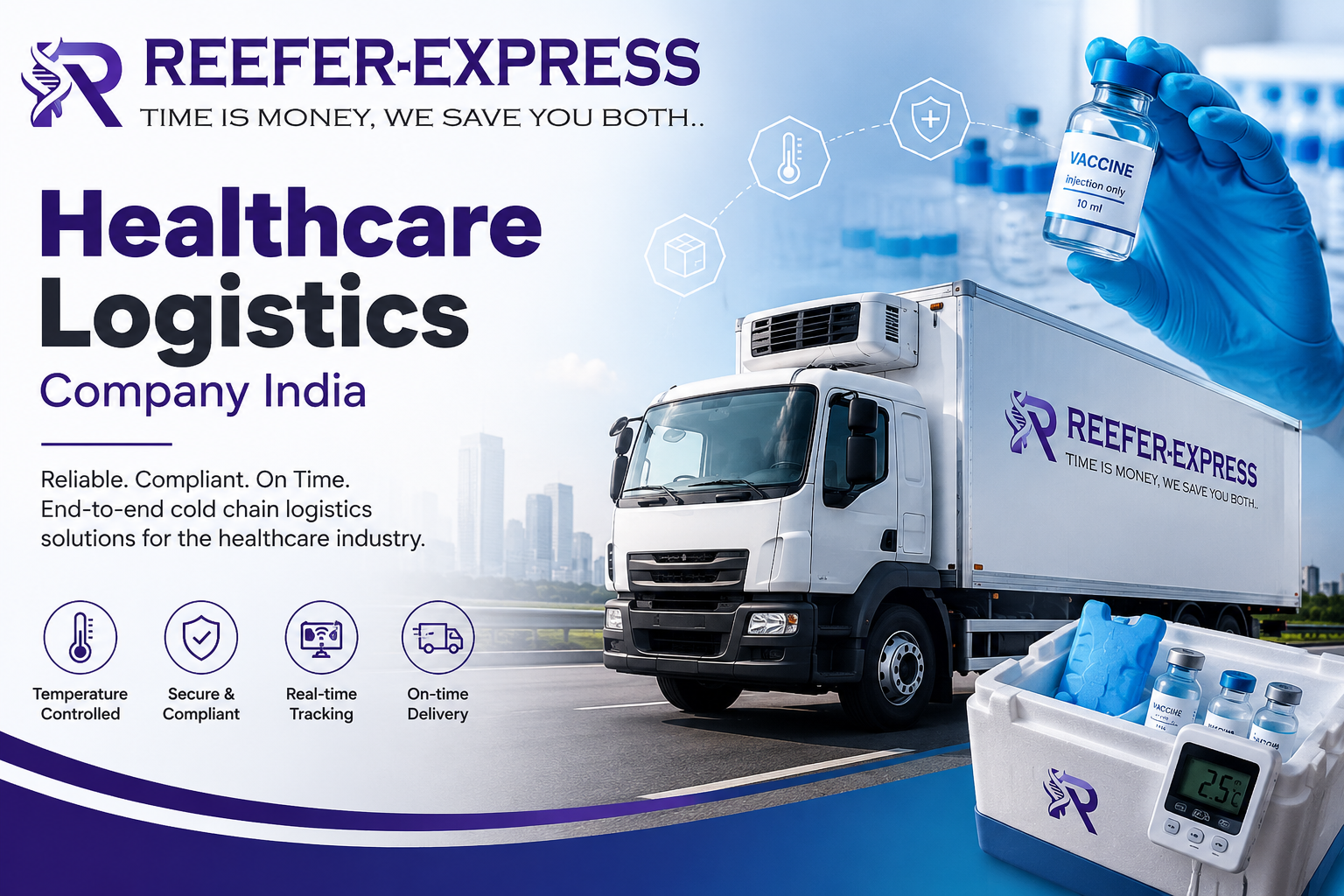
If you are searching for a healthcare logistics company in India right now, you are probably not looking for an explanation of what cold chain means. You already know. You are looking for the provider who will not let a shipment fail when it matters most, whether that is a batch of vaccines moving through a Delhi summer or a diagnostic reagent that needs to stay within two degrees for eighteen hours on a highway with no guaranteed refueling stops. This article is built to help you make that decision with the right questions and the right standards, not marketing language.
Most buyers evaluating a healthcare logistics company in India have already been burned once, either by a provider that promised route-specific validation and delivered a generic test certificate, or by a last-mile handoff that undid everything the rest of the chain got right. The evaluation criteria below reflect what actually predicts reliability, not what sounds good on a sales call.
Why Healthcare Logistics in India Is Not Standard Freight
Pharmaceutical and healthcare shipments carry a different kind of risk than a pallet of packaged goods. A late delivery is an inconvenience. A temperature excursion on a biologic shipment is a regulatory event, a financial loss, and in some cases a patient safety issue. Any healthcare logistics company operating in India has to treat those two outcomes as fundamentally different problems, not variations of the same delivery job.
The Compliance Weight Behind Every Shipment
India’s pharmaceutical distribution rules require documented control over storage and transport conditions from the manufacturer to the point of dispensing. The Central Drugs Standard Control Organisation has laid out Good Distribution Practices guidelines that place direct responsibility on every party in the distribution chain, including transporters, to maintain product quality and prevent contamination or mix-ups. That responsibility does not end when the shipment leaves a warehouse. It follows the product until it reaches the person who dispenses it.
Global frameworks reinforce the same expectation. The World Health Organization’s cold chain and logistics management guidance sets out how temperature-sensitive health products should be monitored and handled at every stage of distribution, not only at storage facilities. A healthcare logistics company that treats transport as a lower-priority link in that chain is working against the standard the rest of the industry is held to.
India’s Climate and Infrastructure Add Real Complexity
India spans multiple climate zones, and a route that performs fine in Bengaluru in December can fail entirely in Nagpur in May. Distances are long, road quality is inconsistent, and last-mile delivery frequently happens outside any controlled environment. A provider that qualifies its fleet and packaging once, using generic ambient assumptions, is not accounting for the country most of its customers actually operate in.
This is also a growing market. India’s cold chain sector was valued at roughly INR 2.5 trillion in 2025 and is projected to more than double by 2034 according to IMARC Group’s market analysis, driven in large part by rising demand from healthcare and pharmaceutical distribution. Growth of that scale attracts new entrants quickly, and not all of them build for pharma-grade requirements from day one.
That growth also means more providers are entering the market with cold chain listed as a service line rather than a core specialty. A logistics company that added refrigerated transport to compete for tenders is not the same as one that built its operations, training, and documentation systems specifically around temperature-sensitive healthcare shipments. The distinction rarely shows up in a sales pitch. It shows up the first time a shipment gets tested by a real excursion, a real last-mile delay, or a real audit request, and that is exactly when you need the difference to already be in your favor.
What a Reliable Healthcare Logistics Company in India Actually Delivers
Marketing pages tend to sound similar across providers. The differences show up in operational detail, and that is where you should focus your evaluation.
Temperature Validation Tied to Your Actual Route
Generic validation data tells you very little. A packaging or vehicle system tested once in a lab at a controlled ambient temperature does not tell you how it performs on a Chennai-to-Hyderabad run in July versus a Mumbai-to-Pune run in January. A serious healthcare logistics company can produce validation documentation tied to specific routes, durations, and seasonal conditions. If a provider hands you a single generic certificate for every lane, that is a signal worth taking seriously before you sign anything.
A Reefer Fleet and Packaging System Built for Pharma
Refrigerated vehicles designed for produce are not automatically suited to biologics, vaccines, or diagnostics. Pharma-grade transport needs tighter temperature tolerances, continuous monitoring, and validated hold times that account for door openings, loading delays, and traffic. The same applies to packaging. EPS foam, vacuum-insulated panels, and phase-change material systems each perform differently across temperature ranges and durations, and a provider offering one solution across every product category is cutting a corner somewhere in that chain.
You can review our cold chain packaging guide for India for a closer look at how packaging selection should be matched to product type and route.
Real-Time Visibility You Can Actually Use
Location tracking without temperature data is close to useless for a release decision. If you can see where a shipment is but not whether it has stayed within range, you still cannot sign off on the product when it arrives. A reliable healthcare logistics company builds temperature and location monitoring into the shipment itself, and gives you access to that data as it happens rather than as a report you have to request afterward.
A Documented Excursion Protocol
Ask any provider what happens the moment a temperature excursion is detected in transit. Who gets notified, how fast, and what is the decision tree for quarantine, retesting, or disposal? A provider without a written answer to this question has not actually planned for the failure mode that matters most. This single question tends to separate operationally mature providers from the rest faster than any brochure claim.
Last-Mile Handling That Doesn’t Undo Everything Before It
Most cold chain failures in India happen at the handoff, not in transit. The reefer vehicle performs exactly as validated, the packaging holds its range, and then the shipment sits on a delivery agent’s bike in direct sun for forty minutes while another drop gets completed first. This is a process failure, not a packaging failure, and it needs to be addressed at that level. Ask specifically how a provider manages the transition from vehicle to final delivery, what the maximum allowable time is, and whether that window is actually monitored or just assumed.
Trained Personnel, Not Just Trained Equipment
Equipment alone does not protect a shipment. The people loading, driving, and handing off the product need to understand why a door stays closed for a set number of seconds, why a packaging unit cannot sit in direct sun during a transfer, and what to do the moment a temperature reading drifts outside range. The International Air Transport Association’s Perishable Cargo Regulations place specific training requirements on personnel handling time and temperature sensitive cargo, and the same logic applies on the ground in India even where air transport is not involved. When you evaluate a provider, ask how drivers and last-mile staff are trained on temperature-sensitive handling, and how often that training is refreshed. A provider that cannot answer this clearly is relying on equipment to compensate for a gap in process, and equipment alone has never been enough to prevent a last-mile failure.
Questions to Ask Before You Commit to a Provider
Before signing with any healthcare logistics company in India, get direct answers to a short set of questions. Can they show validation data specific to your product’s temperature range and your actual shipping lanes? What is their written standard operating procedure for a temperature excursion, and who owns that decision in real time? Are temperature logs delivered with every shipment automatically, or only when you ask for them? How is last-mile delivery handled for temperature-sensitive product, and is that leg monitored the same way the main route is? Have they shipped your specific product category before, and can they share performance data from that experience rather than a general capability statement?
A provider who answers all of this clearly, with documentation ready to back it up, is worth taking seriously. Hesitation, vague language, or an unwillingness to share route-specific data tells you exactly where the gaps are before you find out the expensive way.
Why Reefer Express Is Built for Healthcare Logistics in India
Reefer Express was built around pharmaceutical and healthcare supply chain requirements in India specifically, not adapted from a general freight model after the fact. That distinction shapes every part of how the business operates.
Compliance Built Into Every Shipment, Not Bolted On
Temperature logs, excursion reports, and chain-of-custody documentation come standard with every shipment we run, not on request after a customer asks for proof. This matches the standard the CDSCO’s distribution guidelines set for the industry, and it means you are never scrambling to reconstruct a record during an audit or a batch release review.
Fleet and Packaging Qualified Against India’s Actual Climate Zones
Our reefer fleet and packaging systems are validated against the ambient conditions your product will actually face on the road, not against a single test-chamber benchmark. Route-specific qualification means the data you receive reflects the lane your shipment is moving on, whether that is a short urban run or a multi-state haul through variable climate conditions. You can see how this plays out on our pharma cold chain logistics services page for a full breakdown of how routes are qualified.
Last-Mile Protocols That Close the Gap Competitors Leave Open
Most providers solve the middle leg of the journey and stop there. Reefer Express has specific handling protocols for the vehicle-to-recipient transition, the point where most cold chain failures in India actually occur. If your product needs to arrive compliant and not just delivered, this is the part of the chain that determines whether the effort on the earlier legs actually holds up. Our temperature-controlled transportation network page covers this in more detail.
An Onboarding Process Built Around Your Product, Not a Standard Template
When a new client comes on board, we start with the product category, not the paperwork. Temperature range, hold-time requirements, packaging preference, and route history all shape how a shipment plan gets built before the first delivery ever leaves our facility. That means the validation data you receive reflects your actual shipping pattern from day one rather than a generic capability sheet retrofitted to your account after the fact. For teams moving between providers, this also means a shorter transition window, since the qualification work starts immediately instead of after a quarter of trial shipments.
What Waiting Costs You
Delaying a decision on your healthcare logistics partner rarely feels expensive in the moment. It becomes expensive the first time a shipment excursion happens with no documented protocol behind it, or the first time an auditor asks for a temperature log that does not exist. Product write-offs from failed cold chain shipments are not recoverable costs. Neither is the regulatory scrutiny that follows a documented compliance gap, nor the trust you lose with a client or hospital system when a delivery fails at the last mile. The providers that treat healthcare logistics as a specialty rather than a service line are the ones who prevent these costs before they happen, not after.
If your current provider cannot answer the questions outlined earlier in this article with specific, route-level detail, that gap is already costing you. You just have not seen the invoice for it yet.
Frequently Asked Questions
What makes a healthcare logistics company in India different from a general logistics provider?
A healthcare logistics company builds its fleet, packaging, monitoring, and documentation specifically around pharmaceutical compliance requirements and product sensitivity. General logistics providers typically add cold chain as a service line without the same depth of route validation, excursion protocols, or regulatory documentation built into every shipment.
How is temperature monitored during transit with Reefer Express?
Every shipment includes continuous temperature and location monitoring built into the vehicle and, where required, the packaging itself. Data is available to you as the shipment moves rather than compiled into a report after delivery, which allows for faster decisions if conditions start to shift outside the validated range.
What happens if a temperature excursion occurs during transport?
Reefer Express follows a documented excursion protocol that defines who is notified, how quickly, and what decision tree applies to the affected shipment, including quarantine and retesting steps where needed. Ask any healthcare logistics company for their written protocol before you sign, since a provider without one has not planned for this scenario.
Does Reefer Express handle last-mile delivery for temperature-sensitive products?
Yes. Reefer Express has specific handling protocols for the transition from vehicle to final recipient, which is the point in the chain where most cold chain failures actually happen in India. This includes defined time limits between vehicle and delivery and monitoring across that window.
How do I evaluate whether a provider’s validation data is actually reliable?
Ask for documentation tied to your specific shipping lanes and seasonal conditions rather than a single generic test certificate. Reliable providers can show performance data across the routes and climate conditions you will actually use, not just a controlled lab environment.
How long does it take to onboard a new healthcare logistics provider?
Timelines vary by product category and route complexity, but a provider that starts route qualification and documentation setup immediately, rather than after a trial period, can typically move a new account to full operation within a few weeks. Ask any prospective provider what their onboarding process actually looks like before you assume a switch will be slow.
Talk to Reefer Express About Your Route
If you are shipping pharmaceutical or healthcare product in India and need a logistics partner who has already solved the parts of the chain most competitors have not, contact Reefer Express for a route-specific assessment. Bring your product category, your lanes, and your compliance requirements, and we will show you exactly how the shipment gets handled from pickup to final delivery.