

Pharmaceutical supply chain management in India decides whether a vaccine, an insulin pen or a cancer drug reaches a patient in working condition, or arrives as expensive waste. India is the third largest pharmaceutical producer in the world by volume and sends medicines to more than 190 countries. Even so, the system still leans on imported raw materials, crowded highways, brutal summer heat and a long chain of handovers where one careless hour can ruin a whole consignment. If you run a manufacturing unit, a distribution business, a hospital group or a pharmacy chain, you already feel that pressure. This guide walks through every stage of the chain, the problems that keep repeating, and what to look for when you are ready to book a cold chain partner who can protect your product from the factory gate to the last mile.
At Reefer Express, we move temperature-sensitive medicines across more than 100 cities from our base in Hyderabad. What follows comes from that daily work, not from a textbook.
Why Pharmaceutical Supply Chain Management in India Needs Your Attention Now
The Indian pharmaceutical sector is large, and it is growing. NITI Aayog reports that India’s pharmaceutical and API exports reached about 35.8 billion US dollars in its latest pharma trade review. That success sits on top of a fragile base. Roughly two thirds of the active pharmaceutical ingredients used by Indian manufacturers still come from China, according to ICRA and NITI Aayog analysis. When a port slows down, a border tightens or a tariff changes, the effect travels through every plant, wholesaler and pharmacy shelf in the country.
Global trade pressure adds another layer. Indian exporters now watch tariff discussions in the United States and supply security rules in Europe very closely, because a delay at one end of the chain can freeze stock at the other. A company that treats logistics as an afterthought will lose contracts to a company that treats it as part of the product. That is the real meaning of supply chain management in this industry. It is not a back office function. It is the final stage of quality control.
Key Players in the Pharmaceutical Supply Chain
The chain starts in a laboratory and ends in a patient’s hand, and many parties sit in between. Drug manufacturers and formulation units make the medicine. Packaging companies supply the bottles, blisters, cartons and insulated shippers. The Central Drugs Standard Control Organisation, known as CDSCO, and the state drug regulators set the rules for approvals, manufacturing licences and distribution. Carry and forwarding agents, stockists and wholesale distributors move stock into regional markets. Hospitals, nursing homes and retail chemists dispense it. Insurers, government health schemes and corporate health plans decide who pays. Specialty pharmacies and home delivery services handle high-value injectables, biologics and therapies that need tighter control.
Every one of these parties depends on the one before it. A cold chain partner sits across several of them at once, which is why choosing one carefully matters so much.
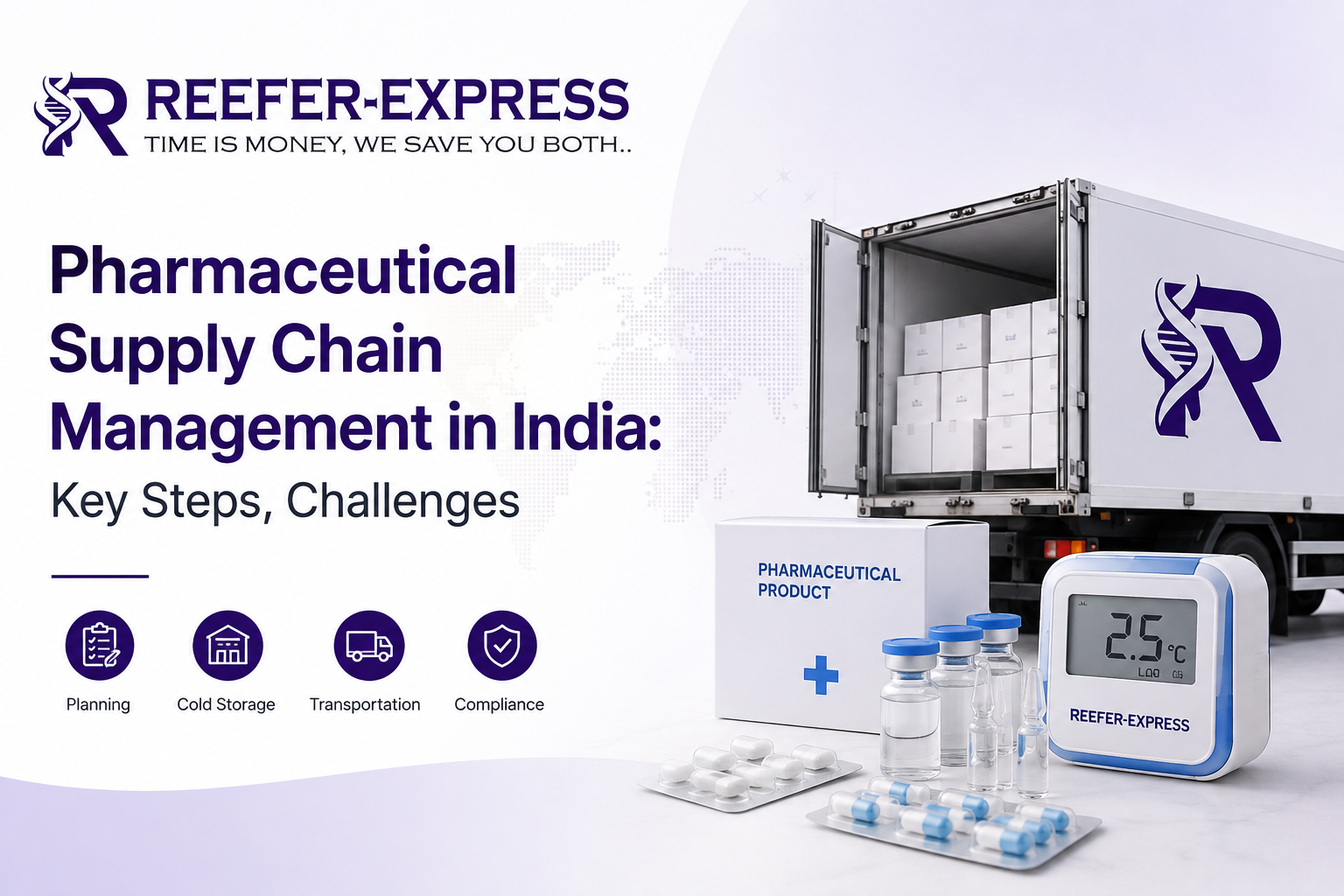
Key Steps Within the Pharmaceutical Supply Chain
Pharma logistics is complicated because of regulation, safety rules and high cost of failure. Each step exists to give patients access to safe medicines, whether those are branded products, generics or over the counter items, while keeping a clear record of where every batch has been.
Research and Development
Everything begins with research. Scientists identify a compound, test its safety and effectiveness in the lab, and then move it into clinical trials with human participants. In India, trial approvals and later marketing approvals pass through CDSCO, which checks the data before any product can be made or sold at scale.
Logistics matters even here. Trial samples, biological specimens and investigational products often need strict temperature ranges and fast courier movement between sites. A broken cold chain in a trial can invalidate months of work, so research teams increasingly hire specialist carriers early instead of waiting until commercial launch.
Manufacturing
Manufacturing is where the product takes its final form. A licensed manufacturer buys raw materials, including active pharmaceutical ingredients and excipients, then produces tablets, capsules, syrups, creams, ointments, injectables, inhalers and other dosage forms. The plant must follow Good Manufacturing Practices, and India has been tightening those standards through the revised Schedule M requirements, which push smaller units to upgrade equipment, documentation and quality systems.
Domestic production capacity has become a matter of national interest. The government has backed that goal through production linked incentives and bulk drug parks, and the early results are visible. Even so, many antibiotics and intermediates still depend on imports, and that dependence is why raw material logistics deserve as much planning as finished goods.
Packaging
Packaging protects the medicine, identifies it and makes it traceable. Primary packaging touches the product directly. Secondary packaging holds it together for storage and carriage. Tertiary packaging, such as insulated shippers, gel packs, phase change materials and pallets, protects the load during transit. Good packaging keeps out light, moisture and temperature swings, and it carries the labels, batch numbers and codes that regulators and buyers expect.
Good packaging also cuts the chance of mix-ups at the dispensing end, shields valuable products from damage, supports compliance during audits, and improves traceability across the network. It reduces cost in a quiet way too, because fewer damaged cartons mean fewer claims, fewer reshipments and fewer angry phone calls. You can see how we approach this on our packaging and distribution page.
Wholesale Distributors, Stockists and Repackagers
Once the product leaves the plant, it usually moves through carry and forwarding agents and then to stockists and wholesalers. These distributors buy in bulk, store the goods and supply chemists and hospitals in their territory. Because most medicines in India reach patients through this layer, a weak warehouse or an unreliable transporter here can disrupt a whole region.
Repackagers and relabelling units handle another job. They break bulk packs into smaller quantities, often for institutional buyers and government tenders. Delays caused by staffing gaps, equipment faults or late raw material arrivals show up quickly downstream, because pharmacies cannot dispense what has not arrived. Warehouses in this layer must hold the right temperature, humidity and security level for each product class, and they must be able to prove it with data, not promises.
Pharmacies
Pharmacies are normally the last stop before the patient. India has several lakh retail chemists, along with hospital pharmacies, long term care units, organised pharmacy chains and online platforms. Each type works differently, but the goal is identical. The right medicine must reach the right person at the right time, and it must still be effective when it does.
Specialty medicines add more demands. Insulin, monoclonal antibodies, vaccines, fertility injections and oncology drugs often need refrigeration or even frozen storage, and the pharmacy needs the equipment and the discipline to hold that range. Many smaller outlets struggle with this, which is why dependable last mile cold delivery has become a selling point for distributors.
Dispensed to Patients
The final stage is dispensing. The patient may receive the medicine from a doctor, a hospital counter, a neighbourhood chemist or a home delivery rider. At that point the supply chain has either worked or it has not, and the patient usually cannot tell the difference by looking at the box. A vial that sat in a hot vehicle for four hours looks exactly like one that stayed at the correct temperature. That invisible risk is the reason documentation, data loggers and trained handlers matter so much.
Challenges in Pharmaceutical Supply Chain Management in India
India’s pharma network faces several problems at once. Understanding each one helps manufacturers, distributors and hospitals decide where to spend money and which partner to trust.
Costs
Logistics cost eats into margin at every stage. Long routes, fuel prices, toll charges, idle trucks, poor load planning and product loss during transit all add up. Cold chain adds a further premium because it needs insulated or refrigerated vehicles, backup power, monitoring equipment and trained staff.
The smart response is not to cut corners but to reduce waste. Better route planning, shared load consolidation, real time tracking and clear service level agreements bring costs down without touching product safety. Digital tools help too. Many pharma executives worldwide are now investing in data and artificial intelligence to build resilience, and Indian companies are following. We wrote about this shift in our post on how AI is changing cold chain logistics.
Regulations
Compliance rules protect patients, but they also slow things down when a company is not prepared. The Drugs and Cosmetics Act and its rules cover licensing, storage conditions, labelling and record keeping. State drug controllers inspect warehouses and vehicles. Exporters also face the requirements of foreign regulators, along with the rules of airlines and shipping lines.
The best way to manage this is to work with a logistics provider that already understands the paperwork. Ask whether the partner can supply storage records, temperature logs, delivery proofs and licence copies without delay. You can check the national framework directly on the CDSCO website.
Safety and Security
Safety comes first, and no discount or deadline should override it. Manufacturers must protect quality during production, and every handover after that must protect it again. Contamination, tampering, theft and counterfeit drugs are real risks, and the problem grows when stock passes through many hands.
Proper packaging, tamper evident seals, sealed vehicles, controlled warehouse access, and shipment level data loggers lower those risks. These tools matter most for biologics, vaccines, cell and gene therapies and other complex products, where a small temperature slip can destroy the whole batch.
Drug Shortages
Shortages hurt patients and strain hospitals. They also hurt reputation, because a company that cannot supply on time loses shelf space to a competitor. In the global market, shortages have become longer and more frequent. In India, the pattern shows up in oncology drugs, antibiotics, injectables and certain chronic care medicines, especially when raw material supply or price controls disturb production.
Why Drug Shortages Happen
Manufacturing quality problems. This is one of the leading causes worldwide. When an inspection finds quality failures at a plant, production can stop for months. A famous example was the 2022 cisplatin shortage in the United States, which began after an inspection of an Indian facility that supplied a large share of that chemotherapy drug. It showed how a single site can shape supply for an entire country.
Raw material supply. If an active ingredient is delayed, production is delayed. India learned this in 2020, when disruptions in Chinese supply pushed up the price and availability of common ingredients such as those used in paracetamol and certain antibiotics.
Limited capacity and discontinuation. Some products carry low margins. Under price control, a manufacturer may decide that making a low priced medicine is not worth the effort and quietly stop production.
Sudden demand. Seasonal illness, outbreaks and health scares can drive demand far above forecast. Fever medicines, antivirals, respiratory products and newer weight management drugs have all seen demand surges.
Supply chain disruption. Floods, cyclones, strikes, road closures and heatwaves interrupt movement. A truck that stands in a queue for twelve hours without working refrigeration can destroy a consignment, and the shortage that follows is not caused by the factory at all.
National security concerns. Heavy dependence on a single country for key ingredients exposes the whole health system. That is why the government keeps pushing domestic API production and why buyers increasingly ask suppliers about their backup sources.
Pharmaceutical Supply Chain Priorities for 2026 and Beyond
Not every disruption can be prevented, but a more efficient chain absorbs shocks better. Industry leaders and health agencies are focusing on three priorities. The first is visibility, meaning the ability to see where stock is and what condition it is in at any moment. The second is partnership between private companies and public health agencies, so that planning and data move faster. The third is resilience, which means backup suppliers, regional warehouses and flexible transport capacity instead of a single fragile route.
India has also set a larger goal, which is to become a stronger source of high value medicines such as biologics and advanced therapies. NITI Aayog has pointed out that India’s presence in those segments is still limited. Reaching them will require far better cold chain capacity than the country has today, because these products are among the most temperature sensitive on the market.
The Future of Pharmaceutical Supply Chain Management
The next few years will reward companies that combine data with discipline. Artificial intelligence and predictive analytics already help planners anticipate delays, choose better routes and spot temperature drift before it becomes a failure. Internet connected sensors give live readings from inside a shipment. Digital records reduce paperwork and speed up audits. Greener vehicles and smarter refrigeration reduce the carbon footprint of every delivery.
The trend is clear. Buyers will expect proof, not assurance. A distributor that can send a temperature graph with every delivery will win trust faster than one that only promises care. Our own cold chain logistics services are built around that expectation.
The Critical Role of Packaging in Supply Chain Transparency
Transparency and security are the two main priorities in the list above, and packaging supports both. Strong packaging protects the medicine from contamination, light and impact. Clear labelling, barcodes and serial numbers let stakeholders follow a product from the plant to the end user. India has already moved in this direction by asking manufacturers to put scannable codes on many leading brands, which helps with authentication and recalls.
When something goes wrong, transparent packaging data lets a company find the affected batch in hours instead of weeks. Tamper evident seals show whether a pack has been opened. Smart packaging with embedded sensors gives live temperature and location readings. Together they reduce counterfeit risk, support compliance and make audits easier. For temperature sensitive products, the packaging system and the vehicle must work as one unit. An excellent shipper in a poorly cooled truck still fails.
How Reefer Express Supports Pharmaceutical Supply Chain Management in India
Reefer Express is a cold chain logistics company built around exactly the problems described above. We operate 12 warehouses with more than 130,000 pallet positions, a fleet of over 50 vehicles and delivery coverage across more than 100 cities. We have more than six years of experience in temperature controlled storage and transport, and our teams work around the clock, every day of the week.
Our pharma supply chain solutions cover storage, transport, distribution and last mile delivery for medicines and biologics. Each storage unit comes with a data logger that tracks temperature and humidity in real time, and each shipment travels with its own logger so you receive a record of the journey and not just a delivery note. Our warehouses run round the clock monitoring and security, and our staff are trained to handle sensitive stock correctly.
We also offer temperature controlled logistics for products that need either refrigerated or frozen carriage, healthcare logistics for hospitals, labs and clinics, and a dedicated cell and gene supply chain service for therapies where the margin for error is almost zero. Door to door movement removes the risky handovers that usually cause excursions. Storage can be short term or long term, and long term contracts attract better pricing. If your volumes are in the south, our team also handles cold chain logistics in Visakhapatnam.
We also work with IATA aligned air cargo processes for exports. If you want to understand what airlines expect for medicines, the IATA pharma programme is a useful reference.
What to Check Before You Book a Cold Chain Partner
A cheap quote means little if the shipment arrives out of range, so ask direct questions. Start with the licences and audit history of the warehouses and vehicles. Ask what temperature ranges they can hold and how they prove it, and request a sample temperature report from a real delivery. Find out what happens during a power failure, a vehicle breakdown or a delay at a toll plaza, and who you can call at two in the morning. Check how they pack, whether they use validated shippers, and how they handle returns and damaged goods. Finally, confirm how pricing works, so that surprises do not appear on the invoice.
We published a longer checklist in our guide on the 12 questions to ask before you sign a cold chain contract. Use it when you compare providers, including us. A good partner will answer every question without hesitation.
How Booking Works With Reefer Express
The process is simple. You contact our team with your product type, required temperature range, shipment volume, origin, destination and timeline. We review the details and suggest the right combination of storage, vehicle type and packaging. You receive a clear quote with the service terms. Once you approve, we schedule pickup, assign a monitored vehicle, attach the data logger and track the shipment until it reaches the receiver. After delivery, you get the temperature record and proof of delivery for your files. Regular shippers can move to a contract with fixed rates and a dedicated coordinator.
To start, contact our team or call +91 8555971022. You can also write to contact@Reefer-ex.com. Share the product details and we will reply with a plan and a price.
Frequently Asked Questions
What is pharmaceutical supply chain management in India?
It is the planning and control of every step that moves a medicine from research and manufacturing through packaging, storage, distribution, pharmacies and finally to the patient, under Indian regulations and quality standards. For temperature sensitive products, it also includes continuous temperature control and proof of that control.
Why is the cold chain so important for medicines?
Many vaccines, biologics, insulin products and specialty drugs lose potency when they leave their approved temperature range, and the damage is often invisible. A reliable cold chain keeps the product within range from the factory to the patient, which protects safety, effectiveness and your brand.
Which medicines need temperature controlled transport?
Vaccines, insulin, biologics, monoclonal antibodies, blood products, certain antibiotics, oncology drugs, hormones and cell and gene therapies commonly need cold or frozen transport. The product label and the manufacturer’s stability data define the exact range, which is often 2 to 8 degrees Celsius for refrigerated products.
How much does pharma cold chain logistics cost in India?
The price depends on distance, temperature range, shipment size, packaging, vehicle type, urgency and the level of monitoring. Because those factors change from one consignment to another, a fixed public rate would be misleading. Send your details to our team and we will provide a written quote.
How do you track temperature during transit?
We place a data logger with each shipment and monitor storage units continuously. The logger records temperature and humidity at set intervals, and we share the report after delivery so you can verify that the product stayed in range.
Can Reefer Express handle both small and large shipments?
Yes. We serve small consignments as well as full truckloads and long term storage contracts, and our fair pricing approach is designed to work for businesses of different sizes.
What happens if there is a temperature excursion?
Our team acts immediately. We alert you, record the details, assess the condition of the goods and follow the agreed procedure for quarantine, retesting or replacement. Because every shipment carries a logger, the data shows exactly when and for how long the excursion happened.
Does Reefer Express serve cities outside Hyderabad?
Yes. Our network covers more than 100 cities across India, and we run dedicated services in locations such as Visakhapatnam. Contact us with your route and we will confirm coverage.
Ready to Protect Your Pharma Shipments?
Pharmaceutical supply chain management in India will keep getting more demanding as volumes grow, regulations tighten and patients expect more. The companies that win will be the ones that can prove every shipment stayed safe. If you are planning a new route, replacing a weak provider or preparing for audit, talk to a team that handles this every day. Request a quote from Reefer Express or call +91 8555971022, and we will help you build a cold chain you can rely on.
Sources and further reading: Press Information Bureau, Government of India, pharmaceutical sector overview (March 2026). NITI Aayog, Trade Watch Quarterly on pharmaceutical and API trade (June 2026). Central Drugs Standard Control Organisation, cdsco.gov.in. IATA, Pharma cargo programme. India Brand Equity Foundation, pharmaceutical industry in India.