

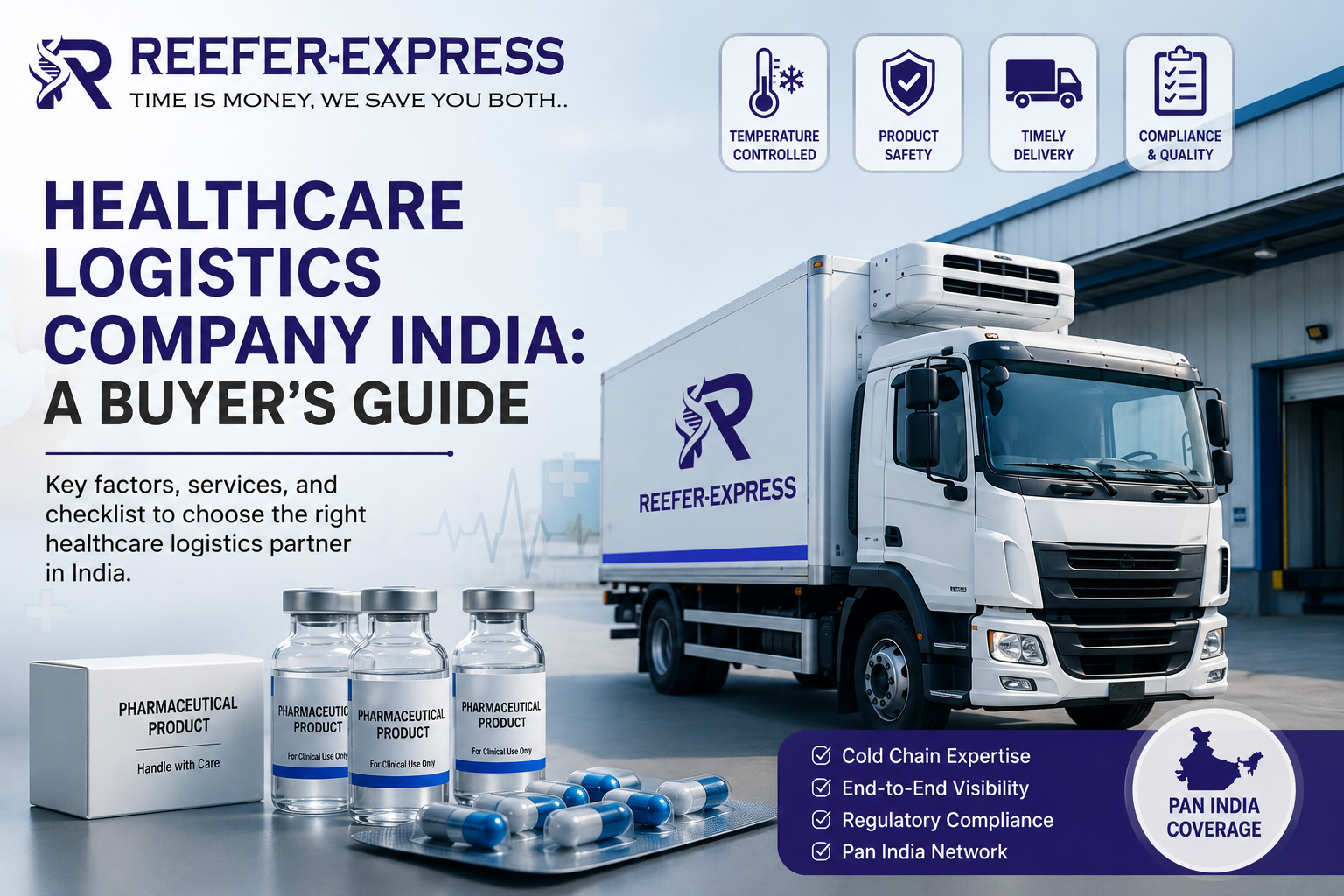
If you’re evaluating a healthcare logistics company in India, you’re probably past the research stage. You already know why temperature control matters, why documentation matters, and why one missed handoff can turn a shipment into a total loss. What you need now is a way to tell a genuinely capable partner from one that simply added “cold chain” to its list of services. This guide covers what actually separates the two, the questions worth asking before you sign a contract, and why Reefer Express has built its entire operating model around the real demands of healthcare logistics in India.
The State of Healthcare Logistics in India Right Now
India’s pharmaceutical logistics market is expanding fast. Industry estimates place it at close to USD 19 billion in 2026, on track to cross USD 25 billion by 2031, and India continues to supply roughly a fifth of the world’s generic medicines by volume (Mordor Intelligence). That export position, combined with rising domestic consumption, is pushing more volume through cold storage, line haul, and last-mile networks every year.
The bigger shift is in what’s moving. A wave of patent expirations between 2026 and 2030 is pushing Indian manufacturers toward biologics, GLP-1 analogs, and specialty injectables, most of which need continuous 2–8°C control from the factory to the patient. That is a very different handling requirement from the bulk oral solids most of India’s logistics network was originally built around.
Capacity has not caught up. There are more than 3,500 cold chain operators active in India today, but only 8 to 10 percent of them meet WHO Good Distribution Practice standards (ResearchAndMarkets). Coverage thins out further once you move past the major metro corridors, which is exactly where a lot of institutional healthcare demand, insulin, vaccines, diagnostics, now sits. This is the backdrop against which you’re choosing a partner: fast-growing demand running ahead of qualified supply.
Government investment is also reshaping where that demand comes from. Production-linked incentive schemes for pharmaceuticals and bulk drugs had drawn cumulative investment of roughly INR 41,943 crore by the end of 2025, more than double the original target, with cumulative sales under those schemes crossing INR 3,35,000 crore across nearly 2,000 products (Mordor Intelligence). West India currently holds close to 30 percent of the pharmaceutical logistics market, while South India is projected to grow fastest through 2031. That means new manufacturing capacity is coming online in places that don’t always have mature cold chain infrastructure sitting next to it, which puts even more weight on choosing a logistics partner who can qualify a new route properly rather than assume an existing one will work.
Who Actually Needs a Dedicated Healthcare Logistics Partner
Not every shipment needs this level of scrutiny, but a wider range of organizations need it than most people assume. Pharmaceutical manufacturers moving finished biologics, vaccines, or specialty injectables from plant to distributor are the obvious case. Hospitals and diagnostic chains that receive reagents, blood products, or temperature-sensitive test kits on a recurring schedule face the same exposure, just at smaller shipment sizes and higher frequency. Clinical research organizations moving investigational products between trial sites carry an added layer of protocol-driven documentation on top of the standard compliance requirements.
Distributors and third-party logistics buyers sit in between, often managing multiple manufacturers’ products across a single network, which means their provider has to hold consistent standards across very different product categories at once. If your organization falls into any of these groups and your current logistics arrangement was set up before your product mix shifted toward biologics or cold chain diagnostics, it’s worth re-evaluating whether that arrangement still fits.
What Sets a Real Cold Chain Logistics Company in India Apart From General Freight
Plenty of transport companies added “cold chain” as a line item once demand picked up. A cold chain logistics company in India that was actually built for pharma starts from a different place: compliance isn’t a feature they bolted on, it’s the reason the business exists. That difference shows up in three places.
Regulatory Grounding, Not Just Marketing Language
The World Health Organization’s Good Distribution Practices set out how temperature-sensitive pharmaceutical products should be stored and transported (WHO), and the European Medicines Agency maintains a parallel framework that most global pharma buyers use as a reference point (EMA). Ask a prospective provider how their standard operating procedures map to these frameworks. If the answer is vague, or if it’s really just an internal quality slogan dressed up as a policy, that tells you how seriously compliance is actually treated inside the business.
It also helps to ask who inside the provider’s organization owns compliance day to day. A named quality lead with the authority to hold a shipment over a documentation gap is a very different setup from a compliance manual that sits in a shared drive and only gets referenced when a customer asks for it. The first setup tends to catch problems before they reach your dock. The second tends to surface them during an audit, after the shipment has already been released.
A Fleet Actually Built for India’s Climate Zones
A reefer vehicle running a Delhi to Mumbai route in January is doing a different job than one running Chennai to Hyderabad in May. Fleet design, insulation standards, and backup power all need to account for that range, not just meet a single national spec on paper. Temperature continuity has to hold for the entire route, not just at pickup and delivery.
Packaging Matched to the Product, Not the Inventory
EPS foam, vacuum-insulated panels, and PCM-based systems each perform differently across temperature ranges and hold times. A provider that offers one packaging solution for everything, from 2–8°C vaccines to 15–25°C diagnostics, is cutting a corner somewhere. We’ve covered this in more depth in our guide to cold chain packaging in India, which is worth a read if packaging selection is still an open question for your team.
Core Capabilities to Verify Before You Sign a Contract
Once you’ve narrowed your shortlist, the real evaluation starts. These four capabilities separate providers who can actually support pharma cold chain logistics in India from those who are still figuring it out mid-contract.
Route-Specific Validation Data
A test certificate from a controlled lab environment tells you very little about how packaging performs on your actual route in your actual season. Ask for documentation tied to specific temperature profiles, duration windows, and ambient conditions for the lanes you’ll actually use. Generic validation is not the same thing as qualification.
Real-Time Temperature and Location Visibility
GPS tracking on its own answers where a shipment is, not whether it’s still within its compliant temperature window. You need both, delivered in a format you can act on at the point of release, not a spreadsheet you have to request after the fact.
A Documented Temperature Excursion Protocol
A temperature excursion is any point where a product moves outside its prescribed storage or transport range, however briefly. Ask what happens when one occurs. A serious provider has a written answer covering immediate quarantine, who gets notified, how root cause is investigated, and how a disposition decision gets made. If that answer doesn’t exist on paper, it doesn’t exist in practice either.
Last-Mile Handling That Actually Holds
India has already proven that last-mile cold chain visibility works at scale, just not always in the commercial sector. The government’s Electronic Vaccine Intelligence Network digitized temperature monitoring across tens of thousands of vaccine cold chain points nationwide, and an independent economic assessment found it delivered a measurable positive return on investment (peer-reviewed study, PubMed). That’s proof the last mile is solvable with the right process and monitoring discipline. Most private cold chain providers stop short of applying that same rigor once a shipment leaves the reefer vehicle.
Why Cold Chain Logistics in India Still Breaks at the Handoff
Most cold chain failures don’t happen in the warehouse or on the highway. They happen at the handoff, when a compliant reefer vehicle drops a shipment off and a delivery agent carries it the final stretch on a bike, in direct sunlight, between other stops. The vehicle was compliant. The packaging was validated. And none of that mattered for the twenty minutes the product spent outside both.
This is a process gap, not a packaging gap, and it’s one most providers in cold chain logistics in India haven’t actually closed. They’ve solved the middle leg well. The first and last legs remain the weak points, and they’re the ones that determine whether a shipment arrives in a state your quality team can actually release.
The fix isn’t complicated in principle. It requires a defined maximum time between vehicle and recipient, a way to monitor whether that window was held, and a person accountable for it, the same combination of process and visibility that made eVIN effective at national scale. What’s uncommon is a commercial provider actually applying that discipline to a single delivery agent on a single bike, rather than reserving it for the legs that are easier to control.
The Business Case for Getting This Decision Right
A failed cold chain shipment isn’t just a lost product. It’s a batch release problem, a regulatory documentation gap, and potentially a liability question if the failure traces back to your choice of provider. As more of India’s pharmaceutical output shifts toward biologics and specialty injectables, the value sitting inside every reefer shipment keeps climbing, which means the cost of getting this decision wrong climbs with it. Price matters, but it should not be the first filter you apply when the downside of failure is this asymmetric.
There’s also a procurement angle that’s easy to underweight during vendor selection. Regulatory audits, whether from India’s own drug regulators or from an overseas buyer conducting supplier due diligence, will ask for exactly the kind of route-specific validation and excursion documentation described above. A provider who can produce that on request during onboarding saves your quality and regulatory teams weeks of back-and-forth later, compared to one who has to build that documentation retroactively once an auditor asks for it.
Why Reefer Express Is the Healthcare Logistics Company India Pharma Teams Choose
Reefer Express was built around pharma supply chain requirements in India, not adapted from a general freight model after the fact. That distinction shows up in how the business actually runs. The reefer fleet is qualified against India’s real climate zones, so validation data reflects road conditions, not a test chamber. Temperature logs, excursion reports, and chain of custody records come with every shipment as standard, not as an add-on you have to request.
On last-mile handling, specifically, Reefer Express runs dedicated protocols designed to hold cold chain integrity through the final leg, which is where most competitors’ coverage quietly ends. You can see how this fits into a full pharma logistics service build, or read more about how our reefer fleet is qualified route by route across India’s climate zones.
What Working With Reefer Express Looks Like
Engagement starts with a route assessment, not a generic quote. We look at your product’s temperature range, your actual lanes, and your delivery windows, then share validation data specific to that combination before you commit to anything. From there, most partners run a pilot shipment so their quality team can review the temperature logs and excursion reporting firsthand. Once that’s approved, onboarding covers documentation formats, escalation contacts, and access to shipment-level monitoring, so nothing about how the relationship runs is a surprise after the first invoice.
Ongoing accounts get a named point of contact rather than a rotating support queue, which matters most on the days something doesn’t go to plan. If a route needs to be re-qualified because a new distribution point opens up, or a product’s temperature range changes, that update happens through the same relationship rather than a fresh procurement cycle. The goal is a partner your quality and logistics teams can plan around, not just book shipments with.
If you’re ready to talk specifics, routes, product categories, and turnaround times, get in touch through our contact page for a route-specific assessment.
Frequently Asked Questions
What does a healthcare logistics company in India actually manage besides transport?
Beyond moving product from point A to point B, a real healthcare logistics company in India manages temperature validation, route qualification, real-time monitoring, excursion documentation, and last-mile handling. Transport is one piece of a much larger compliance and accountability chain.
How is cold chain logistics in India different from standard cold storage?
Cold storage keeps a product at a set temperature in one place. Cold chain logistics in India has to maintain that same temperature continuously across warehouses, reefer vehicles, and the last-mile leg, often through significant climate variation between regions and seasons, with documentation proving that continuity held at every stage.
What temperature ranges do healthcare logistics providers in India need to support?
Most providers need to support at least three bands: 2–8°C for vaccines and biologics, 15–25°C for many diagnostics and certain drug categories, and frozen ranges below –15°C for select biologics. A provider offering one packaging or monitoring approach across all three is usually cutting corners on at least one of them.
How do I verify a provider’s cold chain validation data?
Ask for documentation tied to your specific route, product, and season, not a generic lab certificate. Legitimate validation data includes temperature profiles, duration windows, and ambient conditions that match the actual lane you plan to ship on.
What happens if there’s a temperature excursion during transit?
A provider with a serious excursion protocol will quarantine the affected shipment immediately, notify your quality team without delay, log the duration and extent of the excursion, and run a root cause investigation before any disposition decision is made. If a provider can’t describe this process clearly, that’s a gap worth taking seriously before you sign.
Does Reefer Express handle last-mile delivery for pharma shipments?
Yes. Reefer Express runs dedicated last-mile protocols that carry temperature monitoring and handling standards through the final leg of delivery, which is where most cold chain failures in India actually happen.
Is cold chain logistics in India only relevant to large pharma manufacturers?
No. Hospitals, diagnostic labs, distributors, and clinical research organizations all move temperature-sensitive products on a regular basis, often in smaller, more frequent shipments than a manufacturer would. The compliance and documentation requirements apply regardless of shipment size.
How do I get a quote from Reefer Express?
Reach out through our contact page with your product category, routes, and volumes. We’ll walk you through route-specific validation data before you commit to anything.
Bottom Line
Choosing a healthcare logistics company in India is not a commodity decision. It affects product integrity, batch release, regulatory standing, and your own liability if something goes wrong in transit. Look for documented validation, real-time visibility, a written excursion protocol, and last-mile handling that’s actually been thought through, not assumed to work itself out. Reefer Express was built around those requirements from the start, and we’re happy to walk through exactly how, route by route.