



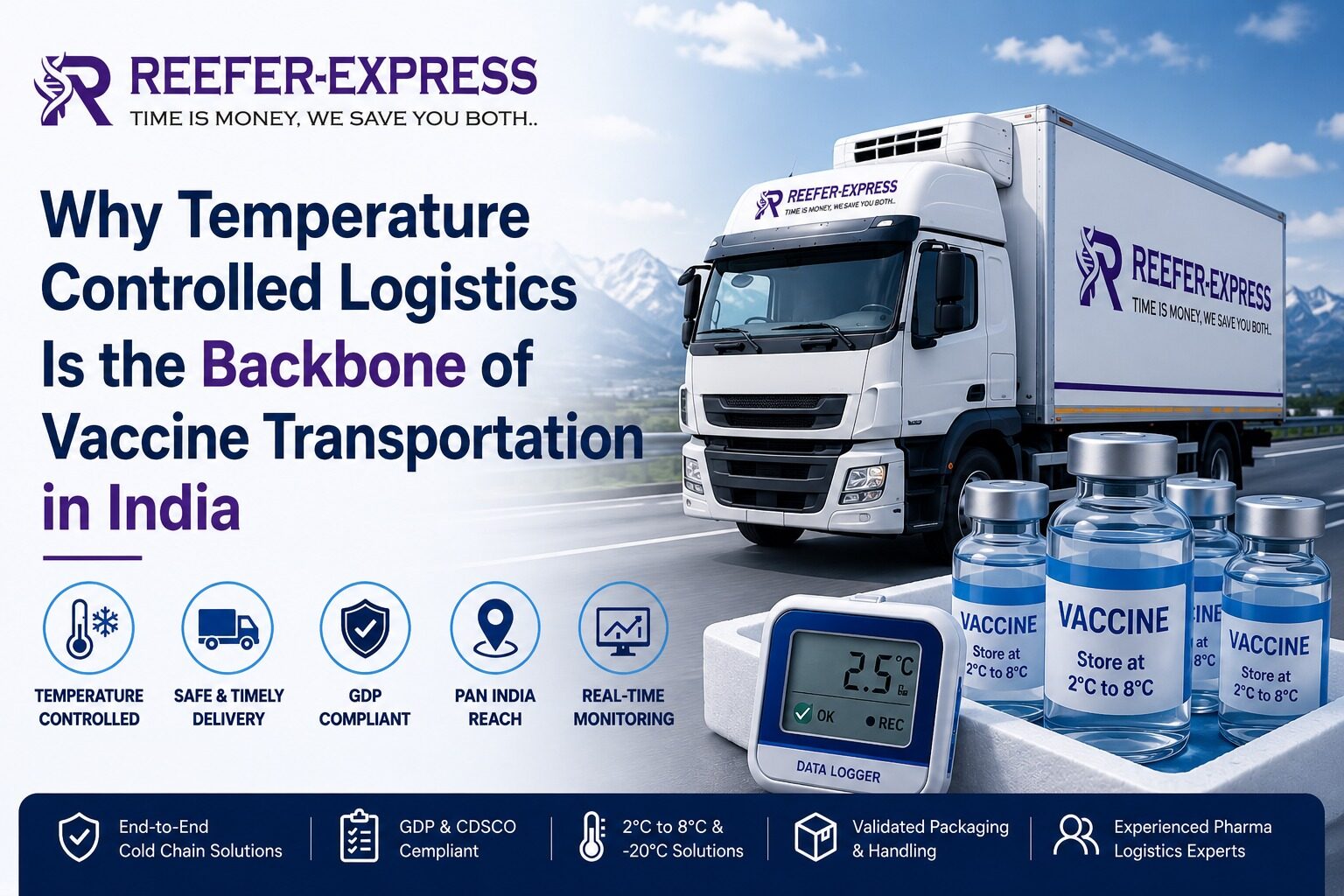
Every year, millions of vaccine doses are wasted across India before they even reach a patient. The reason is not a shortage of supply. It is a failure in the cold chain. A single hour at the wrong temperature can render a vaccine completely useless. This is why temperature controlled logistics is no longer just a business function. It is a public health responsibility.
India’s pharmaceutical and healthcare sector has grown rapidly over the last decade. With it, the demand for reliable vaccine transportation services has gone up significantly. Yet many companies still underestimate what it actually takes to move temperature-sensitive products safely from a manufacturing plant to the last mile.
This blog covers what temperature controlled logistics really means, why vaccine transportation in India faces unique challenges, how to pick the right cold chain logistics company in India, and what separates a good provider from a poor one.
What Is Temperature Controlled Logistics?
Temperature controlled logistics refers to the entire system used to store and transport goods that need to stay within a specific temperature range throughout their journey. This includes refrigerated warehouses, insulated packaging, temperature-monitoring devices, and specially designed vehicles.
For vaccines, the acceptable temperature window is usually between 2°C and 8°C. Some vaccines, like certain flu shots and oral polio vaccines, require storage below -20°C. Even a brief deviation outside these ranges can break down the active ingredients, making the vaccine ineffective.
The cold chain is the name given to this end-to-end system. Every link in that chain, from the manufacturer’s cold storage to the transport vehicle to the last distribution point, must hold. If one link breaks, the product is compromised.
Why India Presents a Unique Challenge
India is not a straightforward country to run cold chain operations in. The geography alone creates massive complexity. You have coastal humidity in Mumbai, extreme heat in Rajasthan, high altitude routes in Himachal Pradesh, and monsoon flooding in the Northeast. Each condition creates a different threat to temperature-sensitive cargo.
On top of that, road infrastructure in rural and semi-urban areas remains patchy. Power outages are still common in smaller towns. Cold storage facility density is low outside major metros. All of this means a cold chain logistics company in India has to solve problems that simply do not exist in more developed markets.
Then there is the regulatory side. The https://cdsco.gov.in/ has set strict guidelines for pharmaceutical logistics. Good Distribution Practice (GDP) compliance is now a requirement, not an option. Companies that ignore this risk losing licenses, failing audits, and in the worst case, contributing to public health failures.
The Cost of Getting It Wrong
The numbers are sobering. The https://www.who.int/ estimates that up to 50% of vaccines are wasted globally every year, and a significant portion of that is due to cold chain failures. In India, the stakes are even higher given the scale of immunization programs like the https://nhm.gov.in/, which covers over 26 million newborns annually.
Beyond vaccines, temperature failures affect insulin, blood products, cancer drugs, and fertility treatments. A broken cold chain does not just waste money. It puts lives at risk and creates liability that pharmaceutical companies, hospitals, and logistics providers share.
What a Reliable Vaccine Transportation Service Looks Like
Not all cold chain providers are built the same. Here is a comparison of what differentiates a strong vaccine transportation service from a basic one:
| Feature | Basic Cold Chain Provider | Reliable Vaccine Transportation Service |
| Temperature monitoring | Manual checks at pickup and delivery | Continuous IoT-based real-time monitoring |
| Vehicle type | Standard reefer trucks | Validated pharmaceutical-grade vehicles |
| Deviation alerts | Post-trip reports | Instant alerts with corrective action protocols |
| GDP compliance | Partial or self-declared | Third-party audited and CDSCO aligned |
| Last-mile reach | Tier 1 cities only | Tier 2, Tier 3, and rural coverage |
| Cold storage network | Leased third-party warehouses | Dedicated temperature-controlled facilities |
| Packaging | Basic insulated boxes | Validated packaging with phase-change materials |
| Documentation | Basic delivery receipts | Full chain-of-custody records with timestamps |
The difference between these two columns is not just about service quality. It is about whether your product arrives safe or not.
Key Technologies Driving Better Temperature Controlled Logistics
The last five years have brought genuine improvements to how cold chains are managed in India. Data loggers that record temperature every few minutes have largely replaced manual checks. GPS tracking lets logistics managers see exactly where a shipment is at any given moment. IoT sensors now send real-time alerts if a vehicle’s refrigeration unit malfunctions.
Some of the more advanced cold chain logistics companies in India are now using predictive analytics to anticipate route delays and proactively reroute shipments to avoid temperature breaches. Blockchain is also being tested as a way to create tamper-proof records of the entire cold chain journey, which matters enormously for regulatory audits and insurance claims.
Packaging technology has also improved. Phase-change materials (PCMs) can maintain precise temperatures for 72 hours or more without active refrigeration. This is critical for last-mile delivery in areas without reliable power.
How to Choose the Right Cold Chain Logistics Company in India
Picking a cold chain partner for vaccine transportation is not a procurement decision you should rush. Here is a comparison table of what to evaluate:
| Evaluation Criteria | What to Check |
| Regulatory compliance | GDP certification, CDSCO alignment, audit history |
| Infrastructure | Owned vs leased cold storage, vehicle fleet age, maintenance records |
| Technology | Real-time monitoring capability, data logging, alert systems |
| Geographic reach | Whether they cover your key distribution zones including rural areas |
| Track record | Years in pharma logistics, reference clients, case studies |
| Incident management | How they handle deviations, what the SLA looks like for failures |
| Transparency | Whether they provide full data access and documentation to you |
Do not choose a provider based on price alone. A cheaper provider who saves you 10% on freight costs but causes a temperature excursion that destroys an entire batch of vaccines is not saving you anything. The loss in product value, regulatory penalties, and reputational damage far outweighs the cost difference.
The Role of Government and Industry Standards
The Indian government has recognized cold chain as a national priority. The National Cold Chain and Vaccine Management Resource Centre (NCCVMRC) provides technical support and training for public sector cold chain management. Private sector pharmaceutical companies are expected to align with WHO’s Good Distribution Practices.
The https://pharmexcil.com/ and the Indian Pharmaceutical Alliance also provide frameworks that serious cold chain logistics companies follow. When evaluating a provider, asking whether they align with these standards is a simple and effective filter.
A Comparison of Cold Chain Models in India
| Model | How It Works | Best For | Limitation |
| In-house cold chain | Company owns and operates all infrastructure | Large pharma manufacturers with high volume | Very high capital cost |
| 3PL cold chain outsourcing | Third-party provider manages entire cold chain | Mid to large companies wanting to focus on core business | Requires strong vendor governance |
| 4PL cold chain management | A single partner manages multiple logistics providers | Companies with complex multi-region distribution | Less direct control |
| Hub-and-spoke model | Central cold hub with regional spoke distribution | National vaccine programs, government immunization | Needs strong last-mile infrastructure |
For most pharmaceutical companies and healthcare distributors in India, outsourcing to a reliable 3PL cold chain logistics provider is the most practical choice. It gives access to specialized infrastructure without the capital investment, provided you do your due diligence on the partner.
Final Thoughts
Temperature controlled logistics is the difference between a vaccine that saves a life and a vial of water. As India scales its healthcare ambitions, from domestic immunization programs to becoming a global pharmaceutical export hub, the cold chain sitting underneath all of it needs to be solid.
Vaccine transportation services in India have improved considerably, but gaps still exist, especially at the last mile and in underserved geographies. Choosing the right cold chain logistics company in India is not just a supply chain decision. It is a commitment to the people at the end of the chain.
If you are evaluating providers, use the comparison tables in this blog as a starting checklist. Ask hard questions. Ask for audit reports, not just brochures. The right partner will have no problem answering them.
Looking for a reliable cold chain logistics company in India?
Contact Reefer Express for temperature-controlled transportation solutions built for pharmaceutical and healthcare distribution.
Comments3
[6907]boss777 Official Login | Best Online Slots PH with GCash Bonus,boss777 offers a seamless app download for top gaming. Enjoy easy GCash bonuses and learn how to play baccarat with our guides. Join the action today! visit: boss777
[8627]ok bet login at app APK | legit na online slots at casino,Gamitin ang ok bet login para sa legit na online slots. Kunin ang gcash casino bonus at alamin kung paano maglaro ng baccarat. Mag-register na rito! visit: ok bet
Really glad I stumbled upon this platform. The user interface is clean and it doesn't lag even during peak hours. Great job on the optimization of phta903.