



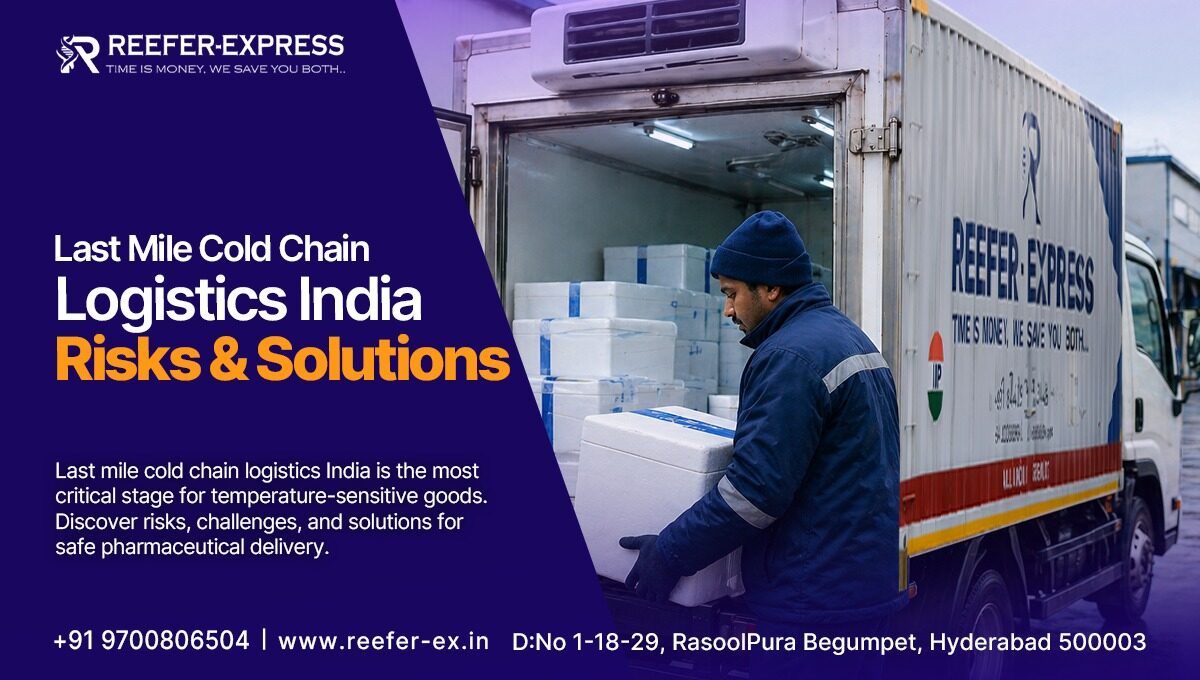
In last mile cold chain logistics India, most people focus on the journey—the long highways, reefer trucks, and monitoring systems. But the biggest risk doesn’t happen on the highway.
But in reality, the biggest risk doesn’t happen on the highway.
It happens at the last mile.
That final stretch, where the shipment moves from a controlled reefer environment to its delivery point, is where temperature-sensitive goods are most vulnerable. In India’s climate, where external temperatures can rise quickly and infrastructure varies from city to city, the last mile becomes the most unpredictable and critical stage of the entire cold chain process.
This is where even a perfectly managed long-distance transport can fail.
Why Last Mile Delivery Is the Weakest Link in Cold Chain Logistics
By the time a pharmaceutical or perishable shipment reaches its destination city, it has already survived multiple checkpoints. It has been loaded correctly, transported in a temperature-controlled reefer truck, and monitored continuously.
But the moment it enters the last mile phase, control starts to shift.
Unlike long-distance transport, the last mile involves multiple touchpoints. There is unloading, short-distance movement, waiting time at delivery points, and often manual handling. Each of these stages introduces exposure.In last mile cold chain logistics India, even small delays can cause temperature excursions
Even a delay of 20 to 30 minutes during unloading in high ambient temperatures can cause a temperature excursion. For pharmaceutical products that must be maintained between 2°C and 8°C, this is not a small deviation. It can compromise product stability, effectiveness, and compliance.
This is exactly why global authorities like the World Health Organization emphasize strict cold chain maintenance at every stage, including final delivery.
What Actually Happens During Last Mile Delivery
On paper, last mile delivery looks simple. The truck arrives, goods are unloaded, and delivery is completed. But in real conditions, especially across Indian cities, the situation is very different.
A reefer truck may reach the delivery point on time, but unloading doesn’t always happen immediately. There may be queue delays, documentation checks, or unprepared receiving facilities. During this time, the truck doors are opened repeatedly, allowing cold air to escape.
Once the shipment is taken out, it often moves through areas without temperature control. Even short exposure to heat can start affecting sensitive products. In some cases, goods are left temporarily at ambient conditions before final handover.
This entire process, though short in duration, is enough to disrupt the temperature integrity maintained over hundreds of kilometers.
Temperature Control Challenges in Last Mile Cold Chain Logistics India
India presents a unique set of challenges for cold chain logistics. High ambient temperatures, traffic congestion, and inconsistent infrastructure all contribute to last mile risks.
In metro cities, traffic delays can extend delivery times unexpectedly. In smaller towns, the lack of proper unloading docks or cold storage facilities increases exposure risk. Even simple factors like power outages at the delivery location can create complications.
Another overlooked issue is human handling. Cold chain logistics is not just about equipment; it also depends on how well the personnel understand temperature sensitivity. Mishandling, delays, or lack of urgency during unloading can result in temperature excursions.
These challenges make last mile delivery not just a logistical step, but a critical control point.
How Temperature Deviations Occur in the Final Stage
Temperature deviations during last mile delivery are rarely caused by a single factor. They are usually the result of small, combined issues.
Repeated door openings reduce internal cooling efficiency. Delays during unloading extend exposure time. Improper coordination between transport and delivery teams creates gaps in handling.
Even when reefer units are functioning perfectly, the moment goods leave the controlled environment, they depend entirely on how quickly and efficiently the final delivery is executed.
This is why many cold chain failures are traced back not to transport, but to the last mile.
Solutions to Strengthen Last Mile Cold Chain Delivery
Improving last mile delivery requires a shift in approach. It is not enough to focus only on transportation; equal attention must be given to final handling and delivery coordination.
Pre-planned delivery schedules can significantly reduce waiting time at the destination. Ensuring that receiving teams are ready before arrival minimizes exposure. Using insulated packaging during unloading adds an extra layer of protection.
Real-time temperature monitoring should not stop at transit. It should continue until the final handover is completed. This ensures complete visibility and accountability across the entire process. Improving last mile cold chain logistics India requires better coordination.
Most importantly, trained personnel play a key role. When teams understand the importance of temperature control, they act faster, handle better, and reduce risks significantly.
The Role of Reefer Logistics in Last Mile Control
Modern reefer logistics is evolving beyond transportation. It is becoming a complete temperature management system.
With advanced monitoring, route planning, and operational coordination, companies can now manage not just the journey, but also the final delivery stage. Integrating last mile planning into the overall logistics strategy ensures that temperature control is maintained from origin to destination.
To understand how temperature deviations are controlled during transit, you can also explore our detailed blog on fleet monitoring and temperature control:
Similarly, our insights on long-distance risks explain how extended journeys impact cold chain stability:
For global cold chain standards and pharmaceutical guidelines, refer to WHO Guideline.
Why Businesses Must Rethink Last Mile Strategy
Many businesses invest heavily in transportation but overlook the final stage. This creates a gap where most risks actually occur.
A strong cold chain strategy is not just about moving goods safely across distances. It is about ensuring that the same level of control exists until the moment the shipment reaches its final destination.
Ignoring last mile risks can lead to product loss, regulatory issues, and financial damage. On the other hand, strengthening this stage can significantly improve reliability, compliance, and customer trust.
Conclusion
Last mile delivery is not just the final step in cold chain logistics. It is the most critical one.
In a country like India, where environmental and operational challenges are constant, maintaining temperature control during this stage requires precision, planning, and coordination.
A shipment that has successfully traveled hundreds of kilometers can still fail in the last few minutes if proper control is not maintained.
This is why businesses must shift their focus from just transportation to complete end-to-end temperature management.Businesses must strengthen last mile cold chain logistics India to prevent losses
Reefer Express delivers temperature-controlled logistics solutions across India with a strong focus on real-time monitoring, operational control, and safe last mile delivery.
📞 +91 9700806504 | 🌐 https://www.reefer-ex.in
FAQ – Last Mile Cold Chain Logistics
Last mile delivery refers to the final stage where temperature-sensitive goods are transported from a distribution point to the end destination while maintaining required temperature conditions.
Because this stage involves unloading, handling, and short exposure to external environments, increasing the chances of temperature deviation.
By using insulated packaging, reducing unloading time, ensuring coordination at delivery points, and continuing real-time temperature monitoring.
Common causes include delays, repeated door openings, improper handling, and lack of temperature-controlled infrastructure at delivery points.
It is the final checkpoint where product quality can either be preserved or compromised, making it the most critical stage of the entire logistics process.
Comments2
[1532]JLJL11: Login, Register & App Download | Best Casino Slots & Promo Bonuses,Join JLJL11 today for the ultimate online casino experience in the Philippines. Register now to enjoy the best casino slots, exclusive promo bonuses, and seamless app downloads. Login to JLJL11 for secure gaming and big wins! visit: jljl11
Really enjoying the current promotions. The gameplay is fluid and the wins feel rewarding. Jump into pkq98 and see for yourself.